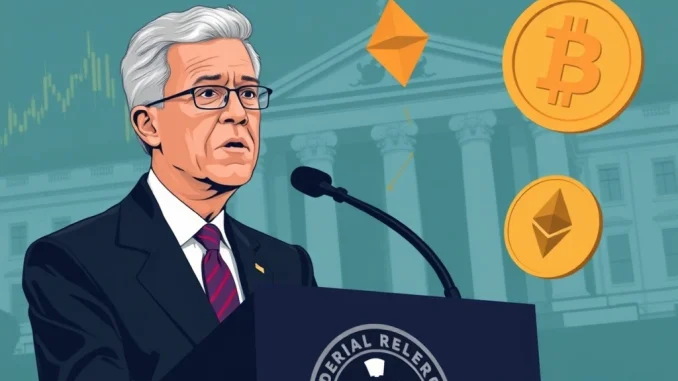
The financial world consistently monitors the actions of central banks. Therefore, when the **Federal Reserve** concludes its Federal Open Market Committee (**FOMC meeting**), investors worldwide pay close attention. This is especially true for the dynamic cryptocurrency sector. The decisions made by the Fed, particularly concerning monetary policy, ripple through traditional markets. Consequently, these decisions often influence the volatile **crypto market impact** and investor sentiment. Understanding the nuances of these announcements is crucial for anyone navigating digital assets.
Federal Reserve’s Crucial Role in Global Finance
The **Federal Reserve** serves as the central banking system of the United States. Its primary mandate involves maintaining maximum employment, stable prices, and moderate long-term interest rates. The FOMC, or Federal Open Market Committee, acts as its monetary policymaking body. This committee meets eight times annually to assess economic conditions and determine the appropriate course for monetary policy. Their decisions significantly shape the availability and cost of money and credit in the economy. This, in turn, influences economic growth and inflation.
During these critical gatherings, FOMC members analyze a vast array of economic data. They consider inflation trends, employment figures, GDP growth, and global economic developments. Ultimately, they vote on key policy levers. The conclusion of a press conference by **Jerome Powell**, the current Fed Chair, marks the official communication of these policy decisions. These announcements often include updates on the federal funds rate, quantitative easing or tightening measures, and the Fed’s overall economic outlook. Investors keenly await these details to adjust their strategies.
Understanding the FOMC Meeting Outcomes
Every **FOMC meeting** culminates in a policy statement and often a press conference. These events provide vital insights into the Fed’s economic assessment and future plans. Key outcomes typically revolve around the federal funds rate. This target rate influences other interest rates throughout the economy. For instance, changes affect borrowing costs for businesses and consumers. Additionally, the Fed may announce adjustments to its balance sheet. This involves buying or selling government securities, which impacts market liquidity. A shift towards quantitative tightening, for example, reduces the money supply.
The Fed’s forward guidance also plays a significant role. This refers to statements about the likely future path of monetary policy. Such guidance helps manage market expectations and reduces uncertainty. For example, if the Fed signals a prolonged period of high rates, markets react accordingly. Conversely, a hint at rate cuts can stimulate investment. Therefore, every word spoken by **Jerome Powell** at the press conference is meticulously analyzed. Market participants look for clues about the economy’s direction and the Fed’s commitment to its dual mandate. This careful scrutiny often precedes significant market movements.
Jerome Powell’s Insights and Market Interpretations
**Jerome Powell** leads the Federal Reserve and communicates its policy decisions. His press conferences are crucial events for financial markets globally. During these sessions, he elaborates on the FOMC’s decisions and provides context for their economic projections. Powell’s remarks often offer deeper insights into the Fed’s assessment of inflation, labor market conditions, and future growth prospects. His tone and choice of words are heavily scrutinized by analysts and traders. Even subtle shifts in language can signal a change in the Fed’s stance. This can lead to immediate market reactions across asset classes.
Market participants closely monitor Powell’s responses to questions from journalists. These interactions can reveal the nuances behind the official statement. For example, a firm stance on combating inflation might suggest continued aggressive monetary policy. Conversely, an emphasis on employment concerns could hint at a more dovish approach. The market attempts to interpret these signals to anticipate future **interest rate decision**s. This anticipation directly influences investor confidence and risk appetite. Consequently, the conclusion of his press conference marks a moment of intense speculation and adjustment for traders.
The Significance of the Interest Rate Decision
The **interest rate decision** is arguably the most impactful outcome of any FOMC meeting. The federal funds rate directly affects short-term borrowing costs. Furthermore, it indirectly influences longer-term rates like mortgages and corporate loans. When the Fed raises rates, borrowing becomes more expensive. This can slow down economic activity by discouraging investment and consumer spending. Higher rates also tend to strengthen the U.S. dollar, making imports cheaper and exports more expensive. This policy aims to curb inflation by reducing demand.
Conversely, a decision to lower interest rates makes borrowing cheaper. This stimulates economic growth by encouraging spending and investment. It can also weaken the dollar, boosting exports. The Fed uses these adjustments to fine-tune the economy. A hawkish stance, meaning higher rates, generally makes risk assets less attractive. This is because safer investments, like bonds, offer better returns. A dovish stance, indicating lower rates, tends to favor risk assets. This is due to a search for higher yields in a low-interest-rate environment. Therefore, every **interest rate decision** carries significant weight for investors across all markets.
Connecting Macroeconomics to Crypto Market Impact
The **crypto market impact** of Federal Reserve policy is undeniable. Although cryptocurrencies operate outside traditional banking systems, they are not immune to macroeconomic forces. Interest rate decisions, in particular, play a crucial role. When the Fed raises rates, it generally makes riskier assets, including cryptocurrencies, less appealing. Investors might reallocate capital from volatile assets like Bitcoin and Ethereum to more stable, interest-bearing instruments. This shift can lead to downward pressure on crypto prices. Furthermore, a stronger U.S. dollar, often a consequence of higher rates, can also weigh on crypto. Many cryptocurrencies are priced against the dollar, so its appreciation can make them appear more expensive to international buyers.
Liquidity also heavily influences the crypto market. When the Fed engages in quantitative tightening, it effectively reduces the money supply in the financial system. This reduction in available capital can decrease speculative investment. Cryptocurrencies, often considered speculative assets, can suffer during periods of reduced liquidity. Conversely, a dovish Fed policy, characterized by lower rates and quantitative easing, can inject liquidity into the market. This often encourages investors to seek higher returns in riskier assets, benefiting cryptocurrencies. Thus, understanding the Fed’s stance is essential for predicting potential **crypto market impact**.
Investor Sentiment and Regulatory Scrutiny
Beyond direct financial mechanisms, Fed actions profoundly influence investor sentiment. A cautious or hawkish outlook from **Jerome Powell** can foster a risk-off environment. This means investors become more conservative, prioritizing capital preservation over growth. Such sentiment often translates into sell-offs in speculative markets, including crypto. Conversely, a more optimistic or accommodative stance can boost confidence. This encourages a risk-on attitude, leading to increased investment in assets like cryptocurrencies. Therefore, the psychological impact of Fed communications cannot be overstated.
Moreover, the broader economic stability influenced by the **Federal Reserve** can indirectly affect regulatory discussions around crypto. In periods of economic uncertainty, regulators might intensify their scrutiny of novel financial instruments. This aims to protect consumers and maintain financial stability. Clear and stable monetary policy, however, can provide a more predictable environment. This potentially fosters clearer regulatory frameworks for digital assets. Ultimately, the Fed’s decisions create the macroeconomic backdrop against which the crypto industry operates and evolves. Investors must remain vigilant and informed.
Future Outlook and Navigating Volatility
Following the conclusion of the **FOMC meeting** and **Jerome Powell’s** press conference, markets begin to digest the information. Analysts will dissect every statement, comparing current policy with previous guidance. They will also update their economic models. For cryptocurrency investors, this means reassessing risk exposure. It also involves adjusting portfolios based on the Fed’s projected path for **interest rate decision**s and economic growth. The immediate reaction in the **crypto market impact** can be swift and significant. However, longer-term trends depend on sustained policy direction and broader economic performance.
Navigating the volatility inherent in both macroeconomics and the crypto market requires a disciplined approach. Staying informed about central bank communications is paramount. Understanding the potential implications of these decisions on liquidity, investor sentiment, and the attractiveness of risk assets is key. While cryptocurrencies offer unique value propositions, their price movements remain deeply intertwined with global monetary policy. Therefore, continuous monitoring of the **Federal Reserve** and its policy trajectory is not just for traditional finance enthusiasts; it is increasingly vital for the digital asset community.
Conclusion: The Fed’s Enduring Influence on Digital Assets
The conclusion of **Jerome Powell’s** press conference after the **FOMC meeting** represents a significant moment. It provides clarity on the **Federal Reserve’s** current monetary policy stance. This includes the latest **interest rate decision** and its economic outlook. While the cryptocurrency market operates with distinct characteristics, it remains profoundly affected by these macroeconomic shifts. Investors must recognize this interconnectedness. The Fed’s actions directly influence liquidity, risk appetite, and the broader financial environment. Consequently, these factors exert a powerful **crypto market impact**. Staying informed about these developments is not just prudent; it is essential for making well-considered investment decisions in the evolving digital asset landscape.
Frequently Asked Questions (FAQs)
1. What is the Federal Open Market Committee (FOMC)?
The FOMC is the monetary policymaking body of the Federal Reserve System. It comprises 12 members. They meet eight times a year to discuss economic conditions. They then make decisions on the federal funds rate and other monetary policies. These decisions aim to promote maximum employment and price stability.
2. How do Federal Reserve interest rate decisions affect the crypto market?
When the Federal Reserve raises interest rates, it generally makes riskier assets, including cryptocurrencies, less attractive. Investors may move capital to safer, interest-bearing investments. This can lead to downward pressure on crypto prices. Conversely, lower rates can encourage investment in riskier assets, potentially boosting crypto values.
3. What is quantitative easing (QE) and quantitative tightening (QT)?
Quantitative easing (QE) is a monetary policy where the Fed buys government securities and other assets. This injects money into the financial system, increasing liquidity. Quantitative tightening (QT) is the reverse process. The Fed reduces its balance sheet, effectively removing money from the system. Both policies significantly influence market liquidity and asset prices, including cryptocurrencies.
4. Why is Jerome Powell’s press conference so important?
Jerome Powell, as the Federal Reserve Chair, communicates the FOMC’s policy decisions and economic outlook. His press conferences provide detailed explanations and forward guidance. Market participants scrutinize his every word for clues about future monetary policy. These insights can trigger immediate and significant market reactions.
5. How can crypto investors stay informed about Fed policy?
Crypto investors should regularly monitor official Federal Reserve announcements, including FOMC statements and meeting minutes. Watching Jerome Powell’s press conferences and reading expert analysis can also provide crucial insights. Keeping an eye on key economic indicators like inflation and employment data is also vital.
6. Does the Fed directly regulate cryptocurrencies?
No, the Federal Reserve does not directly regulate cryptocurrencies. However, its monetary policy decisions create the broader economic environment. This environment indirectly influences crypto market dynamics. Other government agencies, like the SEC and CFTC, are more directly involved in potential cryptocurrency regulation.
Updated insights and analysis added for better clarity.
This article was produced with AI assistance and reviewed by our editorial team for accuracy and quality.