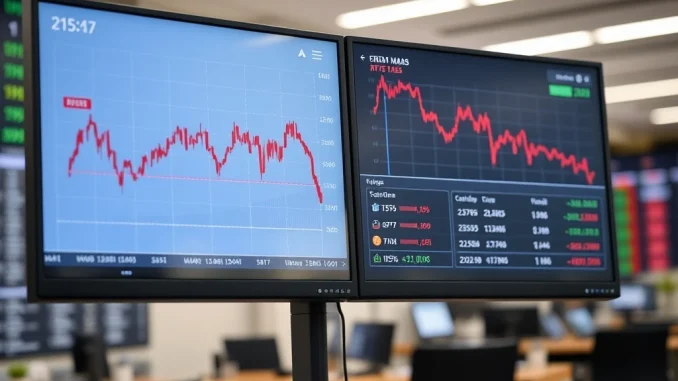
Global Financial Markets, February 2025: The cryptocurrency market is experiencing a pronounced corrective phase this February, characterized by broad-based declines across major assets. This movement contrasts sharply with the selective, significant gains posted by a handful of specific protocols. Market analysts and institutional reports consistently point to shifting macroeconomic conditions as the primary catalyst for the current volatility, creating a landscape where fundamental differentiation between projects is becoming critically apparent.
Analyzing the Macroeconomic Drivers Behind February’s Crypto Market Correction
Financial markets globally are reacting to a confluence of macroeconomic signals that have introduced risk-off sentiment among investors. The cryptocurrency sector, increasingly correlated with traditional risk assets like technology stocks, is not operating in isolation. Key factors contributing to the February pullback include revised expectations for central bank interest rate policies. Recent statements and economic data from major economies have led markets to anticipate a slower pace of monetary easing than previously forecast, strengthening national currencies and increasing the opportunity cost of holding non-yielding speculative assets.
Furthermore, geopolitical tensions have resurfaced, prompting capital flows into perceived safe-haven assets. This environment of heightened uncertainty typically pressures growth-oriented and high-volatility sectors. The strengthening U.S. dollar index (DXY) has also been a direct headwind for dollar-denominated crypto assets, making them more expensive for international buyers. These macro forces create a challenging backdrop where capital exits broad market indices and seeks either safety or exceptionally high-conviction thematic bets.
The Divergence: Why Assets Like STABLE and TAO Exhibit Market Resilience
Amid the widespread sell-off, the performance of certain cryptocurrencies demonstrates that not all digital assets are responding identically to macro pressures. This divergence underscores the maturation of the crypto ecosystem, where project-specific utility and economic models can provide relative insulation. For instance, tokens associated with decentralized physical infrastructure networks (DePIN) or those offering verifiable computational services have shown notable resilience. Their value proposition is tied to real-world usage and demand for their network’s output, which may be less sensitive to short-term financial market sentiment than pure store-of-value narratives.
This selective strength highlights a market that is beginning to discriminate based on underlying technology and revenue models. Projects that facilitate specific, in-demand functions—such as providing decentralized machine intelligence or stable transaction mediums—can maintain demand even during risk-averse periods. Their price action suggests investors are allocating capital based on long-term thematic beliefs in specific blockchain use cases, rather than broad sector exposure.
Examining the Stablecoin Niche and Computational Marketplaces
Stablecoins, by design, aim to minimize volatility by pegging their value to a stable asset or basket of assets. Their role as a settlement layer and safe harbor within crypto trading pairs often leads to increased usage during volatile market periods, as traders seek to exit positions into a stable unit of account. Similarly, protocols like Bittensor (TAO), which operate a decentralized market for machine intelligence, derive value from the usage of their network. Demand for AI model training and inference can remain robust regardless of financial market conditions, supporting the token’s economic model. The performance of these assets in February suggests a flight to utility and functionality within the crypto space itself.
The Landscape for Emerging AI-Crypto Projects: A Focus on Fundamentals
The intersection of artificial intelligence and blockchain technology represents one of the most discussed growth vectors in the digital asset space. Projects in this domain propose various models, from decentralized AI training and data markets to AI-powered security and analytics platforms. When evaluating such projects, analysts emphasize scrutinizing the technical whitepaper, the credibility of the development team, the clarity of the token utility, and the progress of the live protocol or testnet. Market sentiment often amplifies movements in smaller-cap assets within this niche, but sustainable value is built on verifiable technological milestones and user adoption.
It is critical for observers to distinguish between speculative narratives and projects with a working product, active users, and a sustainable economic loop. The long-term trajectory for any project in the AI-crypto sector will depend on its ability to deliver unique, scalable solutions that cannot be easily replicated by centralized alternatives. Due diligence remains paramount, especially for newer entrants aiming to capitalize on the powerful convergence of these two technological trends.
Conclusion: Navigating Volatility Through Macro Awareness and Fundamental Analysis
The February downturn in the broader cryptocurrency market serves as a reminder of the asset class’s continued sensitivity to global macroeconomic currents. However, the simultaneous resilience of specific tokens underscores a pivotal evolution: the market is increasingly rewarding differentiated utility and real-world function over homogeneous speculation. For investors and observers, this environment reinforces the importance of macro-economic literacy combined with rigorous, fundamental analysis of individual protocols. Understanding the ‘why’ behind market movements—whether driven by interest rate expectations, currency flows, or sector-specific demand—is essential for navigating the inherent volatility of the crypto landscape and identifying opportunities that may extend beyond short-term cycles.
FAQs
Q1: What are the main macroeconomic factors affecting crypto in February 2025?
The primary factors include shifting expectations for central bank interest rate cuts, a strengthening U.S. dollar, and renewed geopolitical tensions, all of which promote a risk-averse investment climate.
Q2: Why might some crypto assets rise while the overall market falls?
Assets with strong, in-demand utility, unique economic models, or those serving as a safe haven within the crypto ecosystem (like certain stablecoins) can decouple from broad market sentiment based on their specific use cases and fundamentals.
Q3: What is a decentralized physical infrastructure network (DePIN)?
DePIN refers to blockchain protocols that coordinate and incentivize the provision of real-world physical infrastructure or services, such as computing power, wireless networks, or data storage, in a decentralized manner.
Q4: How should one evaluate emerging AI-related cryptocurrency projects?
Evaluation should focus on the project’s technical feasibility, the development team’s expertise, the clarity and necessity of the token’s role, the status of the live product or testnet, and the scalability of its proposed solution compared to centralized alternatives.
Q5: Is the correlation between crypto and traditional stock markets increasing?
Historical analysis shows periods of both correlation and decoupling. Recently, crypto has shown increased sensitivity to macro factors that also affect technology stocks, but this relationship is dynamic and can change based on market structure and catalyst events.