The Federal Bureau of Investigation has issued an urgent public warning about a sophisticated cryptocurrency scam involving a fake ‘FBI’ token on the Tron blockchain, designed to impersonate federal agents and defraud users. This alarming scheme, which began circulating in early 2026, represents a significant escalation in crypto-related phishing tactics, directly leveraging the authority of a major federal law enforcement agency to instill fear and compel victims into surrendering personal information and assets.
FBI Token Scam Mechanics and the Tron Network Threat
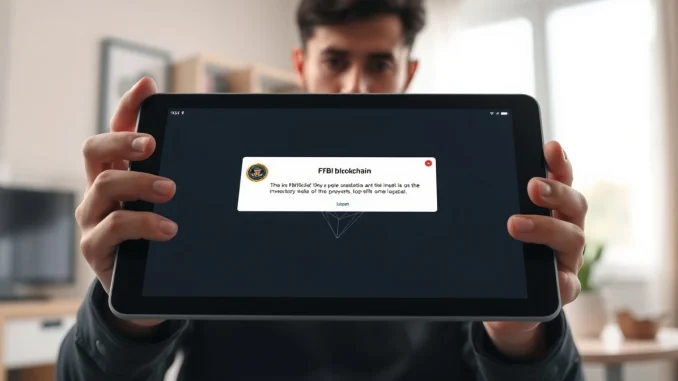
According to an official alert from FBI New York’s verified social media account, scammers have deployed a malicious token bearing the FBI’s name and official seal directly on the Tron blockchain. This token functions as the delivery mechanism for a fraudulent message sent to Tron wallet addresses. The message falsely informs recipients that their wallet is ‘under investigation’ by the Federal Bureau of Investigation. Subsequently, it directs users to complete a sham ‘anti-money laundering (AML) verification’ through a linked website, threatening a ‘total block’ on their assets if they fail to comply. The FBI has explicitly warned all Tron network users to exercise extreme caution and under no circumstances provide identifying information to any website linked to this token.
The Tron blockchain, known for its high throughput and low transaction fees, has become a popular ecosystem for decentralized applications and token transfers. Unfortunately, these same features can attract malicious actors. The scam exploits the blockchain’s inherent transparency and interactivity, where tokens can carry metadata or be used to trigger messages to wallet holders. This incident highlights a growing trend of ‘on-chain phishing,’ where fraudulent communications are embedded within blockchain transactions themselves, making them appear more legitimate to users familiar with network interactions.
Context: The Rising Tide of Crypto Fraud
This fake FBI token scheme is not an isolated incident but part of a dangerous and costly upward trend in cryptocurrency fraud. In April 2025, the FBI’s Internet Crime Complaint Center (IC3) published its annual report, noting that the agency received over 140,000 complaints related to cryptocurrency scams in 2024 alone. These crimes resulted in staggering financial losses exceeding $9.3 billion, marking a 66% increase from the approximately $5.6 billion reported in 2023. The report consistently identifies phishing, investment fraud, and extortion as the primary vectors for these losses.
- Phishing: Fraudsters impersonate legitimate entities to steal login credentials, private keys, or personal data.
- Investment Fraud: ‘Pump-and-dump’ schemes and fake investment platforms promise high returns.
- Extortion: Threats, often involving fabricated legal claims or compromised data, used to coerce payments.
The fake FBI token scam uniquely combines phishing and extortion, using the implied legal authority of the FBI to create a heightened sense of urgency and fear, which is a classic hallmark of successful phishing campaigns.
Historical Precedent: The FBI’s ‘Trap Token’ Operation
In a notable contrast to this criminal activity, the FBI itself has previously utilized blockchain technology for investigative purposes. In a 2024 operation, the Bureau created a ‘trap token’ dubbed ‘NexFundAI.’ This was a deliberately designed, artificial intelligence-themed cryptocurrency token deployed as bait to identify and apprehend individuals engaged in market manipulation and fraudulent pump-and-dump schemes. The operation was successful, leading to charges against at least 18 individuals who participated in manipulating the token’s trading volume.
This historical action underscores a critical distinction for the public: while the FBI may use tokens as investigative tools in controlled, disclosed operations, the agency will never use an unsolicited token to demand personal information or payments from private citizens. The current scam on the Tron network is a criminal impersonation of the FBI, not an official law enforcement action.
Protective Measures and Recommended Response
For users of the Tron network and other blockchain ecosystems, vigilance is paramount. The FBI and cybersecurity experts recommend several key actions to mitigate risk. First, users must verify the source of any on-chain message. A legitimate federal investigation would not be initiated via a blockchain token. Second, never click links or scan QR codes from unsolicited tokens or messages. Instead, independently navigate to an agency’s official website using a known, trusted address.
Furthermore, users should never share private keys, seed phrases, or passwords. Law enforcement will never request this information. Enabling all available security features on wallets, such as multi-factor authentication and transaction whitelisting, provides additional layers of defense. The FBI has directed individuals who believe they may have already provided information to the scammers, or who have suffered financial loss, to file a detailed report immediately with the Internet Crime Complaint Center (IC3). This reporting is crucial as it assists law enforcement in tracking scams, identifying patterns, and building cases against perpetrators.
| Aspect | Legitimate FBI ‘Trap Token’ (2024) | Fake FBI Token Scam (2026) |
|---|---|---|
| Purpose | Investigation to apprehend fraudsters | Theft of personal info and assets |
| Communication | No direct solicitation of public | Direct, unsolicited messages to wallets |
| Demand | None made of the public | Demands for personal verification/payment |
| Outcome | Criminal charges filed | Victim financial loss |
The Broader Impact on Crypto Adoption and Trust
Scams of this nature pose a substantial threat beyond individual financial loss. They actively erode trust in the broader cryptocurrency and blockchain ecosystem at a time when institutional and mainstream adoption is increasing. When bad actors successfully impersonate trusted institutions like the FBI, it creates confusion and fear among new users, potentially stifling the growth of legitimate decentralized technologies. The industry’s ongoing challenge is to improve user education and develop more robust native security protocols within blockchain networks to prevent the misuse of token functionalities for fraud.
Blockchain analysts note that while the technology offers transparency and immutability, these features do not inherently prevent social engineering attacks. The responsibility, therefore, is shared between platform developers to create safer environments, law enforcement to aggressively pursue criminals, and users to maintain a high degree of skepticism and security hygiene. Regulatory bodies worldwide are increasingly focused on establishing clearer frameworks to combat such cross-jurisdictional digital asset fraud.
Conclusion
The fake FBI token scam on the Tron network is a serious and sophisticated criminal operation that exploits both the technical features of blockchain and the authoritative reputation of federal law enforcement. This incident serves as a powerful reminder of the persistent risks in the digital asset space. Users must remain alert to unsolicited communications, understand that legitimate authorities will not use tokens to demand information, and prioritize the security of their wallets and personal data. By combining user education, proactive security measures, and reporting to agencies like the IC3, the community can work to mitigate the impact of such scams. The FBI’s public warning is a critical step in protecting users, and heeding this advice is essential for anyone participating in the Tron ecosystem or the wider cryptocurrency market.
FAQs
Q1: What should I do if I receive a message from the fake FBI token on Tron?
A1: Do not interact with the token, click any links, or provide any information. You should report the incident to the FBI’s Internet Crime Complaint Center (IC3) and consider using your wallet’s features to hide or block the spam token if possible.
Q2: How can I tell if a communication from the FBI is real?
A2: The real FBI will not initiate contact about an investigation via a blockchain token or demand immediate payment or personal details through a website link. Official communications will follow formal procedures, often involving written correspondence or in-person contact.
Q3: Has the FBI taken down the fake token?
A3: As of March 2026, the fraudulent token likely remains on the immutable Tron blockchain. Law enforcement focuses on identifying the perpetrators behind the scam and the associated phishing websites, and on preventing further victimization through public warnings.
Q4: Are other blockchains vulnerable to similar token-based scams?
A4: Yes, any blockchain network that supports the creation of custom tokens and messaging functions can potentially be used for similar phishing and extortion attempts. The principles of caution and verification apply universally across all networks.
Q5: Where can I officially report cryptocurrency fraud?
A5: In the United States, the primary platform is the FBI’s Internet Crime Complaint Center (IC3) at www.ic3.gov. You should also report the fraud to the platform or exchange you were using, if applicable.
Updated insights and analysis added for better clarity.
This article was produced with AI assistance and reviewed by our editorial team for accuracy and quality.