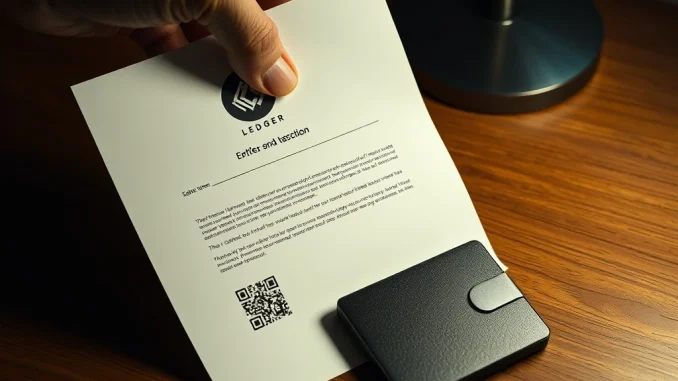
Global, April 2025: In a disturbing evolution of cryptocurrency phishing, security researchers and victims report a sophisticated new attack vector. Scammers are now bypassing digital filters entirely by sending fake physical letters, masquerading as official correspondence from hardware wallet giants Ledger and Trezor. These alarming letters contain QR codes designed to trick users into surrendering their wallet’s seed phrase—the master key to their digital assets—marking a significant escalation in the fight for crypto security.
Fake Ledger and Trezor Letters: The Anatomy of a Physical Phishing Attack
The traditional crypto security playbook focused on digital threats: malicious emails, fake browser extensions, and compromised ads. The emergence of physical mail scams represents a paradigm shift, exploiting a channel users inherently trust more. According to reports from multiple cybersecurity firms and user forums, the letters are professionally printed on high-quality paper. They often feature official-looking logos, convincing typography, and language that mimics corporate crisis communication. The core narrative is urgent: the recipient’s device is compromised, their funds are at immediate risk, and they must act swiftly by scanning a provided QR code to “secure” or “migrate” their wallet. This QR code leads not to a legitimate company site, but to a flawless phishing webpage that harvests the 12 or 24-word recovery phrase.
Why This Seed Phrase Scam Is So Effective
This method bypasses several layers of standard digital defense. Email spam filters and browser security warnings are irrelevant. The physical nature of the letter lends it an air of legitimacy that a suspicious email lacks. Furthermore, it targets a specific, high-value demographic: individuals who have invested in hardware wallets, implying they hold significant crypto assets worth protecting. The scam leverages powerful psychological triggers:
- Fear: The letter creates a immediate sense of danger regarding the user’s life savings.
- Urgency: It demands quick action, short-circuiting careful deliberation.
- Authority: It impersonates trusted brands in the security space.
- Novelty: Users are not conditioned to distrust physical mail from these companies.
The table below contrasts this new threat with common digital phishing methods:
| Attack Vector | Delivery Method | Common User Defense | Bypassed By Letter Scam |
|---|---|---|---|
| Email Phishing | Spam Email | Spam Filters, Sender Verification | Yes |
| Fake Ads (Google/FB) | Search/Social Media | Ad Blockers, Skepticism of Ads | Yes |
| Fake Support Calls | Phone Call | Caller ID, Verbal Scrutiny | Partially |
| Fake Physical Letter | Postal Mail | Almost None (Novel Threat) | N/A |
The Critical Role of the Seed Phrase in Crypto Security
To understand the severity, one must grasp the function of a seed phrase. Unlike a password, a seed phrase is a non-replaceable cryptographic key. It is the absolute master key that generates all the private keys for a cryptocurrency wallet. Whoever possesses the seed phrase has complete, irreversible control over all assets in that wallet and any wallets derived from it. Hardware wallets like Ledger and Trezor are designed to keep this phrase offline and secure. No legitimate company will ever ask a user to enter their seed phrase on a website, in an email, or over the phone. This is the cardinal rule of crypto self-custody. The fake letters are a direct, physical assault on this fundamental security principle.
Historical Context and the Escalating Arms Race
Cryptocurrency phishing is not new. The industry has seen attacks evolve from crude email blasts to sophisticated supply chain compromises, like the 2020 Ledger data breach that leaked customer email addresses. That breach is now suspected to be a source for targeting information in this postal campaign. This evolution follows a predictable pattern: as users become educated about one type of scam, attackers innovate to exploit new, less-guarded vectors. The move to physical mail mirrors tactics long used in high-stakes financial fraud and corporate espionage, now applied to the decentralized finance space. It signals that attackers are investing greater resources to target high-net-worth individuals in the crypto ecosystem, viewing the potential payoff as worth the cost and complexity of physical operations.
How to Identify and Protect Yourself from Fake Hardware Wallet Letters
Vigilance and education are the only effective countermeasures. Users should adopt the following protocols:
- Verify Through Official Channels: If you receive any concerning communication, ignore the contact methods provided in the letter. Instead, navigate directly to the official Ledger or Trezor website via your own browser and contact support through verified links found there.
- The Golden Rule: Never, under any circumstances, type your seed phrase into a website, email, or form. A legitimate company will never ask for it.
- Scrutinize Physical Mail: Look for grammatical errors, odd return addresses, or a sense of manufactured panic. Official companies rarely use urgent physical mail for security issues.
- QR Code Caution: Treat any QR code in unsolicited mail with extreme suspicion. Do not scan it.
- Community Awareness: Report any received letters to the official companies and in community forums. Sharing details helps protect others.
Conclusion
The emergence of fake Ledger and Trezor letters represents a dangerous and sophisticated new front in cryptocurrency security. This seed phrase scam exploits the inherent trust in physical communication and the potent psychology of fear to bypass digital defenses. For hardware wallet users, the fundamental rule remains unchanged: your seed phrase is sacred and must remain offline. As the threat landscape evolves from purely digital to include physical-social engineering, user education and disciplined skepticism become the most critical security layers of all. The safety of your digital assets ultimately depends on recognizing that no official communication will ever request your recovery phrase.
FAQs
Q1: What should I do if I receive a suspicious letter from Ledger or Trezor?
A1: Do not scan any QR codes or visit any links. Take a photo of the letter for documentation, then safely destroy it. Contact the company’s official support directly through their verified website to report the scam.
Q2: Would Ledger or Trezor ever ask for my seed phrase?
A2: Absolutely not. This is the most important rule in cryptocurrency self-custody. No legitimate employee, website, or communication from these companies will ever request your 12 or 24-word recovery phrase.
Q3: How are the scammers getting my physical address?
A3: Addresses are likely sourced from previous data breaches (like the 2020 Ledger breach), from public records, or purchased from illicit data brokers. Using a hardware wallet does not automatically expose your address, but previous online interactions might have.
Q4: Is my hardware wallet itself compromised if I get a letter?
A4: No. The letter is a phishing attempt, not a compromise of the physical device. Your wallet remains secure as long as you keep your seed phrase secret. The scam relies on tricking you into voluntarily giving up the phrase.
Q5: What’s the safest way to manage my seed phrase?
A5: Write it down on the provided recovery sheet or on durable metal, store it in multiple secure physical locations (like a safe or safety deposit box), and never digitize it (no photos, cloud storage, or text files). It should exist only in physical form.