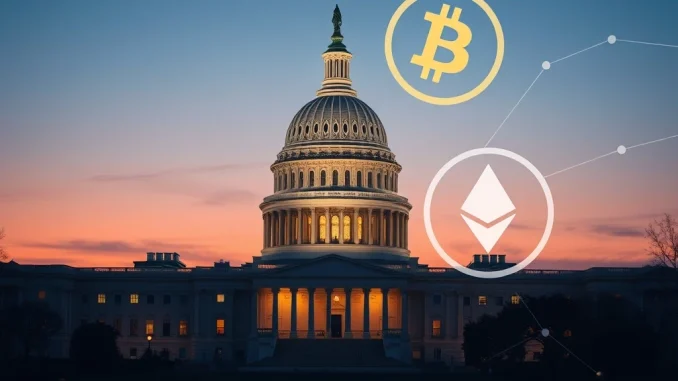
Washington, D.C., March 2025: The political landscape for digital assets has entered a new era of influence. Fairshake, a cryptocurrency industry Super Political Action Committee (Super PAC), has amassed a staggering $193 million war chest as of the end of last year, according to a CNBC report. This unprecedented fundraising haul, fueled by multi-million dollar contributions from industry titans like Ripple and Andreessen Horowitz, signals a decisive and coordinated push to shape the upcoming midterm elections. The massive financial mobilization arrives as the U.S. Senate Agriculture Committee prepares for a pivotal first vote on key components of a comprehensive digital asset regulation bill this week, setting the stage for a high-stakes political battle.
Crypto Super PAC Fairshake Mobilizes Historic $193 Million
The $193 million figure reported by Fairshake represents a watershed moment for political engagement within the cryptocurrency and blockchain sector. Super PACs like Fairshake can raise and spend unlimited sums of money to advocate for or against political candidates, provided they do not coordinate directly with a candidate’s campaign. The scale of this fundraising effort immediately positions Fairshake as one of the most formidable single-issue political action committees in the current election cycle. Analysts note that this level of financial commitment reflects a strategic shift within the crypto industry from a primarily regulatory and lobbying-focused approach to a full-spectrum political strategy aimed directly at the ballot box. The funds are earmarked to actively support candidates from both major parties who demonstrate a favorable stance toward fostering innovation in the digital asset space while advocating for clear and sensible regulatory frameworks.
Major Donors Ripple and Andreessen Horowitz Lead the Charge
Driving this historic fundraising total are substantial contributions from some of the most recognizable names in technology and finance. In the second half of 2025 alone, Ripple, the company behind the XRP ledger, contributed $25 million to Fairshake. Simultaneously, the premier venture capital firm Andreessen Horowitz (a16z), a prolific investor in web3 and blockchain startups, donated $24 million. These are not isolated acts of philanthropy but calculated investments in political outcomes. For Ripple, which has been engaged in a protracted legal battle with the U.S. Securities and Exchange Commission (SEC), supporting politicians who favor regulatory clarity is a business imperative. For a16z, which manages billions in crypto-focused funds, the political environment directly impacts the viability and growth potential of its vast portfolio. Their contributions underscore a consensus among industry leaders that the future of digital assets in America will be decided as much in the halls of Congress as in the markets.
The Strategic Timing: Midterms and Pending Legislation
The timing of this financial offensive is highly strategic, coinciding with two critical events: the approaching midterm elections and imminent legislative action. Midterm elections historically serve as a referendum on the sitting administration and can dramatically shift the balance of power in Congress. By injecting significant capital now, Fairshake aims to influence primary races and general elections to ensure a Congress more amenable to the crypto industry’s priorities in 2026 and beyond. Concurrently, the U.S. Senate Agriculture Committee, which shares jurisdiction over digital commodity assets with other committees, is scheduled this week to hold its first vote on parts of a long-awaited digital asset regulation bill. This legislative effort seeks to clarify the roles of the SEC and the Commodity Futures Trading Commission (CFTC) in overseeing crypto markets. Fairshake’s war chest serves as a powerful signal to lawmakers about the high level of stakeholder engagement and the potential electoral consequences of their regulatory decisions.
Understanding the Political and Regulatory Context
To appreciate the significance of Fairshake’s $193 million, one must understand the recent history of crypto regulation in the United States. The industry has operated for years under a patchwork of state regulations and evolving federal guidance, leading to uncertainty for businesses and consumers alike. High-profile enforcement actions and a lack of clear legislative mandates have been cited as reasons for innovation and capital migrating to other jurisdictions. The formation and funding of Fairshake is a direct response to this environment. It represents a maturation of industry advocacy, moving beyond trade association letters and individual company lobbying to pooled, electoral-focused resources. This model is common in other well-established sectors like healthcare, energy, and finance but is novel at this scale for the relatively young crypto industry. The goal is to elect a critical mass of lawmakers who understand blockchain technology and are committed to creating a regulatory environment that protects consumers without stifling innovation.
Potential Impact on the 2025-2026 Election Cycle
With nearly $200 million at its disposal, Fairshake possesses the capacity to alter electoral outcomes in targeted races. The Super PAC can deploy funds for a wide range of activities, including:
- Television and Digital Advertising: Producing and airing ads that support pro-crypto candidates or critique opponents.
- Direct Voter Outreach: Funding mailers, text campaigns, and get-out-the-vote efforts focused on key constituencies.
- Independent Expenditures: Financing ground operations, polling, and opposition research independently of candidate campaigns.
This financial power allows Fairshake to prioritize competitive House and Senate races where a relatively small investment could sway the result. The strategy is not necessarily partisan; the committee has indicated it will support both Democrats and Republicans who align with its policy goals. This bipartisan approach maximizes its influence but also requires navigating an increasingly polarized political climate. The ultimate impact will be measured by the composition of the next Congress and its willingness to advance digital asset legislation that the industry supports.
Comparative Analysis of Industry Political Spending
The scale of Fairshake’s fundraising invites comparison with political spending from other financial and technology sectors. While $193 million is a colossal sum for a single-issue Super PAC in the crypto space, it is part of a broader ecosystem of political finance. For context, the securities and investment industry routinely spends over $100 million per election cycle on federal lobbying and campaign contributions. The table below provides a simplified comparison of approximate annual federal political spending (including lobbying and PACs) across related sectors:
| Sector/Industry | Approx. Annual Federal Political Spending | Primary Focus |
|---|---|---|
| Securities & Investment | $120 – $150 Million | Banking rules, fiduciary standards, market regulation |
| Commercial Banks | $60 – $80 Million | Dodd-Frank, consumer lending laws, fintech policy |
| Big Tech (e.g., Meta, Google) | $80 – $100 Million+ | Antitrust, data privacy, content moderation laws |
| Crypto/Blockchain (Pre-2025) | $10 – $20 Million | Regulatory clarity, taxonomy of assets |
| Crypto/Blockchain (2025 with Fairshake) | $200+ Million (Est.) | Election of pro-innovation candidates, comprehensive legislation |
This comparison illustrates a dramatic escalation. Fairshake’s single fund effectively multiplies the industry’s visible political footprint several times over, bringing it into rough parity with much older, more entrenched financial sectors in terms of potential electoral influence.
Conclusion: A New Chapter in Crypto Politics
The announcement that the Crypto Super PAC Fairshake has raised $193 million marks a definitive turning point. It transitions the digital asset industry from a sector seeking a seat at the regulatory table to a major player prepared to influence who sits at that table. The monumental contributions from Ripple, Andreessen Horowitz, and other donors reflect a unified, strategic commitment to shaping the political future of finance and technology in America. As the Senate Agriculture Committee moves forward with its regulatory vote, the shadow of this substantial electoral war chest will undoubtedly be a factor in the political calculus of every lawmaker involved. The coming months will reveal how effectively this financial capital translates into political capital, potentially reshaping the congressional landscape and the future of the digital asset regulation framework for years to come.
FAQs
Q1: What is a Super PAC, and how is Fairshake different from a traditional lobbyist?
A Super PAC (Political Action Committee) can raise and spend unlimited funds on independent political expenditures, like ads, to support or oppose candidates. Unlike lobbyists, who directly advocate to legislators on specific bills, Super PACs focus on influencing election outcomes to change the legislature itself. Fairshake uses this model to support pro-crypto candidates.
Q2: Why are companies like Ripple donating tens of millions to a political committee?
For companies deeply embedded in the crypto ecosystem, the lack of clear U.S. regulation creates legal and business uncertainty. They view political engagement as essential to electing lawmakers who will pass laws that provide clarity, foster innovation, and create a stable environment for their businesses to operate and grow.
Q3: Could Fairshake’s spending violate campaign finance laws?
Super PACs like Fairshake are legal under current U.S. campaign finance law following the Supreme Court’s Citizens United decision. They must operate independently of candidate campaigns, report their donors and expenditures to the Federal Election Commission (FEC), and cannot donate directly to candidates. Their activities are focused on “independent expenditures.”
Q4: How might this affect the average cryptocurrency investor or user?
The political outcomes Fairshake seeks could lead to more comprehensive and clear federal regulations. For users, this could mean stronger consumer protections, clearer tax guidelines, and more legal certainty for the platforms they use. It could also influence which blockchain projects and companies can thrive in the U.S. market.
Q5: Is this level of political spending common for new industries?
While established industries like oil, pharmaceuticals, and finance have a long history of major political spending, it is less common for a newer, technology-driven sector to mobilize at this scale and speed. It indicates that the crypto industry views the current political moment as existential and is adopting the political playbook of more mature sectors to secure its future.