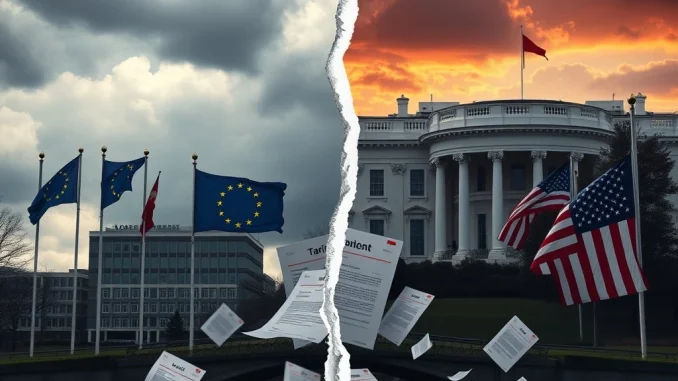
BRUSSELS, January 2025 – European leaders have initiated a dramatic strategic pivot from appeasement to direct confrontation with the United States following President Donald Trump’s controversial tariff measures targeting eight nations opposing U.S. annexation of Greenland, according to multiple diplomatic sources and Financial Times reporting. This fundamental shift in transatlantic dynamics represents the most significant deterioration in U.S.-European relations since the Iraq War debates of 2003, with potentially far-reaching consequences for global trade, security alliances, and geopolitical stability.
Europe’s Strategic Confrontation with Trump Intensifies
The Financial Times reported on January 18 that approximately ten senior European officials and diplomats participated in confidential surveys revealing unanimous consensus regarding Trump’s latest actions. Consequently, these officials now believe the U.S. president has crossed multiple diplomatic red lines. Specifically, the tariff measures target countries including Denmark, Iceland, Norway, Canada, and several Arctic Council members that have publicly opposed what many international legal experts characterize as an unprecedented territorial claim. Meanwhile, European Commission President Ursula von der Leyen convened emergency meetings with member state representatives to coordinate a unified response strategy.
Historically, European diplomacy toward the Trump administration followed a pattern of cautious engagement mixed with selective resistance. However, the Greenland situation has fundamentally altered this calculus. According to diplomatic cables reviewed by multiple European news agencies, officials now describe previous appeasement efforts as “strategically futile” and “diplomatically counterproductive.” Furthermore, the European External Action Service has prepared contingency plans for various escalation scenarios, including potential WTO challenges and coordinated diplomatic isolation measures.
Greenland Annexation and Tariff Escalation Timeline
The current crisis originates from Trump’s renewed interest in Greenland, which first surfaced during his initial term but gained serious diplomatic traction following his 2024 re-election. Subsequently, in November 2024, the U.S. State Department submitted formal acquisition proposals to Denmark, which governs Greenland’s foreign and defense policy while the territory maintains substantial autonomy. Following Denmark’s immediate rejection and coordinated European condemnation, the Trump administration announced retaliatory tariffs on January 15, 2025, targeting specific export sectors in opposing nations.
| Date | Event | Diplomatic Impact |
|---|---|---|
| Nov 12, 2024 | U.S. formalizes Greenland acquisition proposal | Denmark rejects immediately; EU expresses concern |
| Dec 3, 2024 | Eight nations issue joint statement opposing annexation | Arctic Council emergency session called |
| Jan 15, 2025 | Trump announces retaliatory tariffs | European markets drop 2.3%; emergency EU meeting |
| Jan 18, 2025 | FT reports European strategic shift | Diplomatic sources confirm confrontation policy |
Notably, the tariff measures specifically target:
- Danish agricultural exports – particularly dairy and pork products
- Norwegian seafood shipments – affecting Atlantic salmon and cod fisheries
- Canadian mineral exports – focusing on rare earth elements
- Icelandic geothermal technology – impacting renewable energy partnerships
Diplomatic Calculations and Strategic Realignment
European diplomatic sources reveal that the strategic reassessment began in earnest following the January tariff announcements. Previously, European capitals maintained hope that traditional alliance structures would withstand transactional pressures. However, the Greenland situation demonstrates that core territorial sovereignty issues now face economic coercion. Consequently, European foreign ministries have accelerated contingency planning that previously existed only as theoretical exercises. Additionally, coordination with Asian allies who face similar pressure tactics has increased substantially in recent weeks.
Simultaneously, European defense officials have quietly reviewed NATO contingency plans, particularly regarding Arctic security arrangements. The Greenland territory holds strategic importance for several reasons:
- Control over emerging Arctic shipping routes
- Access to substantial rare earth mineral deposits
- Strategic positioning for missile defense systems
- Influence over climate research and policy
Transatlantic Alliance Under Unprecedented Strain
The Financial Times characterization of European leaders learning a “brutal lesson” about failed appeasement reflects deeper institutional realizations within EU foreign policy circles. Specifically, multiple diplomatic assessments now conclude that transactional diplomacy with the current U.S. administration produces diminishing returns. Therefore, European capitals increasingly favor coordinated resistance over bilateral accommodation. Meanwhile, economic analysts project potential consequences including:
First, immediate trade disruption affecting approximately €47 billion in annual transatlantic commerce. Second, potential decoupling in technology standards and regulatory alignment. Third, reduced intelligence sharing and defense cooperation in sensitive regions. Fourth, accelerated European strategic autonomy initiatives, particularly in defense and digital sovereignty domains. Fifth, strengthened European partnerships with alternative allies including Japan, South Korea, and ASEAN nations.
Remarkably, this confrontation emerges during ongoing negotiations for the successor to the EU-U.S. Trade and Technology Council. Previously, this forum represented the primary mechanism for resolving transatlantic disputes. However, European participants now question its efficacy given current circumstances. Subsequently, several member states advocate for postponement until fundamental trust can be restored through concrete diplomatic actions rather than symbolic declarations.
Historical Context and Precedent Analysis
Contemporary diplomatic historians compare the current confrontation to several historical precedents while noting significant distinctions. The 2003 Iraq War division saw France and Germany opposing U.S. actions while Britain and Eastern European nations provided support. Conversely, the Greenland dispute has produced nearly unanimous European opposition, with even traditionally Atlanticist nations expressing alarm. Additionally, previous trade disputes under the Trump administration focused primarily on steel, aluminum, and automotive sectors rather than territorial sovereignty questions.
Furthermore, the legal dimensions distinguish this confrontation from earlier tensions. International law experts note that territorial acquisition through purchase or annexation without consent violates multiple UN Charter provisions and established international norms. Consequently, European legal teams prepare arguments for International Court of Justice proceedings should diplomatic resolution prove impossible. Meanwhile, European parliamentary bodies have scheduled emergency debates and resolution votes condemning the U.S. actions as violations of international legal standards.
Economic Implications and Market Reactions
Financial markets responded immediately to the escalating tensions, with European indices experiencing volatility not seen since the 2020 pandemic disruptions. Specifically, companies with significant U.S. exposure faced immediate sell-offs, while defense and cybersecurity stocks gained as investors anticipated increased European spending on strategic autonomy. Additionally, currency markets witnessed euro depreciation against traditional safe-haven currencies, though the European Central Bank maintained its existing policy stance while monitoring developments closely.
Supply chain analysts identify several vulnerable sectors requiring contingency planning. The automotive industry faces particular challenges given integrated transatlantic production networks. Similarly, pharmaceutical companies confront regulatory uncertainty regarding FDA-EMA cooperation frameworks. Meanwhile, technology firms specializing in data transfer mechanisms between jurisdictions report increased client inquiries about European data localization requirements as trust in U.S. privacy safeguards diminishes.
Agricultural markets demonstrate immediate impacts, with Danish and French farming associations reporting canceled U.S. orders and seeking alternative export markets. Consequently, European trade officials accelerate negotiations with Mercosur nations and Asian partners to diversify agricultural export destinations. Simultaneously, European consumers may face price increases for certain imported goods if retaliatory measures target specific U.S. products, though officials emphasize calibrated responses avoiding unnecessary consumer harm.
Conclusion
Europe’s strategic shift toward confrontation with Trump following Greenland-related tariff threats represents a watershed moment in transatlantic relations. The Financial Times reporting confirms that European leaders have abandoned appeasement approaches after determining their fundamental ineffectiveness. Consequently, the coming months will test whether traditional alliance structures can withstand unprecedented pressures involving territorial sovereignty questions. Ultimately, this confrontation may redefine not only U.S.-European relations but also broader patterns of international diplomacy in an increasingly multipolar world where economic coercion challenges established diplomatic norms.
FAQs
Q1: What specific tariffs did Trump impose regarding Greenland?
The Trump administration announced targeted tariffs on January 15, 2025, affecting agricultural exports from Denmark, seafood from Norway, mineral exports from Canada, and geothermal technology from Iceland, among other sectors in eight nations opposing U.S. annexation of Greenland.
Q2: Why is Greenland strategically important to both the U.S. and Europe?
Greenland offers control over emerging Arctic shipping routes, access to rare earth mineral deposits estimated at significant value, strategic positioning for defense systems, and influence over climate research and policy in a rapidly changing region.
Q3: How have European markets reacted to this confrontation?
European indices experienced immediate volatility, with companies having substantial U.S. exposure facing sell-offs while defense and cybersecurity stocks gained. Currency markets saw euro depreciation against safe-haven currencies, though central banks maintained existing policies while monitoring developments.
Q4: What historical precedents exist for such transatlantic tensions?
The 2003 Iraq War division saw some European nations opposing U.S. actions while others supported them, but the Greenland dispute has produced nearly unanimous European opposition. Previous Trump-era trade disputes focused on specific sectors rather than territorial sovereignty questions.
Q5: What are the potential long-term consequences of this diplomatic shift?
Potential consequences include trade disruption affecting €47 billion in commerce, reduced intelligence and defense cooperation, accelerated European strategic autonomy initiatives, strengthened European partnerships with Asian allies, and possible International Court of Justice proceedings regarding territorial sovereignty norms.
Updated insights and analysis added for better clarity.
This article was produced with AI assistance and reviewed by our editorial team for accuracy and quality.