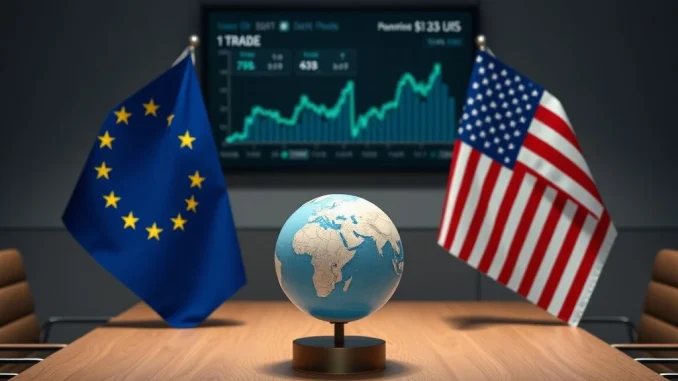
In a significant geopolitical development from Helsinki, Finnish President Alexander Stubb has declared that the European Union possesses substantial leverage and multiple diplomatic instruments to compel the United States to withdraw its recent tariff threats, a statement that immediately reverberated through global financial markets and diplomatic circles on Monday. This assertion directly addresses escalating tensions initiated by former U.S. President Donald Trump’s warnings of imposing ‘Greenland tariffs’ on eight European nations, a move some analysts have tentatively linked to short-term weakness in Bitcoin and other risk assets. The situation underscores a fragile moment in transatlantic relations, where economic tools are positioned as primary counters to political pressure.
EU Tariff Response and Diplomatic Arsenal
President Stubb, speaking in Helsinki, outlined a framework of potential EU countermeasures without delving into specific confidential strategies. Consequently, his comments signal a coordinated European stance. Historically, the EU’s trade defense arsenal includes several powerful mechanisms. For instance, the bloc can initiate World Trade Organization dispute settlement proceedings, a process that has previously resolved transatlantic trade spats. Furthermore, the EU holds the authority to impose retaliatory tariffs on strategically selected U.S. goods, a tactic deployed during the Airbus-Boeing disputes. Additionally, the Union can leverage regulatory measures and strengthen partnerships with other global trade powers to increase collective bargaining pressure.
Analysts from institutions like Bruegel and the European Council on Foreign Relations note that the EU’s single market represents its core strength. Essentially, as the world’s largest trading bloc, access to its 450 million consumers is a powerful bargaining chip. “The EU’s response will likely be calibrated and multilateral,” explained a senior trade policy researcher, who requested anonymity due to the sensitivity of ongoing assessments. “It involves not just retaliation, but also engagement through established channels.” This approach contrasts with unilateral tariff threats, aiming to de-escalate while demonstrating resolve.
The Greenland Context and Dismissed Military Speculation
The immediate catalyst for this diplomatic exchange is the renewed focus on Greenland. Notably, President Stubb explicitly dismissed the notion that the U.S. would employ military means to gain control over the autonomous Danish territory. “I do not believe the U.S. will use military means,” he stated, thereby addressing the most extreme speculation arising from the rhetoric. Greenland holds geopolitical significance due to its strategic location in the Arctic and its potential mineral resources. However, its status is governed by a 2009 self-rule agreement under the Kingdom of Denmark, making any forcible acquisition a severe violation of international norms.
A brief timeline of recent events clarifies the escalation:
- Previous Week: Former U.S. President Trump reiterates interest in Greenland, suggesting tariffs on several EU nations if cooperation is not forthcoming.
- Monday Morning: Reports surface linking Bitcoin’s market dip to the burgeoning U.S.-EU tension.
- Monday Afternoon (Local Time): President Stubb delivers his response, affirming EU capabilities and downplaying military risks.
This sequence highlights how geopolitical statements can rapidly influence global market sentiment, connecting high-level diplomacy to asset price fluctuations.
Market Reactions and Cryptocurrency Volatility
Simultaneously, financial markets exhibited sensitivity to the growing discord. Specifically, Bitcoin and broader cryptocurrency markets experienced notable selling pressure during Asian and European trading hours on Monday. While direct causation in volatile markets is complex, several trading desks and analysts, including those at Genesis Global Trading, observed a correlation. They noted that geopolitical instability between major economic powers often triggers a ‘flight to safety,’ initially impacting perceived risk-on assets like digital currencies. However, cryptocurrencies can also later act as hedges against currency devaluation in prolonged trade wars.
Key factors linking the conflict to market moves include:
- Risk Aversion: Traders may reduce exposure to volatile assets during geopolitical uncertainty.
- Dollar Strength: Trade tensions can boost the U.S. dollar, pressuring dollar-denominated assets like Bitcoin.
- Regulatory Fears: Conflicts may spur harsh regulatory moves across jurisdictions, creating market uncertainty.
Market data from Monday showed Bitcoin briefly dipping below key short-term support levels before partially recovering, a pattern consistent with knee-jerk reactions to news headlines. Consequently, this event serves as a contemporary case study in the interconnectedness of geopolitics and digital asset markets.
Expert Analysis on Trade War Tools and Impacts
Trade policy experts emphasize that the EU’s strategy will extend beyond immediate tit-for-tat tariffs. Maria Demertzis, a former acting director at Bruegel, explained, “The EU’s power lies in its regulatory capacity and its ability to form coalitions. Responses could involve challenges at the WTO, targeted sanctions on politically sensitive U.S. exports, or accelerating trade agreements with other partners.” This multifaceted approach aims to impose calculated economic costs while keeping diplomatic pathways open.
The potential economic impacts are significant for both blocs. The following table outlines possible sectors affected by retaliatory measures:
| Potential EU Retaliatory Targets | Potential U.S. Tariff Targets | Global Impact |
|---|---|---|
| American agricultural products (soybeans, corn) | European automotive exports | Disruption of supply chains |
| Technology and digital services taxes | French wine, German machinery | Increased consumer prices |
| Financial market access provisions | Aerospace components | Reduced business investment |
Such a conflict would likely slow post-pandemic economic recovery, increase inflation, and potentially fragment technological standards between the West’s two largest economies.
Historical Precedents and the Path Forward
This is not the first trade tension between the EU and the U.S. The Trump administration previously imposed tariffs on European steel and aluminum under Section 232, citing national security. The EU responded with counter-tariffs on American motorcycles, bourbon, and other goods. That dispute was eventually mitigated through negotiations, setting a precedent for managed escalation. The current situation over Greenland, however, introduces a unique territorial dimension to what is fundamentally an economic and political power struggle.
Moving forward, diplomatic channels will be crucial. The European Commission, led by President Ursula von der Leyen, holds the formal mandate for EU trade policy. It will likely coordinate a response in consultation with member states, including the eight nations specifically threatened. The goal will be to demonstrate unity and resolve, thereby discouraging further escalation while protecting European interests. Ultimately, both sides have strong incentives to avoid a full-blown trade war, given deep economic interdependence.
Conclusion
Finnish President Alexander Stubb’s confident assertion regarding the EU’s capacity to formulate a robust EU tariff response highlights a prepared and unified European stance against unilateral American pressure over Greenland. While dismissing more extreme military scenarios, the situation has already demonstrated its capacity to inject volatility into global markets, including the cryptocurrency sector. The evolving dispute underscores the intricate link between modern geopolitics, trade policy, and financial market sentiment. As the European Commission deliberates its formal response, the world watches to see if economic tools can successfully de-escalate a tension rooted in both strategy and sovereignty.
FAQs
Q1: What specific tools does the EU have to counter US tariff threats?
The EU’s toolkit includes initiating formal disputes at the World Trade Organization (WTO), imposing legally authorized retaliatory tariffs on U.S. goods, deploying regulatory measures that affect U.S. companies operating in Europe, and strengthening trade alliances with other global partners to increase collective economic pressure.
Q2: Why is Greenland at the center of this trade dispute?
Greenland is an autonomous territory within the Kingdom of Denmark with significant strategic importance in the Arctic. Its location and potential mineral resources have long attracted geopolitical interest. The threat of “Greenland tariffs” uses trade policy as leverage in a broader discussion about influence and access in the region.
Q3: How did Bitcoin markets react to this news?
Bitcoin and several other major cryptocurrencies showed short-term weakness and increased volatility on Monday morning following the reports of escalating U.S.-EU tensions. Analysts noted a correlation, as geopolitical risk often prompts selling in assets perceived as risky, though long-term effects depend on the conflict’s duration and outcome.
Q4: Has the EU faced similar US trade threats before?
Yes. During the previous administration, the U.S. imposed tariffs on EU steel and aluminum. The EU responded with counter-tariffs on iconic American products. That dispute was eventually resolved through negotiation, providing a framework for how such escalations can be managed.
Q5: What are the potential global economic impacts of this conflict?
A sustained trade conflict could disrupt transatlantic supply chains, increase costs for consumers and businesses on both continents, dampen economic growth, and potentially lead to a fragmentation of technological and trade standards between the two major Western economies.
Updated insights and analysis added for better clarity.
This article was produced with AI assistance and reviewed by our editorial team for accuracy and quality.