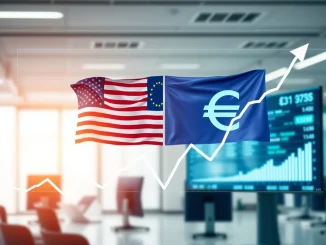
BRUSSELS, January 2025 – The European Union has activated its most powerful trade defense tool for the first time, deploying the anti-coercion instrument against unprecedented tariff threats from the United States over Arctic sovereignty claims. This historic move represents Europe’s most assertive economic response to what officials describe as “economic blackmail” targeting eight member states, fundamentally testing the resilience of transatlantic relations and establishing new precedents for global trade governance.
The EU Anti-Coercion Instrument: Europe’s Economic Shield
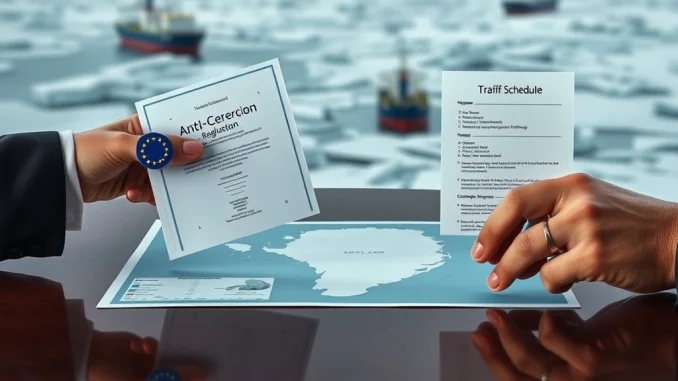
The European Union’s anti-coercion instrument represents a revolutionary development in international trade law. Established in 2023 as Regulation (EU) 2023/2675, this mechanism provides the European Commission with unprecedented authority to counter economic coercion from third countries. The instrument operates on a graduated response system, beginning with diplomatic consultations and potentially escalating to restrictive measures against the coercing country’s economic operators.
Legal experts describe the instrument as Europe’s “economic bazooka” – a carefully calibrated tool designed to deter coercion while maintaining compliance with World Trade Organization rules. The regulation specifically targets situations where a third country pressures the EU or its member states through restrictive trade or investment measures to force policy changes. Importantly, the instrument includes built-in proportionality safeguards, requiring the Commission to demonstrate that any response measures are necessary, proportionate, and in the Union’s interest.
Legal Framework and Implementation Mechanisms
The anti-coercion instrument functions through a multi-stage process. First, the Commission conducts a thorough investigation to establish coercion. Subsequently, it may impose countermeasures ranging from import/export restrictions to investment screening enhancements and public procurement limitations. These measures can target specific sectors, goods, or services from the coercing country. The European Parliament and Council maintain oversight through a comitology procedure, ensuring democratic accountability in deployment decisions.
US Tariff Threats: The Greenland Trigger
The current crisis originated in December 2024 when the United States administration announced plans to impose escalating tariffs on eight European countries: Denmark, Norway, Sweden, France, Germany, the United Kingdom, Netherlands, and Finland. The proposed measures begin with 10% tariffs in February 2025, potentially rising to 25% by June if European nations refuse to accommodate American strategic interests in Greenland.
Greenland’s geopolitical significance has intensified dramatically as Arctic ice retreats, opening new shipping routes and revealing substantial mineral resources. The United States seeks enhanced military and economic access to counter Russian and Chinese Arctic expansion. European nations responded to American overtures by deploying symbolic military contingents to Greenland, asserting their own strategic interests in the region. This diplomatic maneuvering triggered the current economic confrontation.
| Date | Event | Economic Impact |
|---|---|---|
| Nov 2024 | US expresses interest in Greenland sovereignty negotiations | Initial diplomatic tensions |
| Dec 2024 | Eight EU nations deploy troops to Greenland | Military signaling begins |
| Jan 2, 2025 | US announces 10% tariffs starting February | Immediate market reactions |
| Jan 15, 2025 | EU Commission initiates anti-coercion investigation | Formal process begins |
| Jan 20, 2025 | EU Council approves instrument activation | Historic decision made |
European Response: Unity Tested, Sovereignty Asserted
The European response has revealed both remarkable unity and underlying tensions. France and Germany have emerged as the strongest advocates for deploying the anti-coercion instrument, framing the situation as a fundamental test of European sovereignty. French President Emmanuel Macron declared that “Europe will not be intimidated by economic blackmail,” while German Chancellor Olaf Scholz emphasized the need for “proportionate but firm defense of our economic interests.”
However, divisions have surfaced regarding implementation specifics. Northern European nations with strong historical ties to the United States have advocated for measured responses, fearing broader trade disruptions. Meanwhile, southern and eastern member states have generally supported stronger measures, viewing the situation through the lens of European strategic autonomy. The Commission has navigated these differences by proposing targeted countermeasures focusing on specific US sectors where Europe maintains leverage.
Economic Calculations and Strategic Considerations
European policymakers face complex economic calculations. The eight targeted nations represent approximately 65% of EU-US trade volume, with potential tariff impacts estimated at €47-62 billion annually if maximum rates apply. However, the anti-coercion instrument allows for surgical responses that minimize collateral damage. Potential EU countermeasures could include:
- Restrictions on US technology firms’ access to European data markets
- Enhanced screening of US investments in critical European infrastructure
- Public procurement limitations for US companies in defense and technology sectors
- Export controls on specialized machinery and components where Europe maintains dominance
Broader Geopolitical Context: Shifting Global Dynamics
The Greenland standoff occurs against a backdrop of significant global realignment. The United States has simultaneously pursued aggressive economic policies toward Venezuela and maintained pressure on Iran, while experiencing relative calm in Sino-American trade relations following the November 2024 tariff truce. This selective application of economic pressure reflects a broader strategy of using trade as a geopolitical instrument rather than purely economic tool.
European officials note the contrast between current transatlantic tensions and improved EU-China relations, particularly following the resolution of several longstanding trade disputes. This dynamic creates unusual triangular diplomacy where Europe finds itself simultaneously managing deteriorating relations with its traditional ally while stabilizing ties with its strategic competitor. The situation has prompted urgent discussions about European strategic autonomy and reduced dependency on US security guarantees.
Economic Impacts and Market Reactions
Financial markets have responded cautiously to the escalating tensions. The euro has experienced volatility against the dollar, fluctuating within a 3.5% range since the crisis began. European automotive and aerospace stocks have shown particular sensitivity, given their substantial transatlantic supply chains. Meanwhile, commodity markets have priced in potential disruptions to Arctic resource development, with rare earth mineral futures increasing by 8.2% since December.
The cryptocurrency sector has demonstrated unexpected correlation with geopolitical developments. Bitcoin initially surged as a potential hedge against traditional market instability, then corrected as traders anticipated broader economic slowdown. This pattern suggests increasing integration between digital assets and conventional geopolitical risk assessment frameworks. European regulators have accelerated discussions about incorporating geopolitical risk factors into cryptocurrency oversight mechanisms.
Historical Precedents and Future Implications
Current tensions recall previous transatlantic trade disputes, particularly the 2018-2020 conflicts over steel and aluminum tariffs. However, experts note crucial differences: the current confrontation involves explicit linkage between trade measures and territorial claims, represents broader European rather than bilateral responses, and occurs within a more fragmented multilateral trading system. The World Trade Organization’s diminished dispute resolution capacity has created space for unilateral measures that previously would have faced immediate institutional challenges.
The Greenland standoff may establish enduring precedents for how economic powers manage sovereignty disputes in an increasingly multipolar world. Legal scholars anticipate that the EU’s use of its anti-coercion instrument will inspire similar mechanisms in other economic blocs, potentially leading to a new era of regional trade defense systems operating alongside (or instead of) global governance structures. This development could accelerate the fragmentation of the global trading system into competing spheres of influence.
Conclusion
The European Union’s deployment of its anti-coercion instrument against US tariff threats represents a watershed moment in international economic relations. This action demonstrates Europe’s commitment to defending its economic sovereignty through institutional means while testing the limits of transatlantic partnership. The Greenland standoff has exposed fundamental tensions between traditional security alliances and emerging economic rivalries, forcing both sides to recalibrate their strategic approaches. As the February tariff deadline approaches, the world watches whether economic statecraft will escalate into broader confrontation or yield to diplomatic resolution, with implications extending far beyond the Arctic to the future architecture of global governance.
FAQs
Q1: What exactly is the EU anti-coercion instrument?
The anti-coercion instrument is a European Union regulation that allows the bloc to take countermeasures against third countries that apply economic pressure to force policy changes. It represents the EU’s most powerful trade defense tool, enabling restrictions on trade, investment, and market access in response to coercive practices.
Q2: Why is Greenland so strategically important in this dispute?
Greenland has gained strategic significance due to climate change opening Arctic shipping routes and revealing valuable mineral resources. The United States seeks enhanced access for security and economic reasons, while European nations view the territory as within their sphere of influence, leading to competing sovereignty claims and military deployments.
Q3: How might this conflict affect ordinary European consumers and businesses?
Consumers could face higher prices for US imports if tariffs escalate, particularly for technology products, agricultural goods, and manufactured items. Businesses with transatlantic supply chains may experience disruptions, increased costs, and uncertainty. However, targeted EU countermeasures aim to minimize broad consumer impact while pressuring specific US economic sectors.
Q4: What distinguishes this trade conflict from previous US-EU disputes?
This conflict uniquely links trade measures to territorial sovereignty claims rather than conventional trade issues like subsidies or market access. It also marks the first use of the EU’s new anti-coercion instrument and involves a coordinated European response rather than bilateral negotiations between individual member states and the US.
Q5: Could this situation escalate into a full-scale trade war?
While escalation remains possible, both sides have strong incentives to avoid complete economic decoupling. The EU’s targeted response through the anti-coercion instrument allows for measured pressure without immediate broad retaliation. However, miscalculation or failed diplomacy could trigger escalating countermeasures affecting broader economic relations.
Updated insights and analysis added for better clarity.
This article was produced with AI assistance and reviewed by our editorial team for accuracy and quality.