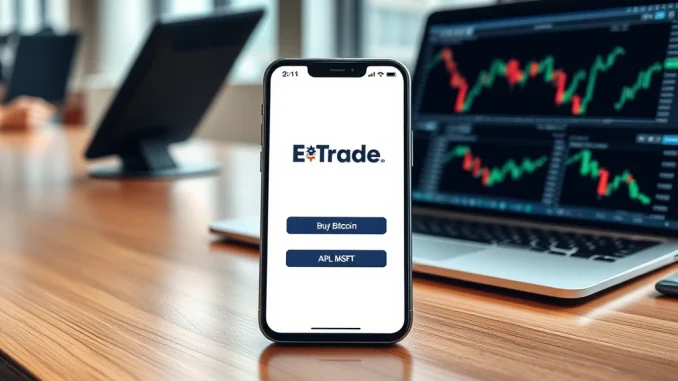
NEW YORK, NY – January 15, 2026 – In a landmark move for mainstream cryptocurrency adoption, the online brokerage giant E*TRADE has officially confirmed plans to launch direct spot Bitcoin trading for its millions of retail customers in early 2026. This strategic initiative, developed through a pivotal collaboration with parent company Morgan Stanley and its technology partner Zerohash, represents the most significant integration of native digital asset trading by a major traditional retail brokerage to date. The announcement, first reported by Live Bitcoin News, signals a profound shift in how established financial institutions are approaching cryptocurrency accessibility for the average investor.
E*TRADE’s 2026 Bitcoin Trading Rollout and Morgan Stanley’s Backend
According to internal documentation and confirmed sources familiar with the roadmap, E*TRADE will integrate spot Bitcoin trading directly into its existing brokerage platform during the first quarter of 2026. Consequently, users will not need separate crypto exchange accounts. The infrastructure powering this service stems from Morgan Stanley’s deep investment in Zerohash, a regulated crypto trading and settlement platform. Furthermore, Morgan Stanley is concurrently developing a proprietary self-sovereign Bitcoin custody solution. This dual-track development aims to position the bank as the first major financial institution with a fully native, vertically integrated digital asset exchange stack—from custody to execution.
Industry analysts point to the gradual regulatory clarity established by the U.S. Securities and Exchange Commission’s (SEC) approval of multiple spot Bitcoin ETFs in 2024 as a critical enabler. “The ETF approvals created a regulated precedent and a massive influx of institutional liquidity,” explains Marcus Thielen, Head of Research at CryptoQuant. “Now, brokerages like E*TRADE are leveraging that infrastructure to offer the underlying asset itself. It’s a logical, yet revolutionary, next step.” The planned rollout follows a phased testing period with select high-net-worth clients on Morgan Stanley’s platform throughout 2025.
Impact on Millions of Retail Investors and the Crypto Landscape
The immediate impact of this move is staggering in scale. E*TRADE services over 7 million retail client accounts with more than $1 trillion in assets. Therefore, introducing a seamless, familiar interface for Bitcoin purchases fundamentally lowers the technical barrier to entry for a massive segment of the investing public. This development is poised to catalyze a new wave of retail demand distinct from the ETF-driven institutional wave of the mid-2020s.
- Democratized Access: Investors can buy, sell, and hold Bitcoin alongside their stocks, ETFs, and options in a single, trusted account, eliminating the need for transfers to external crypto exchanges.
- Enhanced Perceived Security: Morgan Stanley’s development of self-sovereign custody addresses a primary retail concern—asset security. The promise of bank-level security protocols for private keys is a powerful trust signal.
- Market Structure Shift: This move pressures other major retail brokerages (e.g., Charles Schwab, Fidelity Investments) to accelerate or expand their own direct crypto offerings, potentially standardizing such features across the industry.
Expert Analysis on the Strategic Pivot
The decision reflects a calculated evolution in traditional finance’s approach. Sarah Brennan, a fintech analyst at Forrester Research, notes, “This isn’t just adding a new ticker symbol. It’s about building a native competency. Morgan Stanley isn’t just reselling a third-party service; they’re building the plumbing. That gives them control over the user experience, compliance, and ultimately, the economic model.” Brennan emphasizes that the Zerohash collaboration provides the necessary regulatory and technological rails, allowing the bank to focus on integration and client-facing features.
An official from the Securities Industry and Financial Markets Association (SIFMA), speaking on background, indicated that member firms have been actively preparing for this convergence for years. “The operational and regulatory frameworks are now maturing to a point where large-scale retail offering is not just possible, but competitive,” the official stated. This perspective underscores a broader institutional readiness that extends beyond any single firm.
Broader Context: The Evolving Traditional Finance Crypto Roadmap
E*TRADE’s announcement is the latest node in a multi-year sequence of traditional finance (TradFi) embracing digital assets. The progression has moved from custody services for institutions, to Bitcoin futures trading, to spot Bitcoin ETFs, and now to direct retail spot trading. This trajectory highlights a pattern of de-risking and incremental adoption by large entities.
| Phase | Timeframe | Key Development | Primary Audience |
|---|---|---|---|
| Custody & Institutional Access | 2020-2023 | Banks like BNY Mellon offer crypto custody; hedge fund products launch. | Institutions, HNW Individuals |
| Derivatives & ETFs | 2023-2025 | CFTC-regulated futures; SEC-approved spot Bitcoin ETFs (e.g., BlackRock, Fidelity). | Institutional & Retail (via ETFs) |
| Direct Retail Integration | 2026+ | Brokerages like E*TRADE embed spot trading natively into retail platforms. | Mass Retail Investors |
This phased approach allowed firms to manage regulatory scrutiny, develop technical expertise, and gauge client demand at each step. The 2026 target for E*TRADE suggests the industry views the post-ETF landscape as the stable foundation required for this final retail step.
The Next Stage: What Follows the Initial Bitcoin Launch?
Sources indicate that the “next stage of the crypto roadmap” at E*TRADE is already under active consideration. While the initial launch focuses exclusively on Bitcoin, internal discussions reportedly include the potential addition of other digital assets, staking rewards services for proof-of-stake cryptocurrencies, and even integration with decentralized finance (DeFi) protocols through secure, curated interfaces. The success and regulatory feedback from the Bitcoin rollout will directly shape the pace and scope of these subsequent phases.
Market and Competitor Reactions
Following the news, shares of other publicly traded crypto-adjacent companies showed mixed reactions. Pure-play crypto exchanges face the long-term challenge of competing with the convenience and trust of integrated brokerage accounts. Conversely, companies providing B2B infrastructure to TradFi firms, like Zerohash, saw increased analyst interest. Meanwhile, competitor brokerages have remained publicly quiet but are almost certainly reassessing their own timelines. The consensus among observers is that E*TRADE’s move will trigger a wave of similar announcements within 12-18 months, creating a new baseline expectation for retail investing platforms.
Conclusion
The confirmation of E*TRADE’s spot Bitcoin trading launch for 2026 marks a pivotal inflection point in finance. It represents the culmination of years of infrastructure development and regulatory navigation by traditional institutions like Morgan Stanley. For the average investor, it promises simplified, secure access to digital assets within a familiar environment. For the market, it heralds a new era of liquidity and legitimacy, further blurring the line between traditional and digital finance. The key takeaway is that cryptocurrency access is rapidly shifting from a niche, technical pursuit to a standard feature of mainstream investment accounts. Observers should watch the Q1 2026 rollout closely, as its execution and reception will set the template for the entire retail brokerage industry’s future.
Frequently Asked Questions
Q1: When exactly will E*TRADE users be able to trade Bitcoin?
The launch is scheduled for early 2026, with a phased rollout likely starting in Q1. Exact dates will be announced closer to the launch, following final regulatory approvals and system testing.
Q2: How will this be different from buying a Bitcoin ETF on E*TRADE?
Buying spot Bitcoin means you directly own the cryptocurrency asset itself, held in custody for you. An ETF is a stock that tracks Bitcoin’s price. Direct ownership may offer different tax implications and eliminates the ETF’s management fee, but involves direct custody of the asset.
Q3: What is Morgan Stanley’s “self-sovereign custody,” and why does it matter?
It refers to a custody system where the bank holds the cryptographic private keys to clients’ Bitcoin, but with architecture that potentially gives clients more control or verification rights than traditional third-party custody. It matters because it aims to combine bank-level security with the core ownership principles of cryptocurrency.
Q4: Will this make Bitcoin investing safer for regular people?
It addresses a major safety concern—secure storage—by leveraging a large bank’s security infrastructure. However, Bitcoin’s price volatility remains an inherent investment risk, regardless of where it is held.
Q5: Does this mean other cryptocurrencies like Ethereum will be added later?
While the initial launch is confirmed only for Bitcoin, E*TRADE has stated the “next stage” of its crypto roadmap is under consideration. Expansion to other major digital assets is a logical future possibility, contingent on the initial launch’s success and regulatory developments.
Q6: How does this affect existing cryptocurrency exchanges like Coinbase?
In the long term, it introduces significant competition for retail market share by offering extreme convenience. Exchanges may need to compete more aggressively on advanced features, global asset selection, or lower fees for active traders to differentiate themselves.
Updated insights and analysis added for better clarity.
This article was produced with AI assistance and reviewed by our editorial team for accuracy and quality.