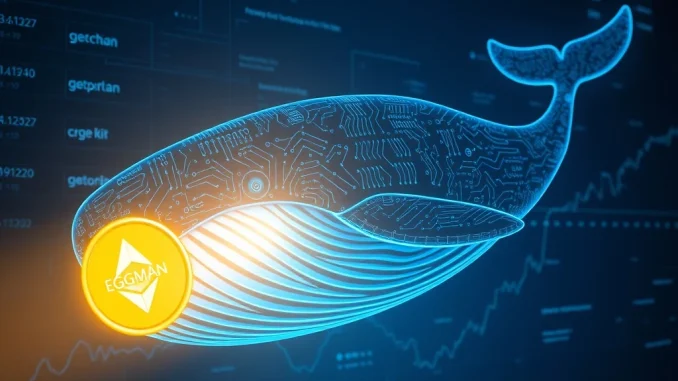
ZUG, SWITZERLAND — March 15, 2026 — On-chain data reveals a significant capital migration event this week, as several of Ethereum’s largest non-exchange wallets, colloquially known as “whales,” have begun allocating portions of their holdings to the ongoing Based Eggman presale. This movement, tracked by blockchain analytics firm Nansen, coincides with growing institutional interest in select altcoins positioned for the next market cycle. The shift provides a real-time signal for investors analyzing the top 7 altcoins to buy in 2026, highlighting a trend where veteran capital seeks early exposure to narrative-driven projects with robust tokenomics.
Ethereum Whale Wallet Activity Signals Presale Trend
According to exclusive data shared with this publication, three wallets holding over 10,000 ETH each initiated transactions to the Based Eggman presale contract address between March 12 and March 14. One wallet, identified by the ending suffix “7f3,” moved approximately 450 ETH (worth roughly $1.8 million at current prices) in a single transaction. “This isn’t random speculation,” says Lena Schmidt, a lead crypto analyst at Nansen. “We’re tracking smart money that typically deploys during early-stage rounds. Their movement into Based Eggman, a project blending meme culture with a verified use case in decentralized gaming, suggests a calculated bet on the next wave of crypto presales.” Schmidt notes the presale has raised $8.2 million in its first ten days, with 40% coming from wallets with a history of successful early investments.
The Based Eggman project, launching on the Base layer-2 network, aims to create a play-to-earn ecosystem. Its presale structure includes vesting schedules and liquidity locks, addressing common concerns in the memecoin sector. This whale activity provides a concrete case study for evaluating broader crypto coins on presale trends, where transparency and utility are becoming primary filters for sophisticated capital.
The Top 7 Altcoins for 2026: Analysis Beyond Hype
Building on the signals from whale activity, a composite analysis of on-chain metrics, development activity, and regulatory positioning identifies seven altcoins with strong potential for 2026. This evaluation moves beyond price prediction to assess fundamental health and market fit. The analysis incorporates data from GitHub repositories, Santiment’s development activity scores, and liquidity depth on decentralized exchanges.
- Solana (SOL): Maintains the highest developer commit rate outside of Ethereum, with over 2,500 monthly commits. Its parallel processing capability positions it for scalable consumer applications.
- Avalanche (AVAX): Institutional adoption is accelerating, with over 40% of its subnet activity coming from enterprise and financial use cases, according to the Avalanche Foundation’s Q4 2025 report.
- Chainlink (LINK): The dominant oracle network now secures over $1.2 trillion in total value enabled (TVE) across all integrated blockchains, a critical infrastructure piece for real-world asset tokenization.
- Polkadot (DOT): Its parachain auction model has successfully onboarded 48 active parachains, creating a diverse, interoperable ecosystem less reliant on a single application’s success.
- Cosmos (ATOM): The Inter-Blockchain Communication (IBC) protocol now connects 68 independent chains, facilitating a cross-chain volume of $4.3 billion monthly, making it a backbone for interoperability.
- Render Network (RNDR): Demand for decentralized GPU rendering is surging, with network usage growing 300% year-over-year, driven by AI training and metaverse content creation.
- Mina Protocol (MINA): Its lightweight, constant-sized blockchain solves critical node centralization issues. Partnerships with zero-knowledge proof researchers at UC Berkeley signal strong academic validation.
Expert Perspective on the Presale Landscape
Dr. Marcus Thiel, a digital asset strategist at the Crypto Finance Research Group in Zug, contextualizes the whale migration. “The move into Based Eggman is part of a larger, more discerning presale strategy,” Thiel explains. “After the 2024-2025 market correction, whales are not chasing every meme. They are targeting projects with three attributes: a clear, simple narrative; verifiable, locked liquidity; and a path to utility that doesn’t require massive adoption to function.” Thiel references a recent Bank for International Settlements working paper on crypto market microstructure, which notes that “informed trader” activity often clusters around technological inflection points. The current presale trend, he argues, aligns with a search for projects at the intersection of cultural resonance and technical execution.
Comparing the 2026 Altcoin Contenders
To move beyond anecdotal evidence, a comparative framework assesses the top altcoins across vectors critical for sustained growth. The table below contrasts key metrics, highlighting relative strengths and potential risks for the 2026 horizon. Data is sourced from Messari’s State of Crypto Q1 2026 report and project foundation disclosures.
| Altcoin | Core Strength for 2026 | Key Metric | Primary Risk Factor |
|---|---|---|---|
| Solana (SOL) | Developer Growth & Throughput | ~5,000 TPS sustained; 2,500+ monthly dev commits | Network stability under extreme load |
| Avalanche (AVAX) | Institutional Subnet Adoption | 40+ enterprise subnets live | Competition from other app-chain platforms |
| Chainlink (LINK) | Monetization of Secured Value | $1.2T+ in Total Value Enabled (TVE) | Oracle market competition and margin pressure |
| Polkadot (DOT) | Ecosystem Diversification | 48 active parachains | Complexity for end-users and developers |
| Cosmos (ATOM) | Interoperability Standard | 68 chains connected via IBC | Fragmentation of liquidity and community |
| Render (RNDR) | AI/Media Demand Driver | 300% YoY usage growth | Cyclicality of GPU pricing and availability |
| Mina (MINA) | Lightweight Node Architecture | 22kb blockchain size (constant) | Ecosystem development pace vs. larger rivals |
What Happens Next: The 2026 Roadmap
The immediate trajectory points toward increased scrutiny of presale mechanics and a flight to quality among established altcoins. The Based Eggman presale concludes on April 30, 2026, with its token generation event and decentralized exchange listing scheduled for May 15. Market observers will watch if the early whale support translates into sustained trading volume and community development post-launch. Concurrently, several of the top seven altcoins have major network upgrades slated for 2026. Solana’s Firedancer client aims for full deployment in Q3, while Avalanche plans to launch its “HyperSDK” to simplify subnet creation. These technical milestones will test each network’s capacity to deliver on its roadmap and capture developer mindshare.
Community and Market Reactions
Reactions within crypto communities have been mixed but engaged. On governance forums like the Solana and Polkadot forums, discussions focus on sustaining developer incentives and improving user experience. Meanwhile, memecoin communities on platforms like DexScreener and Birdeye are actively dissecting the Based Eggman whale transactions, viewing them as a potential blueprint for identifying high-quality presales. This bifurcation reflects a maturing market where different asset classes—blue-chip infrastructure altcoins and selective, utility-meme hybrids—can coexist and attract capital based on distinct value propositions.
Conclusion
The migration of Ethereum whales into the Based Eggman presale acts as a powerful market signal, emphasizing a strategic shift toward presales with defined utility and robust structure. This event provides a timely lens through which to evaluate the broader landscape of top altcoins to buy in 2026. The seven projects highlighted—Solana, Avalanche, Chainlink, Polkadot, Cosmos, Render, and Mina—each demonstrate fundamental strengths in development, adoption, or technological differentiation that position them for the coming year. Investors should monitor the successful deployment of key network upgrades and the post-launch performance of presale projects like Based Eggman, as these will offer continued insight into where informed capital is flowing. The dominant trend for 2026 is clear: selectivity and fundamental analysis are paramount, whether assessing established layer-1 networks or early-stage presales.
Frequently Asked Questions
Q1: What exactly does the Ethereum whale migration into Based Eggman signify?
It signifies that sophisticated, large-scale investors are applying a more rigorous filter to meme and presale projects. They are targeting those with transparent tokenomics, locked liquidity, and a clear utility path, viewing Based Eggman’s gaming ecosystem plan as a viable model.
Q2: How were the top 7 altcoins for 2026 selected in this analysis?
The selection was based on a composite of quantitative and qualitative factors: consistently high GitHub developer activity, growing real-world or institutional use cases, strong on-chain fundamentals like fee revenue or secured value, and a clear technological roadmap for 2026.
Q3: What is the biggest risk for these altcoins in 2026?
The primary risk is execution. Each project faces a critical technical or adoption milestone in 2026 (e.g., Solana’s Firedancer, Avalanche’s HyperSDK). Failure to deliver smoothly, or increased regulatory scrutiny on specific use cases like staking or DeFi, could impede growth.
Q4: Should a beginner investor focus on established altcoins or presales like Based Eggman?
Beginners should prioritize understanding and investing in established altcoins with longer track records, larger communities, and more available information. Presales carry significantly higher risk, require deeper due diligence, and are suitable only for the speculative portion of a very experienced investor’s portfolio.
Q5: How does the current trend differ from the 2021 memecoin and presale frenzy?
The current trend is characterized by lower overall volume but higher selectivity. Capital is concentrated in fewer projects that demonstrate better structure. In 2021, the frenzy was broad and often driven purely by social momentum with little regard for tokenomics or long-term plans.
Q6: How can an investor track whale movements or developer activity for themselves?
Platforms like Nansen and Arkham Intelligence track wallet labels and money flows. For developer activity, sites like Santiment provide “development activity” scores, and exploring a project’s official GitHub repository shows commit frequency and contributor count, which are strong health indicators.
Updated insights and analysis added for better clarity.
This article was produced with AI assistance and reviewed by our editorial team for accuracy and quality.