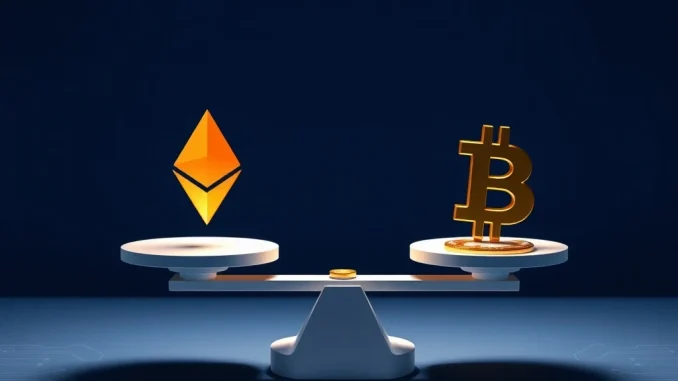
March 15, 2026 — Global cryptocurrency markets continue to scrutinize Ethereum’s foundational economic thesis as new data reveals a stark performance divergence. Since Ethereum’s landmark transition to Proof-of-Stake in September 2022, Ether (ETH) has declined approximately 65% against Bitcoin (BTC), challenging the network’s “ultrasound money” narrative that promised superior scarcity dynamics. This underperformance, documented across multiple trading platforms through early 2026, raises fundamental questions about Ethereum’s monetary policy effectiveness and investor confidence in its deflationary mechanics. Market analysts point to reduced transaction fee burns and shifting network activity as primary factors undermining Ethereum’s scarcity proposition.
Ethereum’s Deflationary Promise Meets Market Reality
The “ultrasound money” concept emerged from Ethereum’s 2021 EIP-1559 upgrade and 2022 Merge, creating expectations that ETH would become scarcer than Bitcoin over time. Proponents argued that fee burning combined with reduced issuance would create consistent deflation. However, blockchain analytics platform Ultrasound.MONEY shows Ethereum’s annual supply growth has averaged approximately 0.23% since the Merge, though still below Bitcoin’s current 0.85% inflation rate. Crucially, Ethereum only achieves deflation when mainnet activity burns more coins than validators receive, a condition that has weakened significantly. This supply dynamic represents a core disconnect between theoretical design and practical economic outcomes.
Historical context reveals the narrative’s evolution. The “ultrasound money” terminology gained traction during 2021’s bull market, contrasting Ethereum’s adaptive supply with Bitcoin’s fixed schedule. Proponents highlighted periods of net deflation following high-fee environments. However, the sustainability of these conditions depended on maintaining expensive mainnet transactions, which conflicted with Ethereum’s scaling roadmap. This inherent tension between scaling through layer-2 solutions and maintaining deflationary pressure created what analysts now identify as a fundamental design contradiction.
Technical Factors Undermining Deflationary Mechanics
The erosion of Ethereum’s deflationary conditions stems from two interconnected technical developments. First, average transaction fees have plummeted to approximately $0.21 as of March 2026, representing a 54% decline year-over-year according to YCharts data. Lower fees directly reduce the ETH burned through EIP-1559’s base fee mechanism. Second, and more significantly, user activity has migrated en masse to layer-2 networks. L2beat metrics show rollups processing 926 user operations per second compared to just 22.36 on Ethereum’s mainnet. While this scaling success benefits network usability, it redirects fee revenue away from Ethereum’s burn mechanism.
- Fee Reduction Impact: Every dollar decrease in average transaction fees reduces annual ETH burn by approximately 15,000 ETH at current transaction volumes
- L2 Migration Effect: Approximately 97% of Ethereum ecosystem activity now occurs on layer-2s, drastically reducing mainnet fee generation
- Validator Issuance Consistency: Despite reduced burn, Ethereum continues issuing approximately 1,700 ETH daily to validators, creating persistent inflationary pressure
Analyst Perspectives on Monetary Policy Divergence
Market analysts attribute ETH’s underperformance to fundamental differences in monetary policy credibility. “Investors trust Bitcoin’s fixed supply because it’s predictable and resistant to change,” explains cryptocurrency analyst Handre, who has tracked the ETH/BTC pair since 2020. “Every scaling debate, every upgrade proposal, every attempt to change Bitcoin’s monetary policy has failed because the economic majority understands what they’re protecting.” This sentiment appears validated by institutional adoption patterns. U.S. spot Bitcoin ETFs held over $91.9 billion in assets under management as of March 2026, compared to approximately $12.1 billion for Ethereum ETFs according to Glassnode data.
Independent researcher Culper Research amplified concerns about insider activity in a March 2025 report, stating they maintained a short position on ETH due to periodic sales by Ethereum Foundation affiliates. “When insiders consistently distribute during strength rather than accumulate during weakness, it signals deeper structural issues,” the report noted. While Ethereum proponents argue these sales fund development, market perception has increasingly viewed them as reducing long-term conviction signals.
Comparative Performance Analysis: ETH vs. BTC Trajectories
The performance divergence extends beyond supply dynamics to fundamental investment theses. Between 2021 and 2026, ETH only marginally exceeded its previous all-time high near $4,800 before losing momentum. Bitcoin, meanwhile, doubled from its 2021 peak to establish new records in 2025. This disparity suggests reduced issuance alone cannot generate sustained demand without corresponding utility growth or store-of-value adoption. The comparison reveals deeper market positioning differences that have become increasingly pronounced.
| Metric | Ethereum (ETH) | Bitcoin (BTC) |
|---|---|---|
| Annual Supply Change (Post-Merge) | +0.23% average | +0.85% current |
| ETF AUM (March 2026) | $12.1 billion | $91.9 billion |
| ATH Performance (2021-2026) | Marginal exceedance | 100%+ growth |
| Monetary Policy Flexibility | Adaptive through governance | Fixed at protocol level |
Future Trajectory and Protocol Evolution
Ethereum’s development roadmap continues evolving, with potential implications for its monetary policy. The upcoming “Verge” and “Purge” upgrades aim to further reduce validator requirements and simplify protocol architecture. However, these technical improvements may not directly address the economic challenges highlighted by ETH’s underperformance. Core developers maintain that Ethereum’s value proposition extends beyond simple scarcity to encompass programmability and decentralized application support. This broader utility argument represents the primary counter-narrative to pure monetary comparisons.
Community and Developer Responses
Ethereum community reactions to the performance data have been mixed. Some developers argue that comparing ETH to BTC represents a fundamental category error, emphasizing Ethereum’s utility as a computational platform rather than pure digital gold. “Ethereum’s value derives from its ability to execute smart contracts and host decentralized applications,” noted Ethereum Foundation researcher Danny Ryan in a February 2026 technical discussion. “Monetary policy represents just one dimension of a multidimensional system.” Meanwhile, investor forums reveal growing skepticism about the “ultrasound money” terminology, with many community members advocating for more nuanced economic discussions.
Conclusion
Ethereum’s “ultrasound money” thesis faces significant challenges as real-world data contradicts initial expectations. The 65% decline in ETH/BTC since the Merge, combined with persistent supply growth and migrating network activity, suggests the deflationary narrative may have been overstated. While Ethereum continues to demonstrate technological leadership in smart contract platforms, its monetary policy credibility has not achieved parity with Bitcoin’s fixed-supply model. Investors should monitor upcoming protocol upgrades and layer-2 economic developments, as these may create new scarcity dynamics or alternative value propositions. The fundamental question remains whether Ethereum can establish a compelling monetary narrative beyond its undeniable technical achievements.
Frequently Asked Questions
Q1: What exactly is “ultrasound money” in the context of Ethereum?
“Ultrasound money” refers to the thesis that Ethereum could become more deflationary than Bitcoin through its EIP-1559 fee-burning mechanism combined with reduced Proof-of-Stake issuance. The term suggested ETH would achieve superior scarcity characteristics, but actual supply data has shown modest inflation averaging 0.23% annually since the Merge.
Q2: Why has ETH underperformed BTC so significantly since the Merge?
Multiple factors contribute: reduced transaction fees limit ETH burning, layer-2 migration redirects fee revenue, Bitcoin’s fixed supply attracts stronger institutional investment, and periodic insider sales have affected market sentiment. The underperformance represents both technical and psychological factors.
Q3: Can Ethereum become deflationary again in the future?
Yes, but only under specific conditions. Ethereum becomes deflationary when mainnet activity burns more ETH than validators receive in issuance. This requires either significantly higher transaction fees or reduced validator rewards through protocol changes. Both scenarios face practical challenges given current scaling directions.
Q4: How do layer-2 networks affect Ethereum’s economics?
Layer-2 networks like Arbitrum and Optimism process transactions off-chain while settling batches on Ethereum. This improves scalability and reduces user costs but redirects fee revenue away from Ethereum’s burn mechanism. While L2s pay Ethereum for security, the economic model differs from direct user transactions.
Q5: What are the main arguments against comparing ETH and BTC as monetary assets?
Proponents argue Ethereum serves as a computational platform and smart contract ecosystem rather than pure digital gold. They emphasize utility value from decentralized applications, tokenization, and programmable money rather than simple scarcity metrics. This perspective views monetary comparisons as incomplete.
Q6: How might Ethereum’s upcoming upgrades affect its monetary policy?
The “Verge” upgrade introduces Verkle trees to reduce validator hardware requirements, potentially allowing more participants. The “Purge” upgrade simplifies protocol architecture and reduces historical data storage. While these improve technical performance, their direct impact on monetary policy remains limited without specific economic parameter changes.