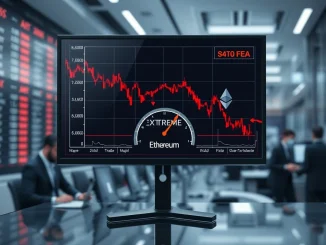
On March 15, 2026, global cryptocurrency markets witnessed a significant technical move as Ethereum (ETH) executed a decisive sweep of its recent trading range highs. Following a reclaim of its complete range Point of Control (POC), the second-largest digital asset by market capitalization reversed sharply, placing immediate focus on a potential retest of the $1,967 Fair Value Gap (FVG). This price action, captured across major exchanges including Coinbase and Binance, represents a critical juncture for ETH’s near-term trajectory, with traders now scrutinizing whether the asset will consolidate at this level before attempting its next upside target near $2,100. The move triggered a surge in trading volume, exceeding $18 billion in 24-hour spot and derivatives activity, according to data from CoinMarketCap.
Ethereum’s Technical Breakout and the $1,967 Pivot
The sequence began in the early Asian trading session on March 15. Ethereum price, which had been consolidating between $1,850 and $1,920 for the preceding week, gathered momentum to break above the range’s upper boundary. Crucially, this move first reclaimed the volume-weighted average price (the POC) of the entire consolidation range, a key level watched by institutional quantitative funds. “The reclaim of the POC was the initial signal that buyer interest was sustained, not just a liquidity grab,” noted Marcus Thielen, Head of Research at crypto analytics firm Matrixport. However, the subsequent sweep of the range high near $1,950 and the sharp rejection that followed created a classic “bull trap” scenario on lower timeframes, immediately drawing the $1,967 FVG into focus as the next logical support zone for a healthy pullback.
This technical pattern is not occurring in a vacuum. It follows a broader market structure shift that began in late February 2026, after the successful implementation of Ethereum’s latest protocol upgrade, “Prague/Electra.” The upgrade, which further optimized gas fees for certain transaction types, has contributed to a 15% quarter-over-quarter increase in network activity, as reported by blockchain analytics provider Glassnode. This fundamental improvement in utility has provided a underlying bid for ETH, separating its price action from pure speculative moves and anchoring trader expectations around higher valuation floors.
Market Impact and Trader Positioning
The immediate impact of ETH’s price sweep resonated across derivative markets. Data from Coinglass shows that the initial move above $1,920 triggered over $45 million in short liquidations, the largest such cluster in the ETH futures market in two weeks. Conversely, the swift reversal led to nearly $30 million in long liquidations, indicating a highly leveraged and tense trading environment. “The market is clearly testing conviction,” said Luka Janković, a derivatives trader at Genesis Trading. “Open Interest remains elevated, suggesting this isn’t a capitulation event but a realignment of leverage ahead of the next directional move. The $1,967 level is now the line in the sand for many systematic strategies.”
- Liquidity Flush: The sweep effectively cleared out stop-loss orders clustered above the range high, a necessary step for a sustainable uptrend by removing immediate sell-side pressure.
- Funding Rate Adjustment: Perpetual swap funding rates, which had turned significantly positive, cooled to neutral following the reversal, reducing the cost for bulls to maintain positions.
- Options Activity: The options market saw a spike in demand for $1,900 and $1,950 put options for end-of-month expiry, reflecting hedging activity against a deeper pullback, while call option interest concentrated at the $2,100 strike.
Institutional and Analyst Perspectives
Reaction from institutional analysts has been measured, focusing on macro-technical factors. In a research note dated March 14, 2026, JPMorgan Chase analysts, led by Nikolaos Panigirtzoglou, highlighted Ethereum’s improving relative strength against Bitcoin, citing the ETH/BTC cross rate’s hold above a key 18-month trendline. They stopped short of issuing a new price target but noted that “on-chain metrics suggest accumulation by large addresses (>10,000 ETH) has accelerated in Q1 2026.” Separately, David Lawant, Head of Research at FalconX, provided context: “This price action fits a historical pattern. In the three previous major upgrade cycles, ETH has experienced a volatile expansion phase approximately 30-45 days post-upgrade as the market prices in the realized utility gains. The $1,900-$2,000 zone was a massive resistance cluster in 2025; seeing it become support is technically constructive.”
Broader Cryptocurrency Context and Historical Precedent
Ethereum’s move occurs amidst a mixed landscape for digital assets. While Bitcoin has struggled to reclaim its December 2025 highs, trading in a tight corridor, several Ethereum-based Layer 2 scaling solutions and DeFi tokens have outperformed. This suggests a rotation of capital within the crypto ecosystem rather than a broad-based rally. A comparison of post-upgrade performance periods reveals telling patterns about market psychology and valuation resets.
| Ethereum Upgrade | Time to Volatility Expansion | Price Range Before Break | Subsequent 30-Day Performance |
|---|---|---|---|
| London (EIP-1559) | ~22 days | +18% | +42% |
| The Merge (PoS Transition) | ~60 days | -12% | +28% |
| Shanghai/Capella (Withdrawals) | ~35 days | +5% | +15% |
| Prague/Electra (2026) | ~40 days (Current) | +8% (Current) | TBD |
The current period aligns closely with the historical precedent set by the Shanghai upgrade, where a period of consolidation and volatile range expansion preceded a sustained trending move. Furthermore, regulatory clarity from jurisdictions like the European Union, whose Markets in Crypto-Assets (MiCA) regulations fully came into force in January 2026, has provided a more stable institutional backdrop for Ethereum’s core use cases in decentralized finance and tokenization.
Forward-Looking Analysis: Pathways to $2,100 and Beyond
The immediate roadmap for Ethereum price action hinges on the market’s behavior around the $1,967 FVG. A successful retest and hold of this level, defined by a higher low on the 4-hour chart, would establish it as a new support floor and likely catalyze a second attempt at the recent highs. Failure to hold, particularly a daily close below $1,900, would signal a deeper correction is underway, potentially targeting the $1,820-$1,850 zone where the 50-day and 200-day simple moving averages converge. The next major scheduled catalyst is the quarterly expiration of ETH options and futures on March 28, 2026, which often leads to increased volatility and pinning behavior around key strike prices, with $1,900 and $2,000 holding the largest open interest.
Community and Developer Ecosystem Response
Within the Ethereum developer community, the price volatility has been met with characteristic focus on network health. Tim Beiko, a core Ethereum protocol coordinator, remarked on a community call that “fee market dynamics post-upgrade are performing within expected parameters,” which is the primary concern for builders. The sentiment among decentralized application (dApp) teams, as gauged by discussions on developer forums like Ethereum Magicians, remains bullish on long-term adoption, viewing short-term price fluctuations as secondary to the continued growth in daily active users and total value locked in smart contracts, which has risen 7% since the start of the year.
Conclusion
Ethereum’s sweep of range highs and subsequent reversal on March 15, 2026, represents a critical technical inflection point. The successful reclaim of the Point of Control indicates underlying buyer strength, but the sharp pullback underscores the market’s immediate focus on the $1,967 Fair Value Gap retest. This price action is consistent with historical post-upgrade volatility patterns and reflects a market digesting fundamental improvements against a backdrop of high leverage. Traders should monitor the $1,967 level closely; a sustained defense there would keep the path toward the $2,100 upside target viable, while a breakdown could extend the consolidation phase. The interplay between on-chain utility growth, derivative market positioning, and broader macroeconomic conditions will ultimately determine whether this technical move marks the beginning of a new leg higher or a prolonged range-bound period for Ethereum.
Frequently Asked Questions
Q1: What does “sweeping the range highs” mean for Ethereum?
In technical analysis, “sweeping” refers to a price move that briefly pushes beyond a known level of resistance (the range high) to trigger stop-loss orders and liquidations before reversing. For Ethereum on March 15, this was a move above $1,950 that cleaned out seller liquidity, a common step before a potential sustained breakout.
Q2: Why is the $1,967 level specifically important now?
The $1,967 zone is identified as a Fair Value Gap (FVG)—an area on the chart where price moved so rapidly it left an imbalance between buyers and sellers. Technical traders expect price to often return to “fill” these gaps. It now acts as a key support test following the recent rejection from higher prices.
Q3: What is the significance of reclaiming the Point of Control (POC)?
The Point of Control is the price level with the highest trading volume over a specified period. Reclaiming it signals that the market is accepting value at that higher level, shifting the volume profile from resistance to potential support, which is a bullish structural development.
Q4: How does the recent Prague/Electra upgrade affect Ethereum’s price?
While not directly causing price moves, the upgrade improves network efficiency and reduces costs for certain transactions. This enhances Ethereum’s fundamental utility, which can attract long-term investment and usage, creating a more positive fundamental backdrop that supports higher valuations.
Q5: What happens if Ethereum fails to hold the $1,967 support?
A decisive break and daily close below $1,967, especially on high volume, would indicate the recent breakout attempt has failed. The next major support zones would likely be found between $1,820 and $1,850, where several longer-term moving averages and previous consolidation lows converge.
Q6: How are institutional traders reacting to this price action?
Data from futures and options markets shows institutions are actively hedging. While some leveraged short positions were liquidated on the initial spike, the subsequent reversal led to long liquidations. Overall, Open Interest remains high, indicating professional traders are engaged and viewing this as a significant battleground for direction, not a reason to exit the market entirely.
Updated insights and analysis added for better clarity.
This article was produced with AI assistance and reviewed by our editorial team for accuracy and quality.