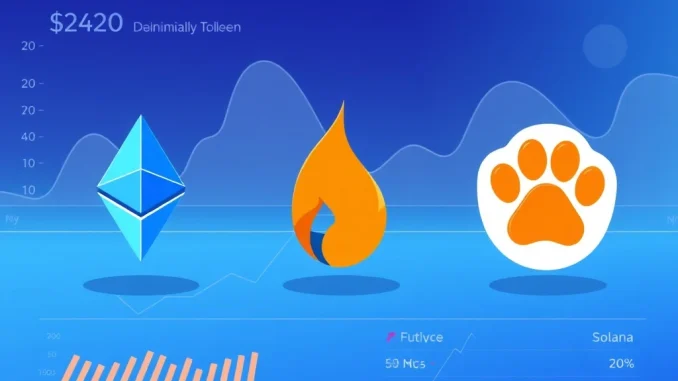
Global, May 2025: The cryptocurrency landscape continues to evolve at a rapid pace, with established networks and newer projects charting distinct paths. This analysis provides a detailed, experience-driven examination of the projected trajectories for three notable assets: Ethereum (ETH), Solana (SOL), and Furrever Token (FURR) through 2026. We will explore their underlying technology, market context, and the factors that analysts consider when formulating potential return on investment (ROI) roadmaps, including the anticipated impact of Solana’s Alpenglow upgrade.
Understanding the 2026 Cryptocurrency Landscape and Investment Thesis
Evaluating any digital asset requires moving beyond short-term price speculation. A robust analysis considers technological milestones, ecosystem growth, regulatory developments, and macroeconomic conditions. The period leading to 2026 is expected to be defined by several key themes: the maturation of layer-2 scaling solutions, the integration of real-world assets (RWAs) on-chain, and the ongoing debate between monolithic and modular blockchain architectures. Furthermore, the potential for spot ETF approvals for assets beyond Bitcoin could significantly alter institutional capital flows. This framework provides the essential context for assessing individual projects. Investors and observers typically construct ROI roadmaps by modeling potential adoption curves against tokenomics, including supply issuance schedules and utility-driven demand.
Ethereum (ETH): The Established Ecosystem and Its Evolutionary Path
Ethereum maintains its position as the dominant smart contract platform by total value locked (TVL) and developer activity. Its roadmap for 2026 centers on the continued execution of its post-Merge vision, focusing on scalability, security, and sustainability. The primary technological driver is the full rollout of proto-danksharding through Ethereum Improvement Proposal (EIP) 4844 and subsequent upgrades. This aims to drastically reduce layer-2 transaction fees, potentially catalyzing a new wave of decentralized applications (dApps). Analysts modeling ETH’s potential ROI through 2026 often factor in the network’s fee-burning mechanism (EIP-1559), which can make the asset deflationary during periods of high congestion. However, challenges remain, including the complexity of future upgrades and competitive pressure from faster, lower-cost chains. The potential approval and success of a spot Ethereum ETF in key markets like the United States is another critical variable in most long-term forecasts, as it could unlock substantial institutional investment.
The Role of Layer-2 Networks and Staking Dynamics
Ethereum’s scalability strategy is inherently tied to its layer-2 ecosystem, including Arbitrum, Optimism, and zkSync. The health and adoption of these networks directly contribute to Ethereum’s security demand and fee revenue. Furthermore, the growth of liquid staking derivatives (LSDs) like Lido’s stETH has created a complex financial layer atop Ethereum’s proof-of-stake consensus. By 2026, the percentage of ETH staked is projected to increase, influencing both network security and the circulating supply available on exchanges. Any ROI analysis must account for staking yields, which provide a baseline return for holders independent of price appreciation, and the potential regulatory treatment of staking services.
Solana (SOL): High-Performance Focus and the Alpenglow Upgrade
Solana has distinguished itself through its high-throughput, low-fee architecture, attracting significant development in decentralized finance (DeFi), non-fungible tokens (NFTs), and consumer applications. Its roadmap toward 2026 is heavily focused on optimizing network reliability and scalability. The most anticipated technical event is the implementation of the Alpenglow upgrade, a major network enhancement. While specific technical specifications are published by the Solana Foundation, upgrades like Alpenglow typically aim to improve transaction processing efficiency, validator client performance, and overall network stability. Successful implementation could strengthen network resilience against past congestion issues, a key concern for investors. Solana’s ROI potential through 2026 is frequently linked to its ability to capture specific market segments that prioritize speed and low cost, such as micropayments, high-frequency trading dApps, and scalable social media platforms. Its monolithic structure offers a different trade-off compared to Ethereum’s modular approach, appealing to developers seeking an all-in-one solution.
Evaluating Ecosystem Growth and Validator Decentralization
Beyond price, Solana’s health can be measured by metrics like monthly active addresses, daily transaction volume, and the diversity of its dApp ecosystem. The growth of its own layer-2 and app-chain solutions, such as the SVM (Solana Virtual Machine) ecosystem, could also play a role. Another critical factor for long-term viability is progress in validator decentralization. A more geographically and entity-diverse validator set enhances network security and censorship resistance. Analysts monitoring Solana’s roadmap for 2026 will watch for improvements in these areas as much as for raw transaction per second (TPS) figures, as they contribute to the network’s fundamental robustness.
Furrever Token (FURR): Analyzing the Meme Coin Phenomenon and Project Roadmap
Furrever Token (FURR) represents a different segment of the cryptocurrency market: the meme coin. Unlike Ethereum or Solana, which are foundational blockchain platforms, FURR’s value proposition is primarily community-driven and cultural. Its stated roadmap for 2026 likely involves phases of marketing, community engagement initiatives, and potential utility expansions within its own ecosystem, such as NFT integrations or community treasury governance. Assessing the ROI potential for a token like FURR involves analyzing different variables compared to infrastructure-layer assets. Key factors include the longevity and engagement of its community, the effectiveness of its tokenomics in preventing rapid sell-pressure, and its ability to maintain relevance in a highly speculative and fast-moving niche. Historically, meme coins have exhibited extreme volatility, with valuations heavily influenced by social media trends, influencer endorsements, and broader market sentiment toward risk-on assets. Any credible analysis must highlight these inherent risks and the speculative nature of such investments.
The Importance of Tokenomics and Liquidity in Meme Coins
For tokens like FURR, the specific tokenomic structure is paramount. This includes the total supply, the allocation to developers and marketing, the vesting schedules for team tokens, and the mechanisms for liquidity provision. A transparent and locked liquidity pool is often cited by communities as a sign of project commitment. Furthermore, the deployment network (e.g., whether FURR is an ERC-20 token on Ethereum or a SPL token on Solana) affects its transaction costs and accessible user base. Potential investors are advised to scrutinize the project’s official documentation and smart contract audits, where available, to understand these foundational elements before considering any investment thesis through 2026.
Comparative Risk Breakdown and Concluding Analysis
A balanced guide must conclude with a clear-eyed risk assessment. The following table outlines the primary risk categories applicable to these assets, though it is not exhaustive.
| Risk Category | Ethereum (ETH) | Solana (SOL) | Furrever Token (FURR) |
|---|---|---|---|
| Technology & Execution | Complexity of future upgrades; L2 fragmentation. | Network stability; successful delivery of Alpenglow and other upgrades. | Lack of fundamental utility; reliance on community sentiment. |
| Market & Competition | Rise of alternative smart contract platforms. | Intense competition in the high-performance blockchain space. | Extreme volatility; competition from thousands of other meme coins. |
| Regulatory | Classification as a security; staking regulations. | Similar regulatory uncertainty as other major tokens. | High regulatory scrutiny on meme coins and unregistered securities. |
| Liquidity & Financial | Generally high liquidity; subject to broad market cycles. | High liquidity; can be correlated with high-beta tech assets. | Typically lower liquidity; potential for high slippage and manipulation. |
In summary, the cryptocurrency trends leading into 2026 present a landscape of both consolidation and innovation. Ethereum’s path hinges on scaling its base layer while nurturing its L2 ecosystem. Solana’s trajectory is closely tied to proving unparalleled reliability and throughput with upgrades like Alpenglow. Assets like Furrever Token operate in a separate, highly speculative domain where community dynamics are the primary driver. Constructing a coherent ROI roadmap for any of these requires understanding their distinct technological foundations, market positions, and risk profiles. Informed participants will continue to monitor on-chain metrics, development activity, and regulatory developments far more closely than price charts alone.
FAQs
Q1: What is the main focus of Ethereum’s development roadmap for 2026?
Ethereum’s core development focus, often called “The Surge,” is on scaling through proto-danksharding (EIP-4844). This aims to massively reduce data costs for layer-2 rollups, making transactions faster and cheaper for end-users while maintaining the security of the main Ethereum chain.
Q2: What is the Solana Alpenglow upgrade expected to achieve?
While exact details are finalized by core developers, the Alpenglow upgrade is anticipated to be a major network-wide enhancement focused on improving validator client performance, transaction processing efficiency, and overall network stability and resilience.
Q3: How do analysts create an ROI roadmap for a cryptocurrency?
Analysts build ROI roadmaps by creating models that incorporate both quantitative and qualitative factors. These include projected user adoption, network fee revenue, token emission/inflation schedules, potential new utility, macroeconomic conditions, and comparative valuation metrics against similar assets.
Q4: Why are meme coins like Furrever Token considered high-risk investments?
Meme coins are typically considered high-risk due to their extreme price volatility, lack of intrinsic utility or cash flow, heavy reliance on social media hype and community sentiment, and potential for low liquidity, which can lead to significant price slippage.
Q5: What is a key difference between evaluating Ethereum/Solana and a meme coin?
The evaluation of Ethereum and Solana primarily focuses on fundamental metrics like network usage, developer activity, technological progress, and total value secured. Evaluating a meme coin primarily focuses on community strength, social media trends, tokenomic structure, and liquidity provisions, with less emphasis on underlying technological utility.
This article was produced with AI assistance and reviewed by our editorial team for accuracy and quality.