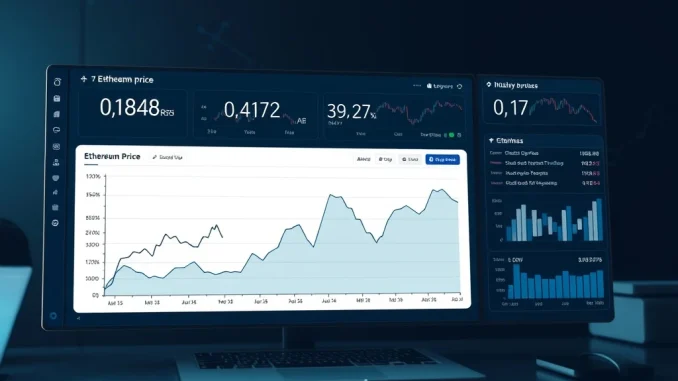
Global, May 2025: A critical on-chain metric for Ethereum, the Market Value to Realized Value (MVRV) ratio, has declined to 0.87, a level historically associated with cycle lows. This movement suggests a potential market bottom forming around the $1,959 price point. Concurrent on-chain data reveals significant accumulation by large-scale investors, commonly referred to as whales, adding a layer of corroborative evidence to this technical signal. This development provides a data-driven focal point for market participants analyzing the current state of the second-largest cryptocurrency by market capitalization.
Understanding the Ethereum MVRV Ratio and Its Significance
The Market Value to Realized Value ratio is a fundamental on-chain metric used by analysts to assess whether a cryptocurrency is overvalued or undervalued relative to its historical cost basis. The calculation is straightforward: it divides the current market capitalization by the realized capitalization. Realized capitalization is a more nuanced measure than total market cap. It values each unit of the asset at the price it last moved on-chain, effectively creating an aggregate cost basis for the entire network.
When the MVRV ratio is above 1, it indicates the market value exceeds the aggregate cost basis, meaning the average holder is in profit. Conversely, a ratio below 1 signals that the market value is below the aggregate cost basis, putting the average holder at a loss. Historically, prolonged periods where the MVRV ratio falls significantly below 1 have often coincided with market capitulation and subsequent cycle bottoms. The drop to 0.87 places Ethereum in a zone where, based on past cycles, the asset has been considered deeply undervalued.
Analyzing the $1,959 Price Level as a Potential Cycle Bottom
The $1,959 price level is not an arbitrary figure but is derived from Ethereum’s pricing bands within the context of its MVRV history. Analysts map historical MVRV ratios against corresponding price levels to identify zones where selling pressure has historically exhausted itself. When the ratio reaches extreme lows, it often reflects a state of maximum pain for short-term speculators, leaving primarily long-term holders who are less likely to sell at a loss.
This potential bottom formation occurs within a broader macroeconomic context. Factors such as interest rate trajectories, regulatory developments, and institutional adoption flows all interact with these on-chain signals. The $1,959 level represents a key technical and psychological support zone. A sustained hold above this level, coupled with a recovery in the MVRV ratio, could signal the beginning of a new accumulation phase for the asset.
Historical Context of MVRV Extremes
Examining previous market cycles provides essential context. During the bear market of 2018-2019, Ethereum’s MVRV ratio fell below 1 for an extended period, reaching lows around 0.7 before a sustained recovery began. Similarly, in the 2022 market downturn, the ratio touched levels near 0.85. Each instance preceded a significant price consolidation period followed by eventual upward momentum. The current reading of 0.87 places the metric in a comparable historical territory, suggesting the market may be in a similar phase of late-stage bearish sentiment.
The Role of Whale Accumulation in Confirming On-Chain Signals
While the MVRV ratio provides a macro view of market sentiment, whale activity offers a more granular look at sophisticated investor behavior. On-chain analytics firms track wallets holding large amounts of Ethereum, typically over 10,000 ETH. Recent data indicates a notable increase in net inflows to these wallets, a pattern often described as “whale accumulation.”
This activity is significant for several reasons. First, whales are generally considered to be more informed or strategic investors. Their buying during price declines can indicate a belief in long-term value. Second, accumulation reduces the available supply on exchanges, which can decrease immediate selling pressure. The convergence of a low MVRV ratio and rising whale accumulation creates a more compelling narrative than either signal alone. It suggests that while the average investor may be fearful or exiting, entities with significant capital are positioning for a potential recovery.
Distinguishing Between Signal and Noise in On-Chain Data
It is crucial to approach these indicators with appropriate caution. On-chain metrics are descriptive, not predictive. They reflect the current state of the network but do not guarantee future price action. A low MVRV ratio can persist, and prices can fall further if broader market conditions deteriorate. Similarly, whale accumulation can be misleading if it represents internal transfers between custodial wallets rather than net new demand. Therefore, analysts typically use a suite of indicators—including exchange net flows, miner reserves, and network growth—to build a more robust picture.
Implications for Investors and Market Structure
The current data presents a clear scenario for different types of market participants. For long-term, value-oriented investors, a sub-1 MVRV ratio historically represents a higher probability investment zone, suggesting assets are trading below their aggregate network cost basis. For traders, these levels can indicate areas of potential support, though they require confirmation from price action itself, such as the formation of higher lows or a break above key moving averages.
Furthermore, this development impacts market structure. A sustained period of accumulation at these levels could lead to a supply shock if demand suddenly increases, as fewer coins are readily available for sale on the open market. The health of the Ethereum network itself, including transaction fee dynamics, active address counts, and development activity on its ecosystem, will ultimately determine whether this technical signal translates into fundamental price support.
Conclusion
The decline of Ethereum’s MVRV ratio to 0.87, pinpointing a potential cycle bottom at $1,959, offers a critical data point for navigating the current market. This on-chain indicator, when combined with observable whale accumulation patterns, provides a fact-based framework for assessing market sentiment and potential turning points. While no single metric guarantees future performance, the convergence of these signals aligns with historical periods of late-cycle bearishness that have often preceded consolidation and recovery. For market observers, the focus now shifts to whether price action can confirm this on-chain narrative and how broader macroeconomic factors will influence Ethereum’s path forward from this juncture.
FAQs
Q1: What does an MVRV ratio below 1 actually mean?
An MVRV ratio below 1 means the current market price of Ethereum is below the average price at which all coins in circulation were last moved. This indicates the average holder is currently at an unrealized loss based on their acquisition cost.
Q2: Is a low MVRV ratio a guaranteed buy signal?
No, it is not a guarantee. A low MVRV ratio is a strong historical indicator of undervaluation, but prices can remain low or go lower. It should be used in conjunction with other fundamental, technical, and macroeconomic analyses.
Q3: How is ‘whale accumulation’ measured?
Whale accumulation is typically tracked by monitoring the net flow of assets into wallets holding very large balances (e.g., 10,000+ ETH). Analytics platforms aggregate this data to show whether these entities are net buyers or sellers over a given period.
Q4: What other on-chain indicators are important to watch alongside MVRV?
Key complementary indicators include Exchange Net Flow (showing if coins are moving to or from exchanges), Network Growth (new address creation), and the Mean Dollar Invested Age (which tracks the movement of older coins).
Q5: Has the $1,959 price level been significant in Ethereum’s past?
The $1,959 level itself is a function of the current MVRV calculation. Its significance is derived from the metric, not from being a prior historical support or resistance level. Its importance lies in what it represents: the price at which the current 0.87 MVRV ratio is observed.
This article was produced with AI assistance and reviewed by our editorial team for accuracy and quality.