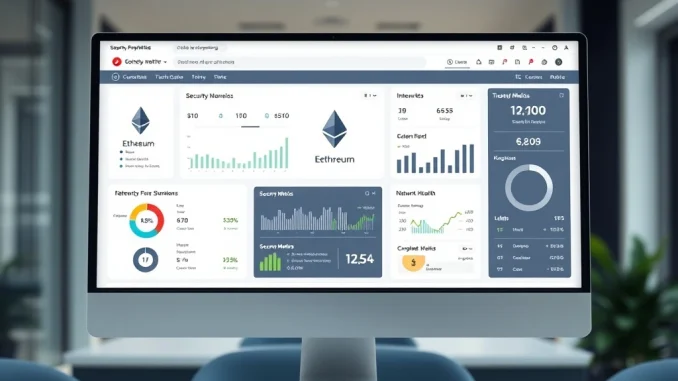
Zug, Switzerland, April 2025: In a significant step for blockchain transparency, the Ethereum Foundation has officially launched a comprehensive security dashboard, a tool designed to demystify the complex safety mechanisms protecting the world’s second-largest cryptocurrency network. This initiative formalizes over a decade of accumulated security knowledge into a publicly accessible framework, aiming to support Ethereum’s continued growth without compromising its decentralized ethos. The dashboard’s release comes at a pivotal moment, following a period of sustained on-chain growth and mainstream adoption that has placed unprecedented scrutiny on network resilience.
Ethereum Security Dashboard: A Decade of Lessons Formalized
The newly introduced Ethereum security dashboard represents more than just a new website; it is the codification of a vast body of knowledge. Since Ethereum’s launch in 2015, its developers and researchers have navigated numerous challenges, from the DAO hack and subsequent hard fork to mitigating spam attacks and refining its consensus mechanism. Each event contributed to a deeper understanding of attack vectors and defensive postures. The dashboard synthesizes these hard-won lessons into a structured, visual format. It moves critical security information from scattered research papers, developer calls, and forum posts into a centralized, authoritative hub. This shift is fundamental for a network that operates without central control, as it empowers every participant—from node operators and dApp developers to institutional validators and everyday users—with the same baseline understanding of network health and risks.
Anatomy of the Dashboard: Risks, Protections, and Ecosystem Work
The dashboard is architectured around three core pillars: risk identification, active protections, and ongoing ecosystem initiatives. Under risk identification, the tool provides real-time and historical data on network stress points, including gas price volatility, validator concentration metrics, and smart contract vulnerability reports. The protections section offers a clear breakdown of Ethereum’s layered defense strategy.
- Consensus Layer Security: Details on proof-of-stake finality, slashing conditions, and validator set health.
- Execution Layer Security: Monitoring for MEV (Maximal Extractable Value), transaction pool dynamics, and client diversity statistics.
- Social Layer Security: Documentation of core developer procedures, upgrade governance (EIP process), and emergency response protocols.
The final pillar highlights ongoing work across the ecosystem, tracking the progress of major upgrades, security audits for core clients like Geth and Nethermind, and research into post-quantum cryptography. This tripartite structure ensures the dashboard is not a static report but a living document of Ethereum’s security posture.
The Imperative for Transparency Amid Unprecedented Growth
The timing of the dashboard’s release is not coincidental. Ethereum has seen its total value locked (TVL) in decentralized finance (DeFi) protocols return to all-time highs, while non-fungible token (NFT) market activity and layer-2 scaling solutions like Arbitrum and Optimism continue to drive user transactions. This growth attracts not only legitimate users but also sophisticated adversaries. High-profile exploits on cross-chain bridges and DeFi protocols, though often not directly compromising Ethereum’s core protocol, have heightened the industry-wide focus on security. By proactively publishing a clear framework of its defenses, the Ethereum Foundation addresses a critical need for institutional and retail investors alike: verifiable, understandable proof of network safety. It shifts the narrative from reactive security announcements to proactive, continuous transparency.
Implications for Developers, Validators, and the Broader Web3 Space
The dashboard’s impact extends far beyond the Ethereum Foundation’s blog. For developers building decentralized applications, the tool provides a standardized reference for security assumptions. They can design systems with a clearer understanding of base-layer risks. For the over 1 million active validators securing the network, the dashboard offers vital operational insights into client performance and network-wide health, enabling more informed decisions about their infrastructure. For the broader Web3 and traditional finance (TradFi) sectors observing crypto, the dashboard sets a new benchmark for operational transparency. It provides a template other blockchain projects may follow, potentially raising the standard for public reporting across the industry. This move aligns with increasing regulatory expectations for clarity and risk disclosure in digital asset markets.
Conclusion: A Foundational Step for Sustainable Decentralization
The launch of the Ethereum security dashboard marks a foundational evolution in how decentralized networks communicate trust. By transforming a decade of complex, niche security research into an accessible public resource, the Ethereum Foundation reinforces the network’s commitment to operating as a global, transparent utility. This dashboard is a crucial tool for scaling securely, ensuring that as adoption grows, so does the collective understanding of the safeguards in place. It represents a mature, next-phase approach to blockchain governance—one where security is not just engineered in code but is also clearly communicated, fostering greater resilience and confidence across the entire Ethereum ecosystem.
FAQs
Q1: What is the primary purpose of the Ethereum security dashboard?
The primary purpose is to centralize and simplify complex security information about the Ethereum network. It provides a transparent, real-time view of network risks, active security protections, and ongoing safety initiatives, making this critical data accessible to developers, validators, and users.
Q2: Does the dashboard prevent hacks or exploits on Ethereum?
No, the dashboard itself is a monitoring and transparency tool, not a direct security measure. Its goal is to improve situational awareness and informed decision-making across the ecosystem, which can indirectly contribute to a more robust security posture by educating all network participants.
Q3: Who is the intended audience for this dashboard?
The dashboard is designed for a broad audience, including core protocol developers, dApp builders, institutional and individual validators, researchers, journalists, and technically-curious users who want a deeper, verified understanding of Ethereum’s security status.
Q4: How often is the information on the dashboard updated?
While specific update cycles may vary by metric, the dashboard is designed to provide a mixture of real-time data (e.g., network activity), frequently updated metrics (e.g., client diversity), and stable reference material on protocols and procedures.
Q5: How does this dashboard relate to the security of my Ethereum assets in a wallet or DeFi protocol?
The dashboard focuses on the security of the Ethereum base layer (the protocol itself). While a secure base layer is fundamental, the safety of your specific assets also depends on the security of your wallet software, the smart contracts you interact with, and your personal operational security. The dashboard is one critical piece of a larger security puzzle.
Updated insights and analysis added for better clarity.
This article was produced with AI assistance and reviewed by our editorial team for accuracy and quality.