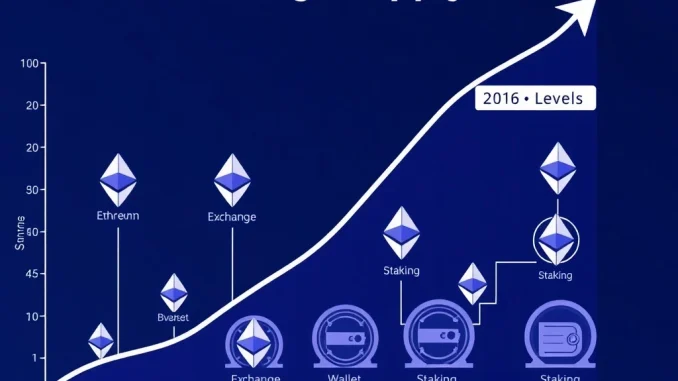
Global, May 2025: A profound shift is reshaping the Ethereum landscape. On-chain analytics reveal that the supply of ETH held on centralized exchanges has dwindled to levels not seen since mid-2016. This dramatic decline in Ethereum exchange supply occurs against a backdrop of a massively expanded ecosystem, growing institutional adoption, and the maturation of Ethereum staking. The movement of assets off trading platforms and into private wallets and staking contracts signals a fundamental change in holder behavior with significant implications for market liquidity and network security.
Ethereum Exchange Supply Reaches an Eight-Year Low
Data from leading blockchain analytics firms shows a consistent, multi-year downtrend in the percentage of Ethereum’s total circulating supply held on known exchange wallets. From a peak of over 30% in the years following its launch, the figure has now fallen below 11%, mirroring the supply distribution from Ethereum’s early days. This trend accelerated markedly following key network upgrades, most notably “The Merge” in September 2022, which transitioned Ethereum to Proof-of-Stake (PoS). The parallel growth of decentralized finance (DeFi) and non-custodial staking services has provided users with compelling alternatives to simply holding assets on an exchange.
The Primary Drivers Behind the Supply Drain
Several interconnected factors explain the sustained migration of ETH away from exchanges. Analysts point to three primary catalysts.
- The Rise of Ethereum Staking: The shift to PoS created a direct financial incentive for users to lock their ETH in the consensus mechanism. Over 30% of the total supply is now actively staked, representing tens of millions of ETH permanently removed from immediate trading liquidity. Validators must lock a minimum of 32 ETH, which encourages long-term holding.
- Growing Preference for Self-Custody: Following high-profile exchange failures and regulatory actions, a significant portion of the market has prioritized self-custody. The mantra “not your keys, not your coins” has evolved from a niche principle to a mainstream risk-management strategy. Hardware wallets and smart contract wallets have seen record adoption.
- Institutional Accumulation Strategies: Large entities, including publicly traded companies and dedicated funds, typically withdraw purchased ETH to regulated custodians or their own cold storage solutions. Their buying activity, therefore, often results in a net withdrawal from exchange balances rather than a simple transfer between accounts on the same platform.
Historical Context and Market Cycle Comparison
Comparing the current supply dynamics to 2016 provides critical perspective. In mid-2016, Ethereum was a nascent project with a small, developer-centric community. The low exchange supply then reflected limited trading infrastructure and a holder base composed largely of early believers. Today, the network supports a multi-trillion-dollar ecosystem of applications. The return to 2016-level exchange balances now indicates a sophisticated, long-term oriented market choosing to utilize ETH within its native ecosystem—for staking, as collateral in DeFi, or for governance—rather than treating it solely as a trading instrument.
Implications for Market Liquidity and Volatility
The tightening of immediately tradable supply has direct consequences for market microstructure. A lower exchange supply typically translates to reduced market depth on order books. This means large buy or sell orders can have a more pronounced impact on price, potentially increasing short-term volatility. However, it also suggests that the remaining liquid supply is held by participants who may be less prone to panic selling, as they have already chosen not to keep assets on an exchange for quick disposal. This dynamic can create a market that is more resilient to downside shocks but also susceptible to rapid upward moves if demand surges.
What Happens Next? Analyzing the Potential Outcomes
The trajectory of exchange balances will be a key metric to watch. If the decline stabilizes, it may indicate a new equilibrium where a smaller, core liquid supply facilitates daily trading while the majority of ETH is “put to work” in the ecosystem. A continued decline could exacerbate liquidity concerns, potentially leading to wider bid-ask spreads on exchanges. The market’s response may also hinge on developments in staking mechanics, such as the ease of withdrawing staked ETH, and the growth of liquid staking tokens (LSTs) like Lido’s stETH, which attempt to provide staking rewards without fully immobilizing the underlying asset.
Conclusion
The decline of Ethereum exchange supply to 2016 levels is not a historical coincidence but a landmark event reflecting the network’s maturation. It underscores a collective move from speculation to utility, from custody with third parties to self-sovereignty, and from passive holding to active participation in network security via staking. While this trend presents new challenges for market liquidity, it fundamentally strengthens Ethereum’s economic security and aligns the incentives of its holders with the long-term health of the protocol. The coming months will reveal how traditional finance adapts to a market where the most sought-after asset is increasingly held off-exchange.
FAQs
Q1: What does “Ethereum exchange supply” actually measure?
It measures the total amount of ETH held in wallets known to belong to centralized cryptocurrency exchanges (like Coinbase or Binance). This is the ETH readily available for users to trade or sell.
Q2: Why is staking causing ETH to leave exchanges?
To stake ETH and earn rewards, users must deposit their coins into the official Ethereum staking contract or a staking service. This process involves moving ETH from an exchange wallet to a specific staking address, effectively locking it up and removing it from the exchange’s liquid supply.
Q3: Does lower exchange supply always mean the price will go up?
Not necessarily. While it can indicate strong long-term holding sentiment (reducing selling pressure), price is determined by the balance of buy and sell orders. Lower liquidity can also lead to increased volatility in both directions.
Q4: How can this trend impact everyday traders?
Traders may experience less market depth, meaning large orders could move the price more than before. It may also become more expensive to execute large trades without significant price slippage.
Q5: Could this trend reverse?
Yes. If staking rewards decrease significantly, if there is a major market downturn prompting holders to sell, or if new, highly convenient trading products launch, we could see an inflow of ETH back to exchanges. The ability to easily withdraw staked ETH also adds a potential future supply source.
Updated insights and analysis added for better clarity.
This article was produced with AI assistance and reviewed by our editorial team for accuracy and quality.