Global, May 2025: The cryptocurrency market continues to present a complex narrative of inter-asset competition, with Ethereum demonstrating notable resilience against its predecessor, Bitcoin. Recent price action shows the ETH/BTC trading pair holding crucial support levels, a development that technical analysts are scrutinizing for clues about the next major cycle move. This stability against the market’s dominant asset has sparked professional discussions about Ethereum’s underlying strength and its potential trajectory, with some models suggesting a path toward the $3,500 price region for ETH in USD terms.
Analyzing the ETH/BTC Pair: A Barometer of Market Sentiment
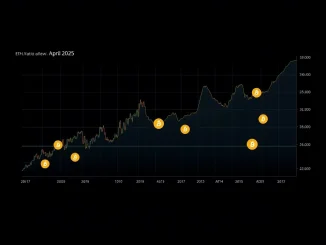
The price of Ethereum measured in Bitcoin, known as the ETH/BTC pair, serves as a critical barometer for relative strength within the crypto ecosystem. Historically, movements in this ratio have signaled shifts in investor preference between the two largest cryptocurrencies by market capitalization. When Ethereum gains or holds ground against Bitcoin, it often reflects increased confidence in Ethereum’s network utility, development roadmap, or its role within the decentralized finance (DeFi) and non-fungible token (NFT) sectors. The current phase shows Ethereum consolidating above a multi-month support zone on the weekly chart against Bitcoin, a technically significant event that precedes many of its past major rallies.
This consolidation occurs against a backdrop of significant network upgrades for Ethereum. The completion of the transition to a proof-of-stake consensus mechanism via “The Merge” in 2022 fundamentally altered its economic model, reducing new issuance. Subsequent upgrades, including proto-danksharding (EIP-4844), have focused on scaling transaction throughput and reducing fees for layer-2 networks. Analysts point to the maturation of this infrastructure as a fundamental driver that may be underpinning its relative value against a Bitcoin narrative increasingly centered on its role as a digital store of value and institutional asset.
Technical Setup and the Path to $3,500
From a chart analysis perspective, the focus on a $3,500 price target for Ethereum in US dollar terms stems from a confluence of technical factors. This level represents a key historical resistance zone from the 2021-2022 market cycle. A decisive break above it would signal a structural shift, potentially opening the door to significantly higher prices. The path to this target is intrinsically linked to the ETH/BTC pair’s performance. For Ethereum to achieve such a USD valuation independently, it would likely require either a broad crypto market rally led by Bitcoin or, more pertinently, a period where Ethereum significantly outperforms Bitcoin, causing the ETH/BTC ratio to rise.
The current setup suggests the latter scenario is being anticipated by some analysts. The holding of key support on the ratio chart indicates that selling pressure from ETH into BTC has subsided at these levels. Market participants often view such consolidation after a downtrend as a potential basing pattern, which can provide the foundation for a new uptrend. It is crucial to note that this analysis is based on observable price patterns and historical precedent, not a prediction of guaranteed future performance. All cryptocurrency investments carry substantial risk.
- Support Level Holding: The ETH/BTC pair has repeatedly tested and held a defined price floor, indicating buyer interest at that level.
- Reduced Volatility: The trading range has contracted, which often precedes a period of expansion and a decisive price move.
- On-Chain Metrics: Supplementary data, such as the number of active addresses and the volume of value settled on the network, provide context for price action.
Contextualizing the Broader Market Cycle
Ethereum’s performance cannot be viewed in isolation. Its potential “next major move” is framed within the context of the broader cryptocurrency market cycle. Historical cycles have shown that altcoins, including Ethereum, often experience their most explosive rallies in the latter phases of a Bitcoin-driven bull market. This phenomenon is sometimes referred to as “altcoin season.” The current resilience of ETH/BTC during a period of general market uncertainty or consolidation may be interpreted by some analysts as an early sign of strength that could foreshadow such a phase.
Furthermore, macroeconomic conditions continue to play a role. Interest rate environments, regulatory developments from bodies like the U.S. Securities and Exchange Commission (SEC) regarding spot Ethereum ETFs, and institutional adoption flows all contribute to the complex equation determining crypto asset prices. Ethereum’s value proposition as a programmable settlement layer gives it exposure to trends in decentralized computing, digital ownership, and automated finance, which may resonate differently under various economic conditions compared to Bitcoin’s monetary policy narrative.
Fundamental Drivers Beyond Price Charts
While technical analysis focuses on price patterns, Ethereum’s fundamental activity provides a tangible basis for its valuation. The network remains the dominant platform for smart contract deployment, hosting the majority of DeFi protocols, NFT marketplaces, and decentralized applications (dApps). The total value locked (TVL) in Ethereum’s DeFi ecosystem, though subject to market fluctuations, represents a significant metric of utility and trust. Additionally, the network’s fee-burning mechanism, introduced in EIP-1559, has led to periods of net deflation for ETH, fundamentally altering its supply dynamics in a way that contrasts with Bitcoin’s fixed, disinflationary schedule.
Developer activity is another critical, long-term fundamental indicator. Ethereum consistently maintains one of the largest and most active developer communities in the blockchain space. This activity drives continuous protocol improvement, security audits, and the creation of new use cases. The health of this ecosystem—measured by GitHub commits, grant funding, and developer conferences—suggests a robust foundation that supports the network’s long-term viability, irrespective of short-term price fluctuations against Bitcoin or the US dollar.
Conclusion
Ethereum’s current market posture, characterized by its firm hold on key support levels against Bitcoin, presents a technically significant setup that market analysts are closely monitoring. This resilience, combined with a completed transition to proof-of-stake and ongoing scaling upgrades, forms a narrative of a maturing network. The discussed path toward a $3,500 price target represents a key technical hurdle that would require a sustained period of strength, likely involving Ethereum outperforming Bitcoin. Investors and observers should consider this analysis within the full spectrum of market risks, fundamental network progress, and the inherently volatile nature of cryptocurrency assets. The coming months will test whether this current consolidation is indeed the foundation for Ethereum’s next major move.
FAQs
Q1: What does it mean when Ethereum “holds support” against Bitcoin?
In technical analysis, “holding support” refers to the price of an asset (like the ETH/BTC pair) finding consistent buying interest at a specific, historically significant level, preventing it from falling further. It suggests that, at that price, market participants see value and are willing to buy.
Q2: Why is the ETH/BTC trading pair important?
The ETH/BTC pair shows the value of one Ethereum expressed in Bitcoin. It is a primary gauge of Ethereum’s relative performance versus the market leader. A rising ratio means Ethereum is outperforming Bitcoin; a falling ratio means the opposite.
Q3: What are the main fundamental factors supporting Ethereum’s value?
Key factors include its role as the leading smart contract platform for DeFi and NFTs, its active developer community, a transition to a deflationary proof-of-stake model, and ongoing technical upgrades aimed at improving scalability and reducing transaction costs.
Q4: Is a $3,500 price target for Ethereum realistic?
Price targets are based on technical analysis of historical patterns and chart formations. While $3,500 is a level of previous significance, its achievement depends on a complex mix of technical breakouts, positive market sentiment, supportive fundamentals, and broader financial market conditions. It is a hypothetical scenario, not a forecast.
Q5: How does Bitcoin’s performance affect Ethereum’s price?
Bitcoin’s price action often sets the overall tone for the cryptocurrency market due to its large market dominance. A strong, rising Bitcoin market can bring capital and positive sentiment into the entire sector, which can benefit Ethereum. However, Ethereum can also experience periods of independent, relative strength where it outperforms Bitcoin, as measured by the ETH/BTC ratio.
Updated insights and analysis added for better clarity.
This article was produced with AI assistance and reviewed by our editorial team for accuracy and quality.