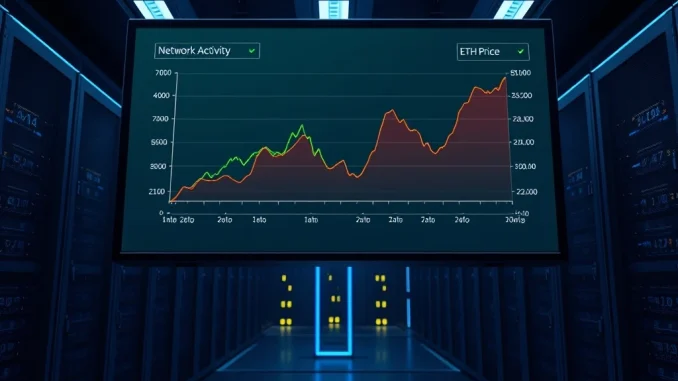
April 10, 2026 — A stark divergence between Ethereum’s fundamental network health and its market valuation is confounding analysts and investors worldwide. Data from blockchain analytics firm CryptoQuant reveals an ‘adoption paradox’ where Ethereum network activity has surged to unprecedented levels throughout early 2026, while the price of Ether (ETH) continues to significantly lag. This critical development, first highlighted by CryptoQuant’s head of research Julio Moreno, suggests a fundamental shift in the drivers of cryptocurrency valuation, moving away from pure usage metrics toward capital flow dynamics. The findings challenge long-held assumptions in crypto investing and provide crucial context for the current market consolidation phase.
Record Network Activity Amidst Price Stagnation
Ethereum’s underlying blockchain is experiencing explosive growth. According to the latest CryptoQuant report published this week, key on-chain metrics have shattered previous records. Total active addresses on the Ethereum network spiked to over 1.1 million in February 2026. This figure represents more than double the activity seen during the same period last year. Furthermore, daily token transfers consistently topped one million throughout March, marking a substantial increase from approximately 750,000 transfers recorded last December. These metrics paint a picture of a vibrant, heavily utilized ecosystem.
Simultaneously, activity within Ethereum’s decentralized application layer has skyrocketed. Smart contract calls and automated protocol token transfers have climbed to all-time highs. This surge directly reflects the accelerating adoption of decentralized finance (DeFi) protocols, the expanding use of dollar-pegged stablecoins like USDC and USDT, and the rapid growth of Layer-2 scaling solutions such as Arbitrum, Optimism, and Base. Leon Waidmann, Head of Research at Ethereum Layer-2 project Lisk, corroborated this trend on social media platform X, noting that Circle’s USDC usage on Ethereum mainnet just reached a historic peak according to data from Token Terminal.
The Core Paradox: Usage Does Not Equal Demand
Despite this robust fundamental picture, Ether’s market performance tells a different story. As of April 10, 2026, ETH is trading just above the $2,000 mark. This price level consolidates near the range it occupied for over a year during the 2022-2023 bear market. More strikingly, the asset remains down almost 60% from its all-time high set in previous cycles. Julio Moreno identified this as a “clear divergence between network usage and asset performance,” labeling the phenomenon the ‘adoption paradox.’
The paradox presents a direct challenge to a foundational narrative in cryptocurrency investing. For years, a core thesis suggested that growing network activity would inevitably translate into increased demand for the native asset, thereby driving its price upward. Ethereum’s current situation fundamentally questions that model. The data indicates that users can heavily utilize the Ethereum blockchain for transactions, DeFi, and NFTs without necessarily needing to hold or speculate on the value of ETH itself, especially with the prevalence of stablecoins and Layer-2 solutions that can abstract gas fees.
- Capital Flow Dominance: Price is now primarily driven by investment capital entering or exiting the asset, not by transactional utility.
- Realized Cap Decline: The yearly change in Ethereum’s realized capitalization has turned negative, signaling net capital outflow.
- Broader Market Pressure: ETH is not suffering in isolation; the total crypto market cap is down 44% from its October 2025 peak.
Expert Analysis: Capital Flows Take the Wheel
Julio Moreno provided deeper analysis on the mechanisms behind the paradox. “The yearly change in Ethereum’s realized capitalization has turned negative, showing that capital is exiting from Ether,” he stated. “This aligns closely with ETH price weakness and suggests that ETH price dynamics are driven primarily by capital flows rather than network activity growth.” Realized capitalization is a metric that values each coin at the price it last moved, offering a more accurate picture of the actual capital invested in the network compared to traditional market cap. Its negative year-over-year change is a powerful bearish signal that overshadows positive usage statistics.
This perspective is echoed by other institutional analysts monitoring chain activity. The divergence highlights a maturation phase where Ethereum is being evaluated more like a traditional tech stock—where user growth is important, but profitability, cash flow, and investor sentiment are paramount. The explosive growth of Layer-2 networks, while boosting overall ecosystem activity, may also be diverting fee revenue and economic activity away from the Ethereum mainnet, further complicating the value accrual model for ETH.
Contextualizing the Divergence in a Broader Market
Ethereum’s paradox unfolds against a complex macroeconomic and geopolitical backdrop. The broader cryptocurrency market has shed approximately $2 trillion in value since its recent peak, with many alternative cryptocurrencies (altcoins) down 80% or more. This points to a severe liquidity drought across digital asset markets. The risk-off investment environment is amplified by ongoing geopolitical tensions and a global monetary policy landscape that remains focused on controlling inflation, keeping traditional safe-haven assets in favor over speculative tech and crypto investments.
The situation invites comparison to previous cycles. The following table contrasts key metrics from the peak of the last major bull market with current conditions, illustrating the unique nature of the present divergence.
| Metric | Q4 2025 Peak | April 2026 | Change |
|---|---|---|---|
| ETH Price | ~$4,800 | ~$2,050 | -57% |
| Daily Active Addresses | ~650,000 | >1,100,000 | +69% |
| Daily Token Transfers | ~800,000 | >1,000,000 | +25% |
| Crypto Total Market Cap | ~$4.5T | ~$2.5T | -44% |
Forward Trajectory: Scrutiny on Value Accrual
The immediate future for Ethereum hinges on how the market reconciles this divergence. Analysts will closely watch the upcoming implementation of Ethereum Improvement Proposal (EIP) 4844, also known as ‘Proto-Danksharding,’ aimed at drastically reducing Layer-2 transaction costs. The core question is whether reduced fees and increased scalability will stimulate new demand for ETH as a capital asset, or simply further boost activity that remains disconnected from its price. Furthermore, the performance of major Layer-2 tokens and their relationship with ETH will provide critical signals about value distribution within the ecosystem.
Market and Developer Community Response
The reaction from the Ethereum community has been a mix of concern and long-term optimism. Some traders and investors express frustration, seeing strong fundamentals ignored by the market. Conversely, many developers and ecosystem builders view the high activity as validation of Ethereum’s utility, believing price appreciation will eventually follow as applications reach mass adoption. This schism highlights the evolving identity of Ethereum—caught between its origins as a speculative digital asset and its growing reality as a global, utility-focused computing platform.
Conclusion
The ‘adoption paradox’ currently defining Ethereum marks a pivotal moment in cryptocurrency market evolution. The clear decoupling of network usage from asset price, driven by negative capital flows, challenges simplistic valuation models and forces a more nuanced analysis. While Ethereum’s blockchain is undeniably busier and more useful than ever, the market is prioritizing macroeconomic liquidity and investor sentiment over on-chain metrics in the short term. Moving forward, observers should monitor capital flow indicators like realized cap and exchange net flows as closely as activity metrics. The resolution of this paradox will likely set the precedent for how next-generation, utility-blockchain networks are valued in an increasingly complex financial landscape.
Frequently Asked Questions
Q1: What is the ‘Ethereum adoption paradox’?
The paradox refers to the current situation where Ethereum network activity (active addresses, transactions) is hitting record highs, while the price of ETH remains significantly depressed. This challenges the idea that increased usage directly drives cryptocurrency prices.
Q2: What data supports the existence of this paradox?
CryptoQuant data shows active addresses doubled year-over-year to 1.1M+ and token transfers surpassed 1M daily, yet ETH’s price is down ~60% from its peak and its realized capitalization (measuring invested capital) is declining year-over-year.
Q3: What is driving ETH’s price if not network activity?
Analyst Julio Moreno states price dynamics are now “driven primarily by capital flows.” Macroeconomic factors, investor sentiment, and overall liquidity in crypto markets are currently outweighing positive on-chain fundamentals.
Q4: Does this mean Ethereum is failing?
Not necessarily. It indicates a maturation and complexity in valuation. The network’s utility and adoption are growing, but the market is applying a different, more traditional financial lens focused on capital investment and returns.
Q5: How does this affect everyday users and developers?
For users and developers, high network activity is positive—it means a vibrant ecosystem. However, low ETH prices can reduce incentives for stakers and impact the security budget. It also may influence funding and investment for projects building on Ethereum.
Q6: What should investors watch to see if the paradox resolves?
Key indicators include a reversal in the yearly change of realized capitalization (signaling capital inflow), a sustained decrease in ETH exchange reserves, and whether future network upgrades successfully translate increased usage into greater economic value captured by the ETH asset itself.