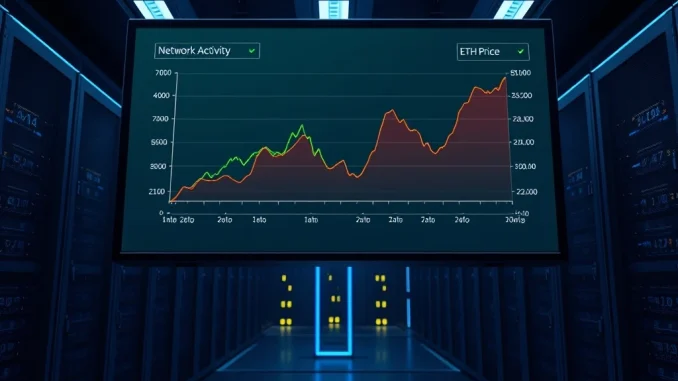
NEW YORK, April 10, 2026 — A stark divergence between Ethereum’s booming network usage and its stagnant market price is creating what analysts term an “adoption paradox,” challenging foundational beliefs about cryptocurrency valuation. Data from blockchain analytics firm CryptoQuant reveals that while key Ethereum network activity metrics—including active addresses and transaction volume—surged to unprecedented levels in early 2026, the price of Ether (ETH) has failed to respond, remaining mired near bear-market levels. This disconnect suggests capital flight, not user growth, is currently driving ETH’s price dynamics, marking a significant shift in market behavior that could reshape investment theses for the world’s second-largest blockchain.
Ethereum Adoption Paradox: Record Activity Meets Price Stagnation
CryptoQuant Head of Research Julio Moreno identified the troubling trend this week. “We are observing a clear divergence between network usage and asset performance,” Moreno stated. His analysis shows Ethereum’s total active addresses spiked to over 1.1 million in February 2026, more than double the figure from the same period last year. Concurrently, daily token transfers on the network topped one million in March, a significant jump from approximately 750,000 in December 2025. These metrics, which include smart contract calls and automated protocol interactions, paint a picture of a blockchain experiencing robust adoption, particularly within decentralized finance (DeFi), stablecoin ecosystems, and Layer-2 scaling solutions.
Despite this surge in fundamental usage, Ether’s market performance tells a different story. As of April 10, 2026, ETH trades just above $2,000, consolidating near the range it occupied for much of the 2022-2023 bear market. This price represents a decline of almost 60% from its all-time high. The contradiction is jarring: more people and applications are using Ethereum than ever before, yet the value of its native token is not reflecting that growth. This phenomenon directly challenges the long-held assumption that increased blockchain utility and transaction volume naturally translate into upward price pressure for the underlying asset.
Capital Flight Drives ETH Price Weakness, Not Network Growth
Moreno’s deeper analysis points to capital flows as the primary culprit behind ETH’s weakness. “The yearly change in Ethereum’s realized capitalization has turned negative,” he explained. Realized cap is a metric that values each ETH token at the price it last moved, providing a more accurate picture of the actual capital invested in the network. A negative yearly change indicates that, on aggregate, money is exiting the Ethereum ecosystem. “This aligns closely with ETH price weakness and suggests that ETH price dynamics are driven primarily by capital flows rather than network activity growth,” Moreno concluded.
- Negative Realized Cap Change: Signals net capital outflow from Ethereum, overriding positive on-chain activity signals.
- Liquidity Drought: The broader crypto market is down approximately 44% from its October 2025 peak, with many altcoins shedding 80% of their value, creating a risk-off environment.
- Macro Headwinds: Ongoing geopolitical tensions and tighter monetary policy have amplified a flight to safety, draining liquidity from speculative assets like cryptocurrencies.
Expert Analysis on the Divergence
Other industry observers corroborate the data. Leon Waidmann, Head of Research at Ethereum Layer-2 project Lisk, noted on social media platform X that the usage of Circle’s USDC stablecoin on Ethereum just reached an all-time high, according to data from Token Terminal. This underscores the growth in practical, value-transfer activity on the chain. Meanwhile, funding rates for ETH perpetual swaps have turned negative, indicating that derivatives traders are leaning bearish and willing to pay to hold short positions—a sentiment indicator that often exacerbates spot price declines. This expert consensus highlights a market where utility and sentiment have decoupled, a scenario with few historical precedents in Ethereum’s history.
Broader Crypto Context and Historical Comparison
The Ethereum adoption paradox unfolds against a bleak backdrop for digital assets. The total cryptocurrency market capitalization has fallen by roughly $2 trillion since its recent peak. This decline is not isolated to ETH; it represents a sector-wide liquidity crunch. However, the severity of the divergence between Ethereum’s strong fundamentals and weak price action is particularly pronounced. Historically, bull markets in crypto have been preceded or accompanied by spikes in on-chain activity. The current scenario inverts that model, suggesting a new phase where macroeconomic forces and capital rotation exert more influence than organic network growth.
| Metric | Q4 2025 | Q1 2026 | Change |
|---|---|---|---|
| Daily Active Addresses | ~550,000 | >1,100,000 | >100% Increase |
| Daily Token Transfers | ~750,000 | >1,000,000 | ~33% Increase |
| ETH Price (USD) | ~$3,200 | ~$2,000 | ~38% Decrease |
| Ethereum Realized Cap (Yearly Change) | Positive | Negative | Critical Shift |
What the Adoption Paradox Means for Ethereum’s Future
The immediate question is whether robust network activity will eventually catalyze a price recovery or if capital outflows will continue to suppress ETH’s value. Analysts are watching two key signals: a reversal in the realized cap metric to indicate new capital inflows, and a sustained reduction in the negative funding rate to show a shift in derivatives market sentiment. The upcoming implementation of Ethereum’s next major protocol upgrade, which focuses on further scalability improvements, could serve as a potential catalyst if it reignites investor enthusiasm. However, the current data suggests that in the short term, global macro conditions and investor risk appetite will remain the dominant price drivers, even for a network demonstrating clear utility growth.
Market and Community Reaction
The revelation of this paradox has sparked intense debate within the crypto community. Some long-term holders (“HODLers”) view the strong network usage as ultimate validation, arguing that price will inevitably catch up to value. Traders and quantitative funds, however, are adjusting models that previously weighted on-chain metrics more heavily. The situation presents a dilemma for project builders on Ethereum: their platform is more active than ever, yet the token that fuels and secures it is under significant selling pressure, potentially impacting treasury management and ecosystem funding.
Conclusion
The Ethereum adoption paradox represents a critical inflection point for cryptocurrency market analysis. CryptoQuant’s data reveals a market where record-breaking network activity and severe ETH price weakness coexist, driven primarily by negative capital flows. This divergence challenges the core thesis that utility begets value in the short term. For investors and observers, the coming months will test whether Ethereum’s fundamental strength can eventually overcome macro headwinds, or if a new paradigm is emerging where on-chain metrics and token prices can remain disconnected for extended periods. The resolution of this paradox will provide crucial lessons for valuing blockchain networks in an increasingly complex global financial landscape.
Frequently Asked Questions
Q1: What is the Ethereum “adoption paradox”?
The adoption paradox refers to the current situation where Ethereum network activity (active addresses, transactions) is hitting record highs, but the price of ETH is stagnating or falling. This contradicts the traditional belief that more usage directly leads to a higher token price.
Q2: What data supports the existence of this paradox?
Data from CryptoQuant shows active addresses doubled to over 1.1 million in February 2026, and daily token transfers exceeded 1 million in March. Despite this, ETH’s price remains down nearly 60% from its peak, and the yearly change in Ethereum’s realized capitalization—a measure of invested capital—has turned negative.
Q3: What is driving ETH’s price down if the network is so active?
Analysts point to capital outflows from the crypto market overall. The negative change in realized cap shows more money is leaving Ethereum than entering, driven by macro factors like geopolitical risk and a broader liquidity drought, which override positive on-chain signals.
Q4: Has this happened to Ethereum before?
While Ethereum has experienced bear markets, such a pronounced and quantifiable divergence between record-high network fundamentals and weak price action is unusual. Historically, bull runs have been closely correlated with spikes in on-chain activity.
Q5: What needs to happen for the paradox to resolve?
For price to realign with activity, analysts say capital flows need to reverse. This would be signaled by the yearly change in realized cap turning positive again, indicating net new investment is entering the Ethereum ecosystem.
Q6: How does this affect developers and users building on Ethereum?
For builders, the network is healthier and more capable than ever. However, the depressed ETH price can impact project treasuries denominated in ETH and may affect the valuation and funding of ecosystem projects, even as their user bases grow.