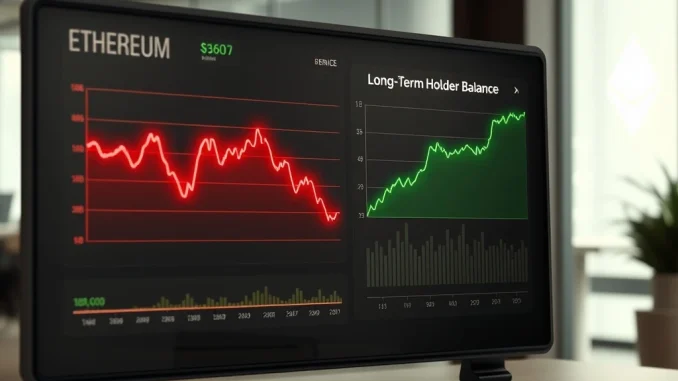
Global, May 2025: A compelling trend is emerging in the cryptocurrency markets as Ethereum accumulation grows among a specific cohort of investors. Despite a consistent downward pressure on ETH prices throughout the first half of 2025, blockchain data reveals that wallets classified as long-term holders are not only retaining their assets but are actively increasing their positions. This divergence between price action and investor behavior presents a nuanced picture of market sentiment, challenging simple bearish narratives and highlighting a deep-seated confidence in Ethereum’s underlying technology and future roadmap.
Ethereum Accumulation Defies Prevailing Market Sentiment
On-chain analytics firms report a significant and measurable uptick in the net flow of Ethereum into wallets held for more than 155 days, a common benchmark for “long-term holder” status. This metric, which tracks the net change in supply held by these entities, has turned positive and remained elevated even as ETH’s USD valuation corrected from its previous highs. This activity suggests a strategic accumulation phase is underway. Analysts point to several potential drivers for this behavior. First, lower prices provide a more attractive entry point for investors with a multi-year horizon who believe in the asset’s long-term appreciation potential. Second, the completion of key network upgrades has fundamentally changed Ethereum’s economic model, reducing new supply issuance and enhancing its value proposition as a yield-generating asset through staking.
Analyzing the Data Behind Long-Term Holder Confidence
The behavior of long-term holders (LTHs) is often considered a leading indicator of market cycles. Their actions are typically less reactive to short-term volatility and more focused on fundamental value. The current accumulation trend can be contextualized by examining supply distribution. Data indicates the percentage of the total ETH supply held in wallets untouched for over a year has reached its highest level since 2021. This supply is effectively being locked away from active trading, reducing sell-side pressure. We can break down the observable trends:
- Supply Shock Dynamics: The combination of staking withdrawals being re-staked and LTH accumulation is creating a noticeable supply squeeze on exchanges.
- Cost-Basis Advantage: Many current accumulators have a lower average purchase price than those who bought during the 2024 peak, insulating them from panic selling.
- Institutional On-Ramps: The approval and growth of regulated spot Ethereum ETFs in key markets have provided a structured, steady inflow channel that aligns with long-term holding strategies.
The Historical Precedent of Accumulation During Downturns
This pattern is not without precedent in cryptocurrency history. Similar accumulation behavior by long-term holders was observed during the bear market phases of 2018-2019 and 2022. In both instances, sustained buying by this cohort preceded significant market recoveries, though the timing was unpredictable. The critical difference in 2025 is the maturity of the Ethereum ecosystem. The network now supports a multi-trillion-dollar economy of decentralized finance (DeFi), non-fungible tokens (NFTs), and real-world asset tokenization. For long-term holders, investing in ETH is increasingly viewed as investing in the foundational infrastructure of this digital economy, not merely speculating on a digital commodity. This shift in perception may explain the heightened resilience and accumulation despite price headwinds.
Implications for the Broader Cryptocurrency Market
The steadfast accumulation by Ethereum’s long-term holders carries significant implications for market structure. Firstly, it suggests a strong underlying bid for the asset, which can establish a firmer price floor. When “weak hands” sell during fear-driven declines, their assets are often transferred to “strong hands” with higher conviction, leading to a healthier distribution of ownership. Secondly, this behavior can reduce overall market volatility over time, as a larger portion of the supply becomes inert. However, analysts caution that this is not a guaranteed short-term bullish signal. Macroeconomic factors, regulatory developments, and broader risk-asset performance remain powerful overlying forces. The long-term holder accumulation simply indicates that a sophisticated segment of the market sees current prices as fundamentally undervalued relative to Ethereum’s future utility and cash flow potential.
Conclusion
The growing Ethereum accumulation among long-term holders amidst a declining price environment paints a picture of strategic conviction. It underscores a critical divide between short-term price action and long-term fundamental belief in the Ethereum network’s role as the primary settlement layer for the next generation of the internet. While near-term price movements remain uncertain and subject to external forces, the actions of these committed investors provide a compelling data point for anyone analyzing the health and future trajectory of the cryptocurrency market. This trend reaffirms that for a significant portion of the market, Ethereum’s value proposition is assessed in years and technological milestones, not daily price charts.
FAQs
Q1: What defines a “long-term holder” of Ethereum?
In on-chain analysis, a “long-term holder” (LTH) is typically defined as a wallet address that has held its Ethereum tokens without spending or moving them for a period exceeding 155 days. This threshold is used to filter out short-term traders and identify investors with a more strategic, patient outlook.
Q2: Why would investors accumulate an asset while its price is falling?
This strategy, often called “buying the dip” or “dollar-cost averaging,” is based on the belief that the asset’s long-term fundamental value is higher than its current market price. Accumulating during downturns lowers the investor’s average cost basis, positioning them for greater potential profits when the market eventually recovers.
Q3: How is this accumulation trend measured?
It is measured using blockchain analytics tools that track the net flow of tokens into and out of wallet cohorts. Key metrics include “Long-Term Holder Net Position Change,” which shows whether LTHs are collectively adding or subtracting from their balances, and “Supply Last Active” charts, which show how much ETH has not moved in various time frames.
Q4: Does long-term holder accumulation guarantee a price increase?
No, it does not guarantee a short-term price increase. While it indicates strong underlying demand and can establish support levels, cryptocurrency prices are influenced by a complex array of factors including macroeconomic conditions, regulatory news, technological developments, and overall market sentiment.
Q5: What is different about Ethereum’s fundamentals in 2025 compared to previous bear markets?
Key differences include the full transition to a proof-of-stake consensus mechanism, which introduces staking yields and reduces net issuance; the maturation of its DeFi and Layer 2 scaling ecosystem; and the emergence of regulated financial products like spot ETFs, which broaden and stabilize its investor base.