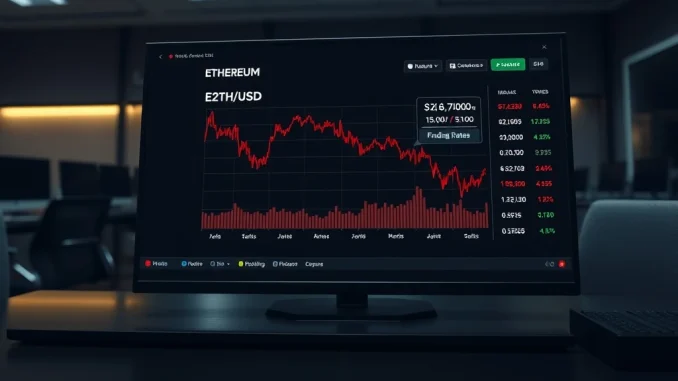
NEW YORK, March 18, 2026 — Ethereum’s derivatives markets flashed a critical warning signal this week as Ether funding rates turned negative for the first time in months. The shift occurred Tuesday morning Eastern Time, reflecting increased demand for bearish positions despite a brief 7% price recovery between Monday and Tuesday. Ether (ETH) has now failed to sustain levels above $2,100 for over thirty consecutive days, gradually eroding trader confidence in what was once cryptocurrency’s dominant smart contract platform. This negative funding rate development comes alongside $225 million in net outflows from spot Ether ETFs between Thursday and Monday, reversing the previous week’s inflows and raising questions about institutional appetite.
Ether Derivatives Data Reveals Bearish Sentiment Shift
Data from derivatives analytics platform Laevitas.ch shows ETH perpetual futures dipped into negative territory on Tuesday, signaling increased demand for short positions. More significantly, this metric has remained below the neutral 6% to 12% range throughout March. Marcel Pechman, Cointelegraph markets analyst, noted the funding rate shift coincides with cooling on-chain activity. “Weekly base layer fees on the Ethereum network averaged just $2.3 million over the past month,” Pechman reported. “That represents a dramatic decline from the $8 million peak we observed in early February.”
Transaction counts have stabilized near 14 million weekly, but the industry’s focus on layer-2 rollup scalability has failed to generate fresh demand for native Ether. Consequently, the network’s fee revenue—a key metric for validator economics and ETH burn mechanisms—has contracted significantly. This contraction occurs despite ongoing development activity, including plans for the upcoming Hegota fork that promises more flexible transaction capabilities.
Institutional Demand Wanes as ETF Flows Reverse
The negative derivatives sentiment aligns with weakening institutional interest, as measured by spot Ether ETF flows. Between Thursday, March 13 and Monday, March 17, these products experienced $225 million in net outflows, completely reversing the $169 million inflow recorded the previous Wednesday. This metric serves as a proxy for institutional demand, which currently faces headwinds from Ethereum’s 2.8% native staking reward rate. By comparison, stablecoin yields on platforms like Sky Lending (formerly MakerDAO) offer approximately 3.75%, creating competitive pressure for yield-seeking capital.
- ETF Outflow Impact: The reversal suggests institutional investors remain cautious despite regulatory approval for staking within these products in late 2025.
- Yield Competition: Ethereum’s staking rewards underperform compared to decentralized finance alternatives, affecting capital allocation decisions.
- Market Timing Challenge: ETF launches coincided with a broader crypto market downturn beginning October 2025, complicating adoption metrics.
Expert Analysis on Ethereum’s Competitive Position
Ray Salmond, Cointelegraph staff editor who reviewed the initial analysis, emphasized the broader context. “No competitor has yet challenged Ethereum’s $56 billion in total value locked,” Salmond noted. “However, the options market tells a nuanced story.” Contrary to perpetual futures, the ETH options risk gauge hovered near the neutral -6% to +6% range on Tuesday. Put options traded at only a 7% premium relative to call instruments, suggesting some confidence persists among Ether bulls. This divergence between derivatives instruments creates a complex picture rather than uniform bearishness.
Broader Market Context and Historical Performance
Ethereum has underperformed the broader cryptocurrency market since October 2025, when total market capitalization approached a $4 trillion all-time high. The ETH/BTC pair has declined approximately 65% since Ethereum’s transition to proof-of-stake, raising questions about the “ultrasound money” narrative that previously supported valuation premiums. Investor sentiment faces additional pressure from Sharplink’s (SBET US) financial results, released Monday. The Ethereum treasury firm, chaired by co-founder Joseph Lubin, reported a staggering $735 million net loss for 2025.
| Metric | Current Status | Comparison Period |
|---|---|---|
| ETH Price vs. $2,100 | Failed to sustain above | 30+ days |
| Weekly Network Fees | $2.3 million average | Down from $8M (Feb peak) |
| ETF Net Flows (5-day) | -$225 million | Reversed +$169M prior |
| Funding Rate Status | Negative territory | Below neutral 6-12% range |
Development Roadmap Offers Long-Term Hope Amid Short-Term Pressure
Ethereum’s development community continues advancing scalability and usability improvements, though their market impact appears delayed. Co-founder Vitalik Buterin stated Saturday that account abstraction—equivalent to smart accounts—will likely ship “within a year” after more than a decade in development. The upcoming Hegota fork will enable transactions to reference each other’s data, supporting quantum-resistant wallets. Additionally, the upgrade will allow paying gas fees in non-ETH tokens using special-purpose decentralized exchanges while adding a “general-purpose public mempool” and modifying privacy platform mechanics.
Community and Developer Perspectives
Developer discussions on Ethereum research forums highlight both optimism and frustration regarding the pace of native chain scalability. “The focus has necessarily shifted to layer-2 solutions,” explained one core developer who requested anonymity due to protocol governance discussions. “But that creates a paradox where Ethereum’s success in scaling via rollups may reduce immediate demand for base layer blockspace.” Meanwhile, community sentiment on social platforms reflects concern about the prolonged price underperformance relative to both Bitcoin and newer smart contract platforms, though Ethereum’s developer activity and institutional integration remain unmatched.
Conclusion
Negative Ether funding rates and persistent ETF outflows signal bearish control in derivatives markets, while ETH’s failure to reclaim $2,100 demonstrates weakening spot demand. However, the options market shows less pessimism, and Ethereum’s fundamental position—measured by total value locked and developer activity—remains robust. The immediate challenge involves translating long-term roadmap improvements into renewed network activity and fee generation. Investors should monitor whether negative funding rates persist through week’s end and whether the Hegota fork announcement generates measurable sentiment shift. Ultimately, Ethereum faces the complex task of maintaining its ecosystem dominance while its scaling strategy temporarily reduces native token economic activity.
Frequently Asked Questions
Q1: What does a negative Ether funding rate actually indicate?
A negative funding rate means traders holding short positions (betting on price decreases) are paying those holding long positions. This typically occurs when there’s excessive demand for short positions in perpetual futures markets, reflecting bearish sentiment among leveraged traders.
Q2: How significant are the $225 million ETF outflows for Ethereum’s price?
The outflows represent approximately 0.4% of the total Ether ETF assets under management. While not catastrophic in isolation, the reversal from previous inflows suggests institutional momentum has stalled, removing a potential source of buying pressure during a technically weak period.
Q3: When will Ethereum’s Hegota fork implement the discussed upgrades?
No official date has been set, but core developers indicate testnet deployment could begin in Q2 2026. The fork includes account abstraction, cross-transaction data references, and gas payment flexibility—features in development for over a decade.
Q4: Why would anyone stake ETH for 2.8% when DeFi offers higher yields?
Ethereum staking provides protocol-level security with different risk profiles than DeFi lending. Institutional investors particularly value the regulatory clarity around ETF staking versus decentralized protocols, even accepting lower yields for compliance certainty.
Q5: Has Ethereum lost its smart contract platform leadership position?
Not by measurable metrics. Ethereum still maintains over 50% market share in total value locked across all smart contract platforms and dominates developer activity. However, its native token has underperformed Bitcoin and some alternatives since late 2025.
Q6: What should retail investors watch to gauge if sentiment improves?
Key indicators include: 1) ETH sustaining above $2,100 for multiple days, 2) funding rates returning to positive territory, 3) ETF flows turning net positive again, and 4) weekly network fees rising above $3 million consistently.