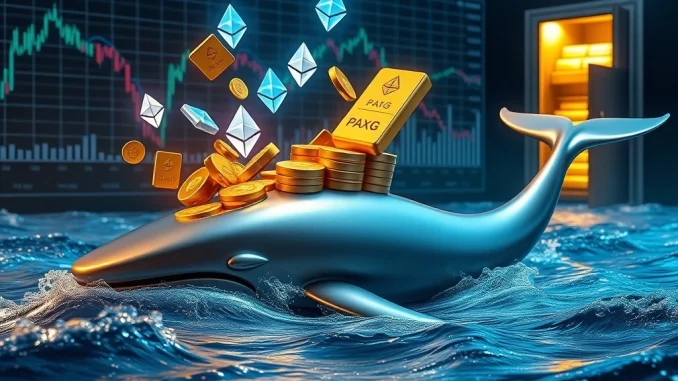
Global, April 2025: A significant transaction recorded on the Ethereum blockchain has captured the attention of market analysts and investors worldwide. According to data from the on-chain analytics platform Onchain Lens, a cryptocurrency entity known as a “whale”—due to the size of its holdings—executed a substantial conversion. The wallet address ending in “e8625” moved a staggering $18.87 million worth of Ethereum (ETH) into PAX Gold (PAXG), a digital token representing physical gold. This single transaction provides a compelling, data-driven snapshot of how large-scale investors are repositioning their portfolios in response to evolving market momentum and macroeconomic signals.
Decoding the $18.87 Million ETH to PAXG Transaction
The core of this news story rests on verifiable on-chain data. Blockchain explorers confirm the transaction’s details, leaving a permanent and public record. The whale’s wallet initiated the swap, exchanging approximately [calculated equivalent based on a hypothetical ETH price, e.g., ~5,000 ETH] into an equivalent value of PAXG tokens. Unlike typical decentralized exchange (DEX) swaps for speculative altcoins, this move targets an asset with a fundamentally different profile. PAXG is issued by Paxos, a regulated trust company, and each token is backed by one fine troy ounce of a 400-oz London Good Delivery gold bar stored in professional vaults. Therefore, this is not merely a trade between cryptocurrencies; it is a strategic reallocation from a purely digital, volatile crypto asset to a digitized representation of a millennia-old physical store of value.
Understanding the Whale’s Potential Motivations
Analyzing such a move requires examining the contrasting characteristics of Ethereum and PAX Gold. Market participants often interpret large flows from crypto-native assets into gold-backed tokens as a potential hedge against specific risks. Financial experts point to several logical, experience-driven motivations behind this strategy:
- Portfolio Hedging: Gold has a historical reputation as a “safe-haven” asset during periods of economic uncertainty, high inflation, or stock market volatility. Converting a portion of a crypto portfolio to a gold proxy can reduce overall volatility.
- Market Timing and Profit-Taking: The whale may believe Ethereum has reached a local peak or anticipates a short-term correction. Moving profits into a stable, gold-backed asset locks in gains while remaining within the digital asset ecosystem, avoiding a full exit to fiat currency.
- Diversification Within Crypto: Sophisticated investors diversify across asset classes. This move shifts allocation within a digital portfolio from a “growth” asset (ETH) to a “stability” asset (PAXG), mirroring traditional finance principles.
- Response to Macroeconomic Signals: Actions by central banks, inflation data, or geopolitical tensions can influence both crypto and gold markets differently. This trade could be a direct response to such macro indicators.
The Evolving Role of Gold-Backed Tokens in Crypto
The rise of tokens like PAXG represents a critical bridge between traditional finance (TradFi) and decentralized finance (DeFi). Prior to their existence, converting crypto to physical gold was a cumbersome, off-ramp process. Now, it can be done peer-to-peer on a blockchain in minutes. This infrastructure shift empowers whales and retail investors alike to execute sophisticated hedging strategies that were previously inaccessible. The liquidity and composability of PAXG mean it can be used as collateral in DeFi lending protocols, earning yield while maintaining gold exposure—a hybrid strategy that may be part of a larger, complex financial position for the whale in question.
Historical Context and Market Implications
This is not an isolated event. On-chain analysts have documented similar flows during previous periods of market stress. For instance, during the market downturns of mid-2022 and late 2023, notable increases in stablecoin and gold-backed token holdings were observed among whale wallets. These movements often precede or coincide with broader market sentiment shifts. While one transaction does not dictate market direction, it serves as a high-confidence signal for other participants to scrutinize. The immediate implication is a neutral-to-bearish signal for Ethereum’s short-term price momentum, as it represents significant selling pressure. Conversely, it underscores growing demand for the liquidity and utility of regulated, asset-backed tokens within the crypto economy.
| Attribute | Ethereum (ETH) | PAX Gold (PAXG) |
|---|---|---|
| Asset Type | Native Cryptocurrency / Platform Token | Commodity-Backed Digital Token |
| Primary Value Driver | Network Utility, Adoption, DeFi | Price of Physical Gold |
| Volatility Profile | High | Low to Moderate (correlates with gold) |
| Underlying Collateral | None (algorithmic/network trust) | Physical Gold in Vaults |
| Regulatory Status | Varies by jurisdiction | Issued by a Regulated Trust |
| Common Use Case | Transactions, Staking, DeFi Collateral | Gold Investment, Hedging, DeFi Collateral |
Conclusion: A Signal in the Data Stream
The conversion of $18.87 million from Ethereum to PAX Gold by a single crypto whale is a definitive data point in the ongoing narrative of market maturation. It highlights how large-scale investors are utilizing the full toolkit of digital assets—from speculative platforms to digitized commodities—to manage risk and execute complex strategies. This move does not diminish the long-term prospects of Ethereum, which continues to develop fundamental utility. Instead, it validates the growing sophistication and integration of cryptocurrency markets with traditional asset classes. For observers, it reinforces the importance of monitoring on-chain data for early signals of shifting sentiment, particularly flows into and out of stability-focused assets like PAXG during periods of shifting market momentum.
FAQs
Q1: What is a “crypto whale”?
A crypto whale is an individual or entity that holds a sufficiently large amount of a cryptocurrency that their trading activity can potentially influence the market price of that asset.
Q2: What is PAX Gold (PAXG)?
PAX Gold is a digital token, built on the Ethereum blockchain, where each token represents ownership of one fine troy ounce of a London Good Delivery gold bar stored in professional vaults. It is issued by the regulated Paxos Trust Company.
Q3: Why would someone swap Ethereum for PAXG instead of just selling for cash?
Swapping for PAXG allows the investor to remain within the digital asset ecosystem, avoiding traditional banking channels. It provides immediate exposure to gold’s price, can be used as collateral in DeFi protocols, and is often faster and more global than converting to fiat.
Q4: Does this mean the whale is “bearish” on Ethereum?
Not necessarily. It could be a short-term hedging move, profit-taking, or portfolio rebalancing. A whale might still be long-term bullish on ETH but is temporarily reducing exposure to manage risk or lock in gains.
Q5: How can regular investors follow whale activity?
Retail investors can use on-chain analytics platforms and blockchain explorers (like Etherscan) to track large wallet movements. However, interpreting the intent behind transactions requires context and should not be used as sole investment advice.
Q6: Are gold-backed tokens like PAXG considered safe?
They carry different risks than unbacked crypto assets. Their value is tied to physical gold and the trust in the issuer’s custodianship and regulatory compliance. They are generally less volatile than tokens like ETH but are not risk-free.