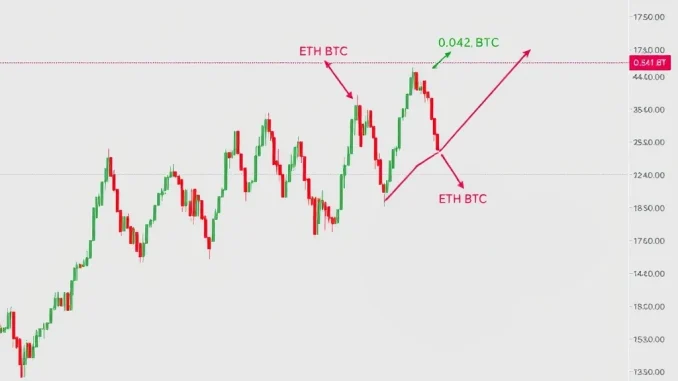
January 15, 2025 – The cryptocurrency market faces a pivotal technical moment as the ETH/BTC pair approaches a critical resistance level that could determine the next major trend direction between Ethereum and Bitcoin. Technical analysts worldwide are closely monitoring the 0.042 BTC neckline, a level that historically preceded significant market movements and now potentially signals a major trend reversal for Ethereum against its dominant counterpart.
ETH/BTC Technical Analysis Reveals Critical Pattern Formation
The cryptocurrency market exhibits complex technical patterns that often signal significant price movements. Currently, the ETH/BTC pair demonstrates a developing inverted head and shoulders formation, a classic technical analysis pattern frequently associated with bullish reversals. This pattern emerges after extended periods of downward pressure, suggesting potential exhaustion of bearish momentum.
Technical analysts identify the neckline resistance at precisely 0.042 BTC, representing a crucial threshold for market direction. Historical data from cryptocurrency exchanges shows this level previously acted as both support and resistance during different market cycles. The pattern’s completion requires a decisive breakout above this level with substantial volume confirmation.
Historical Precedent: 2019-2021 Pattern Comparison
Market analysts draw compelling parallels between current technical formations and historical patterns observed between 2019 and 2021. During that period, a similar inverted head and shoulders pattern preceded Ethereum’s substantial outperformance against Bitcoin. The historical rally saw ETH/BTC appreciate approximately 95% following the neckline breakout.
The current technical setup shares several characteristics with the 2019-2021 pattern:
- Similar duration: Both patterns developed over comparable timeframes
- Volume characteristics: Declining volume during pattern formation followed by breakout volume spikes
- Support/resistance alignment: Key technical levels align with previous market structure
- Market sentiment: Similar skepticism and divided analyst opinions during pattern development
Technical Measurement and Price Targets
Technical analysis provides specific measurement techniques for inverted head and shoulders patterns. The vertical distance from the head’s lowest point to the neckline establishes the minimum price objective following a confirmed breakout. Current measurements suggest a potential rally target of approximately 0.066 BTC, representing a 95% increase from current levels.
This technical projection aligns with Fibonacci extension levels and previous resistance zones identified on longer-term charts. However, analysts emphasize that pattern completion requires several confirmation signals beyond simple price movement above the neckline.
Conflicting Signals: Bear Pennant Threatens Bullish Outlook
While longer-term charts suggest bullish potential, shorter timeframes present conflicting technical signals. A bear pennant pattern has developed on daily charts, typically indicating continuation of the existing downtrend. This pattern presents immediate resistance around current price levels and suggests potential downward pressure.
The bear pennant’s measured move target falls within the 0.024-0.025 BTC range, representing significant downside risk if the pattern confirms. This technical conflict highlights the current market uncertainty and the importance of waiting for clear directional confirmation.
| Scenario | Pattern | Trigger Level | Price Target | Probability Factors |
|---|---|---|---|---|
| Bullish Reversal | Inverted Head & Shoulders | Break above 0.042 BTC | 0.066 BTC (+95%) | Volume confirmation, sustained breakout |
| Bearish Continuation | Bear Pennant | Break below pattern support | 0.024-0.025 BTC | Failed breakout, declining volume |
Market Context and Fundamental Backdrop
The technical patterns develop within a specific fundamental context that influences their potential outcomes. Ethereum’s network continues to demonstrate robust activity metrics, with daily transaction counts consistently exceeding 1 million and decentralized finance (DeFi) total value locked maintaining stability above $40 billion.
Bitcoin, meanwhile, faces its own technical challenges, with the dominant cryptocurrency testing key support levels following recent market volatility. The relative strength between these two major cryptocurrencies often signals broader market rotations and capital flow patterns within the digital asset ecosystem.
Analyst Perspectives and Market Sentiment
Market analysts remain divided on the likely outcome of the current technical setup. Some emphasize the historical precedent and structural similarities to previous bullish reversals, while others point to macroeconomic headwinds and regulatory uncertainties that could suppress cryptocurrency markets generally.
Several prominent technical analysts have published research noting the increasing correlation between traditional financial markets and cryptocurrency movements, particularly regarding interest rate expectations and liquidity conditions. These macroeconomic factors could influence the ETH/BTC pair’s direction independent of pure technical patterns.
Volume Analysis and Confirmation Requirements
Technical analysts universally emphasize volume as the critical confirmation factor for any potential breakout. Historical data shows that successful breakouts typically accompany volume spikes of 150-200% above average daily levels. Current volume patterns show modest increases but lack the explosive characteristics of previous confirmed breakouts.
The coming weeks require careful monitoring of several confirmation signals:
- Sustained price action: Multiple daily closes above the neckline
- Volume confirmation: Significant volume increase during breakout attempts
- Retest behavior: Successful support holds during subsequent retests of broken resistance
- Momentum indicators: Alignment of RSI, MACD, and other momentum tools
Risk Management Considerations
Professional traders emphasize risk management strategies when trading potential breakout scenarios. The current technical setup presents clear risk parameters, with stop-loss levels typically placed below pattern support for bullish scenarios or above pattern resistance for bearish scenarios.
Position sizing becomes particularly important given the substantial price targets in both directions. Many institutional trading desks reportedly maintain reduced position sizes until clearer directional confirmation emerges, reflecting the elevated uncertainty in current market conditions.
Conclusion
The ETH/BTC pair stands at a critical technical juncture with the 0.042 BTC neckline representing a decisive level for future trend direction. While historical patterns suggest potential for a 95% Ethereum rally against Bitcoin, conflicting shorter-term signals and macroeconomic uncertainties require cautious interpretation. Market participants should monitor volume confirmation and sustained price action above key resistance levels for validation of either scenario. The coming weeks will likely determine whether Ethereum can stage a significant trend reversal against Bitcoin or whether the dominant cryptocurrency maintains its relative strength advantage.
FAQs
Q1: What is the inverted head and shoulders pattern in technical analysis?
The inverted head and shoulders is a bullish reversal pattern that forms after a downtrend. It consists of three troughs, with the middle trough (head) being the deepest and the two outside troughs (shoulders) being shallower. A neckline resistance connects the highs between the troughs, and a breakout above this level signals potential trend reversal.
Q2: Why is the 0.042 BTC level significant for ETH/BTC?
The 0.042 BTC level represents the neckline resistance of the current inverted head and shoulders pattern. Historically, this level has acted as both support and resistance during previous market cycles. A decisive breakout above this level with volume confirmation could validate the bullish reversal pattern and trigger substantial upward movement.
Q3: How reliable are these technical patterns in cryptocurrency markets?
Technical patterns in cryptocurrency markets demonstrate similar reliability to traditional financial markets when combined with proper volume analysis and confirmation signals. However, cryptocurrency markets experience higher volatility and sometimes exhibit pattern failures due to sudden news events or regulatory developments. Multiple timeframe analysis and fundamental context improve pattern reliability.
Q4: What timeframes are analysts using for this ETH/BTC analysis?
Analysts typically examine multiple timeframes for comprehensive analysis. The inverted head and shoulders pattern appears on weekly and monthly charts, suggesting longer-term significance. The conflicting bear pennant pattern appears on daily charts, representing shorter-term pressure. This multi-timeframe analysis helps identify both immediate and longer-term potential scenarios.
Q5: How does this technical analysis relate to fundamental factors affecting Ethereum and Bitcoin?
Technical analysis operates alongside fundamental factors rather than in isolation. Ethereum’s fundamental strengths include network activity, DeFi ecosystem growth, and upcoming protocol upgrades. Bitcoin’s fundamentals include institutional adoption, regulatory developments, and macroeconomic conditions. The ETH/BTC ratio reflects the relative market perception of these fundamental factors through price action.
This article was produced with AI assistance and reviewed by our editorial team for accuracy and quality.