Elon Musk has unveiled ambitious plans to establish a major semiconductor manufacturing operation called “Terafab” to serve the growing artificial intelligence and robotics needs of Tesla and SpaceX, marking a significant expansion into the complex chip industry for the billionaire entrepreneur.
Elon Musk Announces Terafab Chip Manufacturing Venture
During an event in downtown Austin, Texas on March 21, 2026, Musk detailed his vision for a chip-building collaboration between his two most prominent companies. According to Bloomberg reports, the facility will be constructed near Tesla’s existing Austin headquarters and gigafactory. Musk stated the project addresses critical supply chain concerns, explaining that current semiconductor manufacturers cannot produce chips quickly enough to meet his companies’ requirements. “We either build the Terafab or we don’t have the chips, and we need the chips, so we build the Terafab,” Musk told attendees.
The announcement comes amid ongoing global semiconductor shortages that have affected numerous industries since 2020. Furthermore, it represents a strategic move to secure computing hardware for advanced AI systems powering Tesla’s autonomous driving technology and SpaceX’s spacecraft operations. Industry analysts note that custom silicon development has become increasingly crucial for technology companies seeking competitive advantages in artificial intelligence applications.
Technical Specifications and Manufacturing Goals
Musk outlined aggressive production targets for the proposed facility. The Terafab aims to manufacture chips capable of supporting between 100 and 200 gigawatts of computing power annually for terrestrial applications. Additionally, Musk revealed plans for space-based computing infrastructure targeting one terawatt of capacity. These specifications would place the operation among the world’s most substantial semiconductor manufacturing endeavors if achieved.
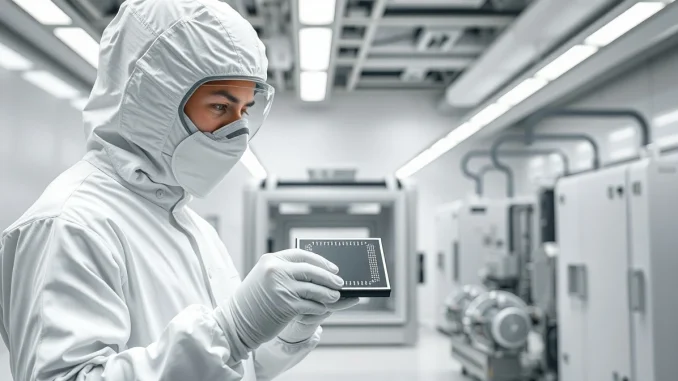
Semiconductor manufacturing represents one of the most capital-intensive and technically complex industries globally. Building a fabrication plant, or “fab,” typically requires investments ranging from $10 billion to $20 billion for advanced nodes. The process involves thousands of precise manufacturing steps conducted in ultra-clean environments to prevent microscopic contamination that could ruin entire batches of chips.
Industry Context and Competitive Landscape
The semiconductor industry currently remains dominated by established players including Taiwan Semiconductor Manufacturing Company (TSMC), Samsung Electronics, and Intel Corporation. These companies have developed manufacturing expertise over decades, with TSMC controlling approximately 54% of the global foundry market as of early 2026 according to industry research firm TrendForce.
Several technology companies have recently entered custom silicon development, though most partner with existing manufacturers rather than building their own fabrication facilities. Apple began designing its own chips in 2010 but relies on TSMC for manufacturing. Similarly, Amazon’s AWS developed the Graviton processors for cloud servers and the Trainium chips for machine learning, both manufactured by established semiconductor companies. Google created its Tensor Processing Units (TPUs) for AI workloads, also manufactured through partnerships.
The table below illustrates recent custom silicon initiatives by major technology companies:
| Company | Chip Initiative | Manufacturing Partner | Primary Application |
|---|---|---|---|
| Apple | M-series processors | TSMC | Personal computing |
| Amazon | Graviton, Trainium | Multiple foundries | Cloud computing, AI |
| Tensor Processing Units | Multiple foundries | Artificial intelligence | |
| Microsoft | Azure Maia AI Accelerator | TSMC | Cloud AI infrastructure |
| Tesla/SpaceX | Terafab (proposed) | Self-manufactured | AI, robotics, space systems |
Strategic Implications for Tesla and SpaceX
The proposed Terafab facility would provide several strategic advantages for Musk’s companies if successfully implemented. Firstly, vertical integration could reduce dependence on external suppliers during periods of semiconductor scarcity. The automotive industry experienced severe production disruptions during the 2021-2023 chip shortage, with consulting firm AlixPartners estimating global automotive revenue losses exceeding $210 billion.
Secondly, custom silicon optimized for specific applications typically delivers superior performance and energy efficiency compared to general-purpose chips. Tesla’s Full Self-Driving computer, already utilizing custom-designed chips, processes visual data from vehicle cameras for autonomous driving functions. SpaceX’s Starlink satellites and spacecraft systems similarly require specialized computing capabilities for communication, navigation, and operational control.
Thirdly, controlling the manufacturing process enables faster iteration cycles for chip designs. This advantage proves particularly valuable for AI applications where algorithmic advancements occur rapidly. Companies like NVIDIA have demonstrated how specialized hardware accelerators can provide substantial competitive advantages in artificial intelligence markets.
Implementation Challenges and Historical Context
Bloomberg’s reporting noted that Musk lacks direct experience in semiconductor manufacturing, though he has successfully led complex engineering organizations across multiple industries. The article also referenced Musk’s history of ambitious timelines that sometimes experience delays. Tesla’s initial production challenges with the Model 3 in 2017-2018 and SpaceX’s developmental timeline for the Starship spacecraft demonstrate both the difficulties and eventual successes possible with Musk’s ambitious engineering projects.
Semiconductor manufacturing presents unique challenges including:
- Extreme capital requirements: Advanced fabrication facilities require investments measured in tens of billions of dollars
- Specialized expertise: Chip manufacturing involves thousands of highly trained engineers and technicians
- Supply chain complexity: Semiconductor production depends on specialized equipment from companies like ASML, Applied Materials, and Lam Research
- Regulatory compliance: Fabrication facilities must meet stringent environmental and safety regulations
- Technological pace: Chip manufacturing technology advances rapidly, requiring continuous investment to remain competitive
Intel’s struggles with its 10nm and 7nm manufacturing processes between 2018 and 2021 illustrate how even established semiconductor companies with decades of experience can encounter significant technical challenges. The company eventually regained manufacturing competitiveness but only after substantial reorganization and investment exceeding $20 billion in new fabrication facilities.
Market Reactions and Industry Analysis
The semiconductor industry has experienced remarkable growth since 2020, driven by increasing digitalization, artificial intelligence adoption, and automotive electronics. The global semiconductor market reached approximately $574 billion in 2024 according to the Semiconductor Industry Association, representing a compound annual growth rate of 6.3% over the previous five years.
Industry analysts express mixed perspectives on Musk’s announcement. Some note that successful entry would require overcoming substantial barriers including:
- Recruiting thousands of semiconductor engineering professionals
- Securing advanced manufacturing equipment with long lead times
- Developing process technology competitive with industry leaders
- Managing the extraordinary capital requirements of fab construction
However, other observers point to Musk’s track record of achieving seemingly impossible engineering feats, including reusable rocket technology at SpaceX and mass-market electric vehicles at Tesla. The companies collectively employ over 140,000 people as of early 2026 and have demonstrated capability in complex manufacturing across automotive, battery, and aerospace domains.
Conclusion
Elon Musk’s Terafab chip manufacturing announcement represents one of the most ambitious vertical integration moves in recent technology history. The proposed facility aims to address critical semiconductor supply needs for Tesla’s artificial intelligence and robotics initiatives and SpaceX’s space computing requirements. While the project faces significant technical, financial, and operational challenges inherent to semiconductor manufacturing, Musk’s companies possess substantial engineering resources and manufacturing experience. The success or failure of this chip manufacturing venture will significantly influence both companies’ technological trajectories and potentially reshape portions of the global semiconductor landscape. As with previous Musk initiatives, execution will determine whether Terafab becomes a transformative manufacturing achievement or an overambitious undertaking in one of technology’s most demanding fields.
FAQs
Q1: What is the Terafab that Elon Musk announced?
The Terafab is a proposed semiconductor manufacturing facility that would produce custom chips for Tesla and SpaceX. Musk revealed plans for the chip-building collaboration during an event in Austin, Texas on March 21, 2026.
Q2: Why does Elon Musk want to manufacture chips for Tesla and SpaceX?
Musk stated that existing semiconductor manufacturers cannot produce chips quickly enough to meet his companies’ artificial intelligence and robotics requirements. Vertical integration would provide supply security and potentially performance advantages for specialized applications.
Q3: What are the production targets for the Terafab facility?
The facility aims to manufacture chips supporting 100 to 200 gigawatts of computing power annually on Earth, along with one terawatt of computing capacity in space for SpaceX applications.
Q4: Has Elon Musk worked in semiconductor manufacturing before?
No, Musk does not have a background in semiconductor manufacturing. However, he has led complex engineering organizations at Tesla, SpaceX, and previously at companies like PayPal and Zip2.
Q5: How does this announcement fit with broader industry trends?
Technology companies increasingly develop custom silicon for specialized applications, though most partner with existing manufacturers rather than building their own fabrication facilities. Examples include Apple’s M-series processors, Amazon’s Trainium chips, and Google’s Tensor Processing Units.
Updated insights and analysis added for better clarity.
This article was produced with AI assistance and reviewed by our editorial team for accuracy and quality.