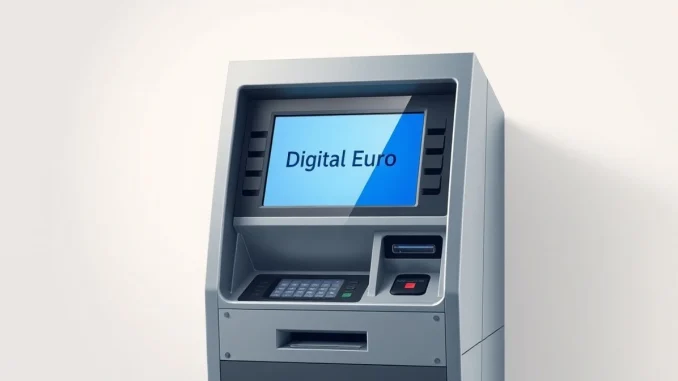
The European Central Bank has launched a significant technical phase in its digital euro project, opening applications for industry experts to define how the central bank digital currency would function across Europe’s vast network of ATMs and payment terminals. This move, announced on March 18, 2026, signals a concrete shift from policy design to practical implementation planning for what could become the eurozone’s first digital currency.
Digital Euro Technical Workstreams Target Existing Infrastructure
The ECB is now seeking technical specialists through two specific workstreams under its Rulebook Development Group. Consequently, these initiatives will directly address how a potential digital euro integrates with Europe’s current payment hardware. The first workstream focuses exclusively on implementation specifications for ATM and terminal providers. Specifically, this includes communication technologies, offline functionality, and the reuse of existing payment standards like those developed by the European Payments Council.
Meanwhile, the second workstream will develop proposals for testing, certification, and approval processes. These frameworks will govern payment solutions and infrastructure used by payment service providers within the digital euro ecosystem. Therefore, the ECB aims to create a standardized rulebook that ensures interoperability across all 20 eurozone countries.
Offline Transactions and Interoperability as Core Priorities
The initiative particularly emphasizes how a digital euro would operate across existing payment rails. A key technical challenge involves enabling secure offline transactions while maintaining robust anti-fraud measures. Additionally, the ECB stresses interoperability with technical standards already used across Europe. This approach potentially reduces implementation costs and accelerates adoption timelines.
According to the ECB’s announcement, selected experts will provide technical input to support rulebook development. The Rulebook Development Group itself includes representatives from merchants, payment service providers, and consumers. This structure ensures multiple stakeholder perspectives inform the technical specifications.
ECB Targets 2027 for Digital Euro Pilot Program
The technical workstreams align with the ECB’s previously outlined timeline for a digital euro pilot. The central bank plans to start selecting European Union-licensed payment service providers ahead of a 12-month pilot expected to begin in the second half of 2027. On February 18, 2026, ECB Executive Board Member Piero Cipollone clarified the pilot’s scope. It will involve a limited number of merchants, Eurosystem staff, and PSPs for controlled testing.
However, the ECB maintains that a final decision on issuing a digital euro will only occur after relevant European Union legislation is adopted. The European Commission proposed a digital euro legal framework in June 2023. Since then, the legislative process has advanced through the European Parliament and Council. The technical work now underway prepares the infrastructure should political approval be granted.
Broader Context of Global CBDC Development
The ECB’s move occurs within a global landscape where over 130 countries are exploring central bank digital currencies. The Bank for International Settlements reports that 36 CBDC pilots were active globally as of December 2025. Major economies like China have already launched large-scale digital currency trials. Similarly, the United States Federal Reserve continues research on a digital dollar.
For the eurozone, a digital euro aims to preserve monetary sovereignty amid rising private digital payment solutions and stablecoins. The ECB has previously warned that stablecoins could weaken bank lending and monetary policy transmission in Europe. A well-designed digital euro could provide a secure, public digital payment option alongside cash.
Technical Challenges and Implementation Considerations
Integrating a digital euro with existing ATM networks presents distinct technical hurdles. ATMs must authenticate users and process transactions without constant online connectivity, especially for offline functionality. Payment terminals at merchants face similar requirements for speed, security, and reliability. The workstreams will address these challenges through detailed technical specifications.
The certification framework represents another critical component. Payment service providers need clear guidelines for testing their solutions against digital euro standards. A robust certification process ensures security and interoperability across different providers and national borders. This is essential for a seamless user experience throughout the euro area.
Key technical areas for the workstreams include:
- Communication protocols between devices and central systems
- Security standards for offline transaction storage and processing
- Hardware requirements for existing ATM and terminal upgrades
- Certification pathways for PSP-developed payment applications
- Interoperability with SEPA Instant Credit Transfer and other EU schemes
Industry Response and Expert Analysis
Financial technology analysts view the ECB’s call for experts as a natural progression in the digital euro project. Industry groups like the European ATM Security Team and the European Payments Institutions Federation have monitored CBDC developments closely. Their members will likely contribute expertise to the ECB workstreams given the practical implications for their operations.
Academic researchers from institutions like the Goethe University Frankfurt’s Institute for Monetary and Financial Stability have published extensively on digital euro design. Their work emphasizes the importance of balancing innovation with financial stability. The ECB’s technical approach appears to incorporate these principles by building upon existing infrastructure rather than creating entirely new systems.
Conclusion
The European Central Bank has entered a decisive implementation phase for its digital euro project by opening technical workstreams focused on ATM and payment terminal integration. This practical step moves beyond theoretical design to address how a digital euro would function in daily transactions across Europe. With a targeted pilot in 2027 and ongoing legislative processes, the digital euro remains a priority for the eurozone’s financial future. The success of these technical efforts will significantly influence the currency’s potential adoption, security, and utility for over 340 million potential users.
FAQs
Q1: What is the ECB announcing regarding the digital euro?
The European Central Bank is opening applications for industry experts to join two technical workstreams. These groups will develop implementation specifications for integrating a digital euro with ATMs and payment terminals, plus certification frameworks for payment solutions.
Q2: When does the ECB plan to pilot the digital euro?
The ECB targets starting a 12-month pilot program in the second half of 2027. This pilot will involve a limited number of merchants, Eurosystem staff, and licensed payment service providers for controlled testing.
Q3: Will the digital euro work offline?
Yes, offline functionality is a stated priority. The technical workstreams will specifically address how a digital euro can enable secure transactions without constant internet connectivity, similar to cash.
Q4: Has the ECB decided to issue a digital euro?
No final decision has been made. The ECB states that a decision will only occur after the relevant European Union legislation is formally adopted. The current technical work prepares the infrastructure in case of political approval.
Q5: How does this development fit with global CBDC trends?
The ECB’s technical planning aligns with broader global central bank digital currency development. Over 130 countries are exploring CBDCs, with several already conducting pilots. The eurozone’s approach emphasizes integration with existing payment systems and hardware.
Updated insights and analysis added for better clarity.
This article was produced with AI assistance and reviewed by our editorial team for accuracy and quality.