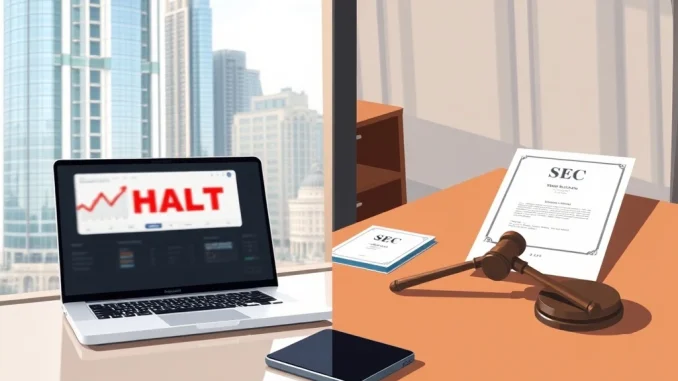
In a significant day for global cryptocurrency oversight, regulators in Dubai and the United States took decisive actions on March 20, 2026, signaling a tightening regulatory environment. The Virtual Assets Regulatory Authority (VARA) in Dubai issued a cease-and-desist order to entities operating the KuCoin exchange, demanding they halt all unlicensed virtual asset services for Dubai residents. Simultaneously, the U.S. Securities and Exchange Commission (SEC) finalized a $10 million settlement with entrepreneur Justin Sun, concluding a three-year legal battle, and submitted a pivotal regulatory proposal to the White House that could redefine how cryptocurrencies are classified under securities law. These parallel developments underscore a coordinated, yet geographically distinct, push for clearer compliance frameworks in the digital asset space.
Dubai’s VARA Orders KuCoin to Stop Unlicensed Operations
Dubai’s ambitious project to become a global crypto hub faced a reality check as its dedicated regulator, VARA, enforced its licensing regime with new rigor. The authority identified four entities—Phoenixfin Pte Ltd, MEK Global Limited, Peken Global Limited, and Kucoin Exchange EU GmbH—all commercially advertising as KuCoin, as operating without the necessary Virtual Asset Service Provider (VASP) license. VARA’s public alert stated these entities “may be providing virtual asset activities to Dubai residents without the necessary regulatory approvals and misrepresenting its licensing status.” The directive compels an immediate halt to all digital asset activities targeting the emirate’s market. This enforcement is grounded in Dubai Law No. 4 of 2022 and Cabinet Resolution No. 111/2022, which mandate that all VASPs obtain formal approval to operate legally within the UAE. The move protects investors but also tests Dubai’s balance between fostering innovation and maintaining strict oversight.
The action against KuCoin is not an isolated incident but part of VARA’s phased implementation plan. Since its establishment, VARA has gradually onboarded major exchanges like Binance and Bybit through its Minimum Viable Product (MVP) license phase. KuCoin’s absence from this licensed cohort had been noted by industry observers. The public “investor and marketplace alert” serves a dual purpose: directly pressuring the exchange and signaling to the broader market that Dubai’s regulatory framework has enforceable teeth. For KuCoin, the path forward involves engaging with VARA’s comprehensive application process, which includes stringent requirements on governance, anti-money laundering controls, and consumer protection—a process that can take several months.
SEC Concludes Justin Sun Case with $10 Million Settlement
Across the globe, the U.S. Securities and Exchange Commission closed a chapter on one of its most prominent crypto enforcement cases. The SEC informed a Manhattan federal court that it reached a settlement with Justin Sun and his associated companies, the Tron Foundation and BitTorrent Foundation. Under the terms, Sun’s company Rainberry will pay a $10 million civil penalty, while the claims against Sun and the foundations will be dropped. Crucially, the settlement includes no admission or denial of the SEC’s original allegations from March 2023, which accused Sun and his companies of selling unregistered securities via Tronix (TRX) and BitTorrent (BTT) tokens and engaging in manipulative “wash trading.”
The resolution follows a notable political shift. Shortly after Donald Trump’s inauguration in January 2025, Sun acquired a $75 million stake in the Trump family’s World Liberty Financial crypto project. A month later, both parties requested the court pause the case for settlement talks. In a post on X after the settlement, Sun stated, “today’s resolution brings closure,” adding he looked forward to “working with the SEC to develop guidance and regulations for crypto going forward.” This language suggests a strategic pivot from adversarial litigation to collaborative dialogue, potentially reflecting a broader industry trend under the current administration. The settlement removes a significant legal overhang for Sun’s ecosystem but leaves unresolved the core question of whether TRX and BTT are securities—a determination deferred to the SEC’s new proposed framework.
Legal Experts Weigh In on the Settlement’s Significance
“The Sun settlement is a classic ‘neither admit nor deny’ resolution that allows the SEC to claim a victory and collect a penalty while letting the defendant move on,” noted Eleanor Vance, a former SEC enforcement attorney now with the firm Clayton & Greene. “It doesn’t set a legal precedent on the securities question, but it does signal the Commission’s willingness to settle high-profile cases under the right conditions, especially when it aligns with a broader regulatory strategy.” Vance points to the simultaneous submission of the “token taxonomy” proposal as the more consequential action. The settlement’s timing, she argues, may have been strategically coordinated to clear the deck before introducing new interpretive guidance, allowing the SEC to present a more forward-looking, rather than punitive, posture to the industry and the White House.
SEC Proposes New “Token Taxonomy” for Crypto Assets
The most potentially far-reaching development of the day was the SEC’s submission of a regulatory proposal to the White House Office of Information and Regulatory Affairs (OIRA). Titled “commission interpretation on application of the federal securities laws to certain types of crypto assets and certain transactions involving crypto assets,” the document reportedly outlines a “token taxonomy” framework. This framework aims to provide clearer criteria for determining which digital assets fall under the SEC’s purview as securities, moving beyond the often-criticized application of the decades-old Howey Test to novel digital assets. The proposal is not a rule but an interpretative guidance, which can be enacted more swiftly than formal rulemaking.
This initiative seeks to address the industry’s long-standing complaint about regulatory ambiguity. A clear taxonomy could distinguish between, for example, a token representing an investment contract in a startup (likely a security) and a fully decentralized, functional token used solely for network governance or transactions (potentially not a security). The proposal’s details remain under review at OIRA, a mandatory step that assesses economic impact and alignment with administration policy. Its submission indicates the SEC is responding to both industry pressure and potential legislative threats from Congress to clarify its authority. The move aligns with a global trend, as jurisdictions from the European Union with its Markets in Crypto-Assets (MiCA) regulation to Hong Kong with its new licensing regime are establishing their own classification systems.
Comparing Global Crypto Regulatory Approaches
| Jurisdiction | Regulatory Body | Core Approach | Key Legislation/Framework |
|---|---|---|---|
| United States | SEC, CFTC | Enforcement-driven, asset classification (security/commodity) | Proposed “Token Taxonomy” (2026), Howey Test |
| European Union | Multiple National Authorities + EBA | Unified, comprehensive rulebook for issuers & service providers | Markets in Crypto-Assets (MiCA) Regulation |
| Dubai/UAE | Virtual Assets Regulatory Authority (VARA) | Pro-innovation with mandatory licensing for all VASPs | Dubai Law No. 4 of 2022 |
| Hong Kong | Securities and Futures Commission (SFC) | Licensing for exchanges, retail trading permitted under rules | Anti-Money Laundering Ordinance, SFC Guidelines |
What Happens Next: Implications for Exchanges and Projects
The immediate consequence for KuCoin is a forced retreat from the Dubai market until it secures a VASP license. The exchange must now decide whether to undergo VARA’s rigorous process or cede the strategically important Dubai market to licensed competitors like Binance and Bybit. For other international exchanges eyeing the region, the message is clear: full compliance is non-negotiable. Meanwhile, the SEC’s actions create a bifurcated path. The settled case against Sun allows his projects to operate without the cloud of active litigation, though they remain subject to future enforcement under any new guidelines. The proposed taxonomy, once released, will become the new benchmark against which every existing and future token project in the U.S. will be measured, likely triggering a wave of legal reassessments and potentially, preemptive compliance restructuring.
Industry and Community Reactions to a Landmark Day
Reaction from the crypto community has been mixed. “VARA’s action is tough but fair,” said Mikhail Al Zaabi, a Dubai-based blockchain consultant. “It shows the regulator is serious about protecting its market, which in the long run builds trust and attracts more legitimate capital.” In contrast, some decentralized finance (DeFi) advocates expressed concern about the SEC’s taxonomy proposal. “The devil is in the details,” posted the pseudonymous founder of a DeFi protocol on a popular forum. “Any taxonomy that relies heavily on the level of ‘decentralization’ is inherently subjective and could be weaponized. We need bright-line rules, not more regulatory discretion.” Major industry groups like the Blockchain Association have issued cautious statements, welcoming regulatory clarity in principle but reserving judgment until the full SEC proposal is public.
Conclusion
March 20, 2026, stands as a pivotal date marking a new phase of maturity in global crypto regulation. Dubai demonstrated its commitment to a regulated crypto ecosystem by enforcing its licensing laws against a major exchange. The U.S. SEC, simultaneously, closed a contentious legal battle and took a preliminary step toward the regulatory clarity the industry has long demanded. The KuCoin directive and the SEC’s dual actions, while geographically separate, collectively underscore a worldwide shift from regulatory ambiguity toward defined frameworks. For investors and builders, the message is increasingly unified: long-term success in the digital asset space will be inextricably linked to proactive engagement with evolving compliance standards. The coming months, as KuCoin responds to VARA and the SEC’s taxonomy is unveiled, will critically shape the operational landscape for the entire sector.
Frequently Asked Questions
Q1: Why did Dubai’s VARA order KuCoin to stop operations?
Dubai’s Virtual Assets Regulatory Authority (VARA) issued the order because the entities operating the KuCoin exchange were providing virtual asset services to Dubai residents without obtaining the mandatory VASP license required under Dubai Law No. 4 of 2022. VARA determined they were operating without regulatory approval and potentially misrepresenting their licensing status.
Q2: What does the SEC’s $10 million settlement with Justin Sun mean?
The settlement ends the SEC’s lawsuit against Sun and his companies without a trial. Sun’s company Rainberry will pay the fine, and the claims are dropped, with no admission or denial of wrongdoing. It resolves the legal uncertainty for Sun’s projects but does not create a legal precedent on whether the tokens involved (TRX and BTT) are securities.
Q3: What is the “token taxonomy” proposal submitted by the SEC?
It is a draft interpretative guidance sent to the White House that aims to create a clearer framework for classifying different types of crypto assets under U.S. securities laws. The goal is to move beyond the vague application of the Howey Test and provide more specific criteria to determine which tokens are considered securities and thus fall under SEC jurisdiction.
Q4: Can KuCoin resume operations in Dubai?
Yes, but only after it successfully applies for and receives a Virtual Asset Service Provider (VASP) license from VARA. This process involves demonstrating compliance with strict requirements on corporate governance, consumer protection, security, and anti-money laundering standards. There is no guaranteed timeline for approval.
Q5: How do the day’s events affect the average cryptocurrency investor?
For investors, these actions are ultimately aimed at increasing market safety and clarity. The Dubai move protects residents from unlicensed platforms. The SEC’s actions could lead to clearer rules for U.S. investors, helping distinguish between compliant and non-compliant projects. However, short-term uncertainty may persist until the new rules are fully understood.
Q6: Does the SEC settlement mean TRX and BTT are not securities?
No, the settlement explicitly does not determine the legal status of the tokens. The “neither admit nor deny” terms leave that fundamental question unanswered. The SEC’s forthcoming “token taxonomy” guidance will be the agency’s next attempt to provide an answer for these and thousands of other digital assets.