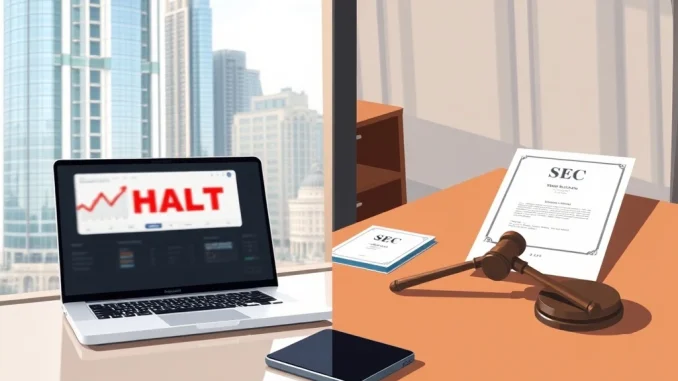
DUBAI, UAE & WASHINGTON, DC — March 20, 2026: Global cryptocurrency markets face simultaneous regulatory actions today as Dubai’s Virtual Assets Regulatory Authority (VARA) ordered KuCoin entities to cease operations, while the U.S. Securities and Exchange Commission finalized a $10 million settlement with entrepreneur Justin Sun. These developments, occurring within hours of each other, signal intensifying regulatory scrutiny across major jurisdictions. Meanwhile, the SEC submitted a potentially transformative “token taxonomy” proposal to the White House that could redefine how cryptocurrencies are classified under U.S. securities laws. Today’s coordinated actions represent the most significant crypto regulatory enforcement day since the 2023 industry-wide crackdown, affecting exchanges, token issuers, and market participants globally.
Dubai’s VARA Orders KuCoin to Halt Unlicensed Operations Immediately
Dubai’s Virtual Assets Regulatory Authority issued a decisive investor alert at 10:00 AM local time today, instructing four entities operating under the KuCoin brand to immediately cease all virtual asset services to Dubai residents. The regulator specifically named Phoenixfin Pte Ltd, MEK Global Limited, Peken Global Limited, and Kucoin Exchange EU GmbH as operating “without the necessary regulatory approvals and misrepresenting its licensing status.” VARA’s enforcement action cites violations of Dubai Law No. 4 of 2022 and Cabinet Resolution No. 111/2022, which mandate licensing for all virtual asset service providers operating within the emirate. The cease-and-desist order represents Dubai’s most aggressive enforcement action against a major exchange since establishing VARA in 2022 as part of its comprehensive virtual assets regulatory framework.
Market analysts immediately noted the timing significance. Dubai has positioned itself as a global crypto hub, attracting numerous exchanges with its progressive regulatory approach. However, today’s action demonstrates VARA’s commitment to enforcement. “This isn’t about being anti-crypto,” explained regulatory analyst Fatima Al-Mansoori of the Gulf Financial Markets Institute. “It’s about establishing credibility. Dubai wants to attract legitimate operators who follow the rules. By taking action against a major player like KuCoin, they’re sending a clear message that no one operates outside the licensing framework.” The alert specifically warned Dubai residents that KuCoin lacks authorization to serve them, marking the first time VARA has publicly named and ordered a top-10 global exchange to halt operations.
SEC Concludes Three-Year Justin Sun Case with $10 Million Settlement
Simultaneously in New York, the U.S. Securities and Exchange Commission filed settlement documents in Manhattan federal court, ending its high-profile lawsuit against Justin Sun and his associated companies. The SEC’s three-year legal battle concluded with Rainberry Inc., one of Sun’s companies, agreeing to pay a $10 million civil penalty. Crucially, the settlement drops all claims against Sun personally, along with the Tron Foundation and BitTorrent Foundation, while requiring no admission or denial of the SEC’s original allegations. The March 2023 lawsuit accused Sun and his companies of selling unregistered securities through TRX and BTT tokens and engaging in manipulative wash trading.
The settlement follows significant political developments. After Donald Trump’s January 2025 inauguration, Sun acquired a $75 million stake in the Trump family’s World Liberty Financial crypto project. One month later, both parties requested the court pause proceedings for settlement talks. “Today’s resolution brings closure,” Sun posted on X immediately after the filing. “I look forward to working with the SEC to develop guidance and regulations for crypto going forward.” Legal experts interpret the settlement as strategically significant. “This represents a pragmatic resolution for both sides,” said securities attorney Michael Carter of Stanford Law School’s Digital Assets Program. “The SEC gets a substantial penalty and a public enforcement win. Sun avoids personal liability and potentially damaging precedent. Most importantly, it removes legal uncertainty that has hovered over the Tron ecosystem since 2023.”
Comparative Analysis: Global Crypto Regulatory Actions March 2026
The table below illustrates how today’s actions fit within broader global regulatory trends affecting cryptocurrency markets and exchanges.
| Jurisdiction | Regulatory Body | Action Type | Target | Key Legal Basis |
|---|---|---|---|---|
| Dubai, UAE | Virtual Assets Regulatory Authority (VARA) | Cease & Desist Order | KuCoin Entities | Dubai Law No. 4 of 2022 (Unlicensed Operations) |
| United States | Securities & Exchange Commission (SEC) | Civil Settlement | Justin Sun & Companies | Securities Act Violations (Unregistered Offerings) |
| European Union | European Securities and Markets Authority (ESMA) | Guidance Implementation | All Crypto Asset Providers | Markets in Crypto-Assets (MiCA) Regulation |
| United Kingdom | Financial Conduct Authority (FCA) | Registration Requirement | All Crypto Firms | Financial Services and Markets Act 2023 |
| Singapore | Monetary Authority of Singapore (MAS) | Licensing Framework | Digital Payment Token Services | Payment Services Act 2019 |
SEC’s “Token Taxonomy” Proposal Could Reshape U.S. Crypto Regulation
Perhaps the most consequential development emerged from the SEC’s Tuesday submission to the White House Office of Information and Regulatory Affairs. The commission filed what officials describe as “interpretative guidance around token taxonomy”—a framework determining which cryptocurrencies qualify as securities under federal law. While full details remain confidential during regulatory review, sources familiar with the proposal indicate it establishes clear criteria based on token functionality, distribution method, and ongoing development control. This represents the SEC’s most significant attempt to provide regulatory clarity since the 2019 Framework for Investment Contract Analysis of Digital Assets.
Industry observers note the proposal’s timing coincides with increasing legislative pressure. “Congress has been pushing for clearer rules,” noted Georgetown University law professor Sarah Chen, who specializes in fintech regulation. “The SEC appears to be proactively establishing its interpretive authority before legislation potentially limits its jurisdiction. A formal taxonomy could reduce enforcement by litigation and provide the predictability markets need.” The proposal reportedly distinguishes between tokens functioning primarily as mediums of exchange versus those representing investment contracts, potentially exempting Bitcoin and similar assets from securities classification while maintaining oversight over tokens with centralized development teams and profit expectations.
Immediate Market Reactions and Industry Response
Crypto markets showed mixed reactions within the first trading hours following the announcements. TRX initially dipped 3.2% before recovering most losses, while exchange tokens generally underperformed the broader market. KuCoin’s native KCS token fell 8.7% following the Dubai news. More significantly, regulatory uncertainty premiums—as measured by volatility index derivatives—declined slightly, suggesting some investors view the SEC settlement as reducing legal overhang. “Markets hate uncertainty more than they hate regulation,” explained Bloomberg Intelligence crypto analyst Jamie Redman. “The Sun settlement removes a specific uncertainty. The taxonomy proposal, if adopted, could reduce broader uncertainty about what constitutes a security.”
Industry associations offered measured responses. The Blockchain Association called the developments “steps toward clarity” while urging “proportionate, innovation-friendly regulation.” Crypto exchange Binance, which secured a VARA license last year, reaffirmed its “commitment to compliance across all jurisdictions.” Meanwhile, investor protection groups praised the actions. “Today shows regulators worldwide are coordinating and enforcing existing rules,” said Consumer Federation of America’s financial services director Mark T. Williams. “This protects investors while allowing legitimate innovation to flourish within clear boundaries.”
What Happens Next: Timeline and Forward Implications
The immediate next steps involve procedural compliance. KuCoin entities must demonstrate to VARA that they have ceased Dubai operations, potentially applying for proper licensing. The SEC settlement requires court approval, typically a formality in such consent agreements. The taxonomy proposal enters a standard White House review process, with potential publication for public comment within 30-60 days. Longer-term, today’s events may establish patterns for future enforcement. “We’re seeing maturation,” observed International Monetary Fund fintech lead Dong He. “Jurisdictions like Dubai are moving beyond framework creation to active enforcement. The U.S. is moving toward clearer classification. This normalization is necessary for institutional adoption.”
Market participants should monitor several developments. First, whether other exchanges face similar VARA scrutiny. Second, how the taxonomy proposal evolves during review. Third, whether the Sun settlement influences other SEC cases against crypto figures. Finally, how these actions affect Dubai’s attractiveness as a crypto hub versus competitors like Singapore and Switzerland. “The message is compliance isn’t optional,” summarized PwC’s global crypto leader Henri Arslanian. “2026 is shaping up as the year of regulatory implementation. Today’s news accelerates that trend.”
Conclusion
March 20, 2026, marks a pivotal moment in cryptocurrency regulatory evolution. Dubai’s decisive action against KuCoin demonstrates that even crypto-friendly jurisdictions will enforce licensing requirements aggressively. The SEC’s settlement with Justin Sun concludes a major legal battle while potentially opening collaborative channels between regulators and industry leaders. Most significantly, the SEC’s token taxonomy proposal could provide the regulatory clarity that has eluded U.S. crypto markets for nearly a decade. Together, these developments signal a global regulatory shift from framework creation to active enforcement and classification. For investors and industry participants, the era of operating in regulatory gray areas is ending. The path forward requires navigating clearly defined—and actively enforced—rules across major jurisdictions. As today’s coordinated actions demonstrate, crypto regulatory news now moves markets and shapes industry trajectories with unprecedented immediacy.
Frequently Asked Questions
Q1: Why did Dubai’s VARA order KuCoin to stop operations?
Dubai’s Virtual Assets Regulatory Authority ordered KuCoin to cease operations because four entities operating under the KuCoin brand were providing virtual asset services to Dubai residents without obtaining the required VARA license. The regulator determined they were violating Dubai Law No. 4 of 2022, which mandates licensing for all virtual asset service providers in the emirate.
Q2: What does the SEC’s $10 million settlement with Justin Sun mean for TRX and BTT holders?
The settlement removes legal uncertainty that has affected TRX and BTT tokens since the SEC’s March 2023 lawsuit. With the case resolved and no admission of wrongdoing required, the regulatory overhang diminishes. However, the settlement doesn’t change the tokens’ regulatory status—they remain subject to existing securities laws unless the SEC’s proposed taxonomy reclassifies them.
Q3: What is the SEC’s “token taxonomy” proposal and when might it take effect?
The SEC’s token taxonomy proposal is interpretative guidance submitted to the White House that establishes criteria for determining which cryptocurrencies qualify as securities. It aims to provide clearer classification based on token functionality and characteristics. After White House review, it would undergo public comment before potential implementation, likely in late 2026 or early 2027.
Q4: How will Dubai’s action against KuCoin affect other crypto exchanges operating there?
Other licensed exchanges like Binance and Coinbase shouldn’t face immediate impacts, as they already hold VARA licenses. However, the action signals VARA will actively enforce licensing requirements. Unlicensed exchanges serving Dubai residents should expect scrutiny and may need to cease operations or apply for licenses promptly.
Q5: Can KuCoin resume operations in Dubai after this order?
Yes, KuCoin entities can potentially resume Dubai operations by applying for and obtaining the proper VARA licenses. The cease-and-desist order specifically targets unlicensed operations, not a permanent ban. The exchange would need to demonstrate compliance with VARA’s comprehensive regulatory requirements for virtual asset service providers.
Q6: How do today’s developments affect average cryptocurrency investors?
For average investors, today’s news reinforces the importance of using properly licensed exchanges in their jurisdictions. Regulatory actions against unlicensed operators provide investor protection. The SEC’s taxonomy proposal, if adopted, could eventually make it clearer which tokens are securities versus commodities, affecting how they’re traded and taxed.