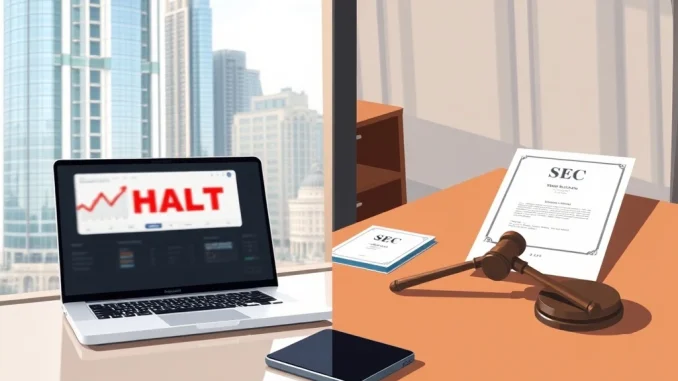
In a significant day for global cryptocurrency oversight, regulatory authorities in Dubai and the United States took decisive actions on Thursday, March 20, 2026, that signal tightening enforcement and evolving frameworks for digital assets. The Virtual Assets Regulatory Authority (VARA) in Dubai ordered entities behind the major exchange KuCoin to cease all unlicensed operations within the emirate. Simultaneously, the U.S. Securities and Exchange Commission (SEC) finalized a $10 million settlement with entrepreneur Justin Sun, concluding a three-year legal battle, and separately submitted a pivotal regulatory proposal to the White House that could redefine how crypto assets are classified under securities law. These parallel developments underscore a coordinated, yet geographically distinct, push for clearer compliance in the digital asset space.
Dubai’s VARA Orders KuCoin to Halt Unlicensed Operations
Dubai’s ambitious project to become a global crypto hub faced a public enforcement test as its dedicated regulator, VARA, issued a cease-and-desist order against KuCoin. The alert named four entities—Phoenixfin Pte Ltd, MEK Global Limited, Peken Global Limited, and Kucoin Exchange EU GmbH—collectively advertising as KuCoin. VARA stated these entities were potentially serving Dubai residents “without the necessary regulatory approvals and misrepresenting its licensing status.” The authority explicitly warned investors that KuCoin holds no license to operate in or from the Emirate of Dubai. This move directly enforces Dubai Law No. 4 of 2022 and the broader UAE’s Cabinet Resolution No. 111/2022, which mandate that all Virtual Asset Service Providers (VASPs) obtain a VARA license. The action is not an outright ban but a suspension until proper licensing is acquired, aligning with VARA’s phased rollout of its regulatory framework which began in 2023.
The timing is critical. Dubai has actively courted crypto businesses with its specialized regulatory zone, the Dubai Virtual Assets Regulatory Authority. However, this enforcement demonstrates that its “test-and-learn” approach has strict boundaries. Industry analysts note that while other exchanges like Binance and Bybit have secured operational licenses, KuCoin’s status had remained provisional. This public alert serves as a stark reminder to over 100 other VASPs in the region that advertising services to Dubai’s residents without final approval carries tangible risk. The directive forces KuCoin to either expedite its licensing application or formally withdraw from one of the world’s most lucrative markets.
SEC Concludes Landmark Case Against Justin Sun with $10M Settlement
Across the globe, the U.S. SEC closed a chapter on one of its most prominent crypto enforcement cases. The agency informed a Manhattan federal court that it had reached a settlement with Justin Sun and his associated companies, the Tron Foundation and BitTorrent Foundation. The core of the agreement requires Rainberry, a Sun-owned entity, to pay a $10 million civil penalty, while the SEC will drop its claims against Sun and the foundations personally. Notably, the settlement includes no admission or denial of the SEC’s original allegations from March 2023, which accused Sun and his companies of selling unregistered securities via TRX and BTT tokens and engaging in manipulative “wash trading.”
The path to settlement was politically charged. The case saw a notable shift in posture shortly after the inauguration of President Donald Trump in January 2025. Sun, who had publicly refuted the SEC’s claims, subsequently acquired a $75 million stake in the Trump family’s crypto venture, World Liberty Financial. A month later, both parties jointly requested the court pause proceedings to pursue settlement talks. In a statement on X following the settlement filing, Sun framed the resolution as “closure” and expressed a desire to “work with the SEC to develop guidance and regulations for crypto going forward.” Legal experts interpret this outcome as a pragmatic retreat by the SEC from a complex, high-profile jury trial, securing a monetary penalty but avoiding a potentially precedent-setting court loss on the core question of whether TRX and BTT are definitively securities.
Legal Expert Analysis of the Sun Settlement
“The $10 million settlement is a classic regulatory compromise,” said Eleanor Vance, a former SEC enforcement attorney now with the firm Clayton & Rice. “It allows the SEC to claim a victory and a substantial penalty, while Sun avoids the existential risk of a trial and the potential for a much larger judgment or injunctions. The lack of admission is key—it leaves the legal status of the tokens deliberately ambiguous, which may have been a strategic goal for both sides given the current regulatory uncertainty.” Vance points to the settlement’s timing, following Sun’s significant investment in a Trump-linked project, as a factor that cannot be ignored in understanding the political dimensions of crypto enforcement.
SEC Proposes New “Token Taxonomy” Framework to White House
Perhaps the most consequential long-term development came not from a courtroom but from a regulatory filing. The SEC submitted a draft “commission interpretation on application of the federal securities laws to certain types of crypto assets” to the White House’s Office of Information and Regulatory Affairs (OIRA). Described by insiders as a “token taxonomy” proposal, this guidance seeks to establish a clearer framework for determining which digital assets fall under the SEC’s purview as securities. The move responds to years of industry criticism that enforcement-by-litigation has created a chaotic compliance environment.
The proposal, currently under executive branch review, is believed to incorporate elements of the long-debated Howey Test adaptation for digital networks. It may outline specific characteristics—such as the level of decentralization, the role of active development teams, and the functionality of the token—that would exempt certain assets from securities registration. This represents a potential strategic pivot for the SEC under its current leadership, moving toward a more structured analytical approach rather than relying solely on enforcement actions to draw boundaries.
| Regulatory Action | Jurisdiction | Key Implication | Status |
|---|---|---|---|
| VARA vs. KuCoin | Dubai, UAE | Enforces mandatory licensing for VASPs; signals strict compliance timeline. | Cease-and-desist; operations halted pending license. |
| SEC vs. Justin Sun | United States | Concludes major case with penalty but no legal precedent on token status. | Settled for $10M; claims dismissed. |
| SEC Token Taxonomy Proposal | United States | Seeks to create interpretative guidance for classifying crypto assets as securities. | Submitted to OIRA for review; not yet public. |
Broker Context: A Global Regulatory Mosaic Takes Shape
The day’s events cannot be viewed in isolation. They represent distinct threads in a growing global tapestry of cryptocurrency regulation. Dubai’s action exemplifies the “regulated hub” model, where a jurisdiction creates a bespoke legal framework to attract business but demands strict adherence. The U.S. developments reflect the complexities of applying traditional securities law to novel assets, oscillating between enforcement and the pursuit of clearer rules. Meanwhile, the European Union’s Markets in Crypto-Assets (MiCA) framework is set for full implementation in 2026, providing another comprehensive model. This creates a multi-polar regulatory landscape where exchanges and projects must navigate a patchwork of requirements, with compliance in one jurisdiction offering no safe harbor in another.
Industry and Community Reactions
Reaction from the crypto industry was mixed. Some compliance officers welcomed the clarity from Dubai, seeing it as a sign of regulatory maturity. “VARA is showing it’s serious about its rules. This is good for licensed players who have invested in compliance,” noted the head of legal for a rival exchange operating in Dubai. Regarding the SEC’s actions, policy advocates expressed cautious optimism about the taxonomy proposal but frustration with the Sun settlement. “A $10M fine is a parking ticket for someone of Sun’s means. It does nothing to clarify the rules for the thousands of other projects in limbo,” said a representative from the Blockchain Association. The community response on social media highlighted the ongoing tension between desires for innovation-friendly regulation and demands for investor protection.
What Happens Next: Compliance and Clarity on the Horizon
The immediate next steps are procedural but significant. KuCoin must now engage directly with VARA to either secure a license or formally wind down its Dubai-facing services. The SEC’s settlement with Justin Sun awaits final judicial approval, which is typically a formality. All eyes, however, are on the OIRA review process for the SEC’s taxonomy proposal. If cleared, the proposal would be published for public comment, kicking off a months-long rulemaking process that could finally provide the guidance the U.S. crypto industry has sought for nearly a decade. The outcome will influence not only domestic policy but also international regulatory dialogues.
Conclusion
March 20, 2026, marked a pivotal day where regulatory theory met enforcement reality in the cryptocurrency world. From Dubai’s assertive licensing enforcement to the SEC’s dual strategy of closing a major case while potentially opening a new path for classification, authorities demonstrated a more coordinated and confident approach. The key takeaway for market participants is that the era of ambiguous compliance is ending. Exchanges must prioritize jurisdictional licensing, and projects must prepare for more nuanced regulatory categorization. While the SEC’s proposed token taxonomy offers a future promise of clarity, today’s actions by both VARA and the SEC deliver a clear present-day message: regulatory adaptation is non-negotiable. The market’s evolution will now be inextricably linked to its ability to navigate this complex new rulebook.
Frequently Asked Questions
Q1: Why did Dubai’s VARA order KuCoin to stop operations?
Dubai’s Virtual Assets Regulatory Authority (VARA) issued the order because the entities behind KuCoin were offering virtual asset services to Dubai residents without obtaining the mandatory operational license required under Dubai Law No. 4 of 2022. VARA stated the entities were misrepresenting their licensing status.
Q2: What does the SEC’s $10 million settlement with Justin Sun mean?
The settlement ends the SEC’s lawsuit without a trial. Justin Sun’s company, Rainberry, pays the fine, but Sun and his associated foundations admit no wrongdoing. Crucially, the settlement does not establish a legal precedent on whether the TRX or BTT tokens are securities, leaving that central question unanswered.
Q3: What is the “token taxonomy” proposal submitted by the SEC?
It is a draft interpretative guidance sent to the White House that aims to clarify how the SEC applies federal securities laws to cryptocurrencies. It seeks to create a framework for determining which digital assets are considered securities, potentially based on factors like decentralization and utility.
Q4: Can KuCoin resume operations in Dubai?
Yes, but only if it successfully applies for and receives the appropriate Virtual Asset Service Provider (VASP) license from VARA. The order is a suspension, not a permanent ban, contingent on regulatory compliance.
Q5: How do these developments affect the average cryptocurrency investor?
They signal a move toward greater regulatory oversight, which aims to increase investor protection but may also limit access to certain unlicensed platforms. Investors should verify the regulatory status of exchanges in their jurisdiction and be aware that rules are rapidly evolving.
Q6: Does the SEC settlement impact the price or functionality of TRX or BTT?
The settlement itself has no direct technical impact on the Tron or BitTorrent blockchains. Market price reactions are possible due to reduced regulatory overhang, but the core functionality of the tokens remains unchanged by this legal resolution.