Global, May 2025: The decentralized finance (DeFi) token dForce (DF) has captured significant market attention after a notable technical move, reclaiming a crucial price level that analysts have monitored for months. This development within the volatile cryptocurrency landscape prompts a closer examination of the token’s underlying fundamentals, its position in the broader DeFi ecosystem, and what such technical milestones have historically signaled for digital assets.
dForce Technical Analysis: Deciphering the Resistance Breakout
Technical analysis, a methodology for evaluating securities by analyzing statistics generated by market activity, plays a significant role in cryptocurrency trading. For dForce, market observers identified a specific price zone that had acted as a formidable barrier—a resistance level—on multiple occasions over the past year. A resistance level represents a price point where selling pressure has historically overcome buying pressure, halting upward momentum.
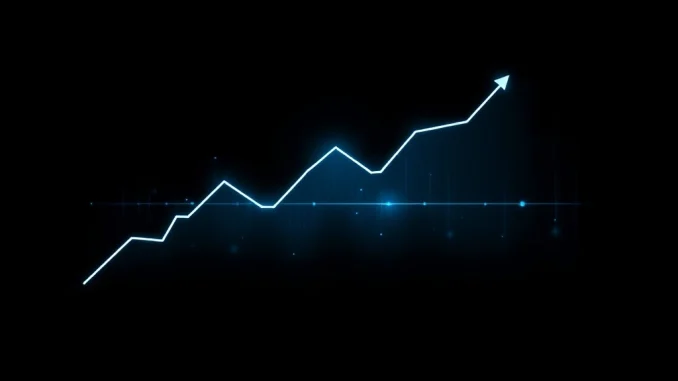
The recent price action of DF saw it not only approach but sustainably trade above this previously unyielding threshold. This event, termed a ‘breakout,’ is often interpreted by chart analysts as a shift in market sentiment. The move suggests that accumulated buying pressure has finally absorbed the available sell orders at that level. Crucially, for the breakout to be considered valid by many analysts, the price must hold above the former resistance, which then often transforms into a new support level—a floor where buying interest may re-emerge.
Several factors can contribute to such a breakout. These include renewed development activity within the dForce protocol ecosystem, positive shifts in broader DeFi market metrics like Total Value Locked (TVL), or simply a realignment of trader positioning based on macroeconomic factors affecting digital assets. The structure now forming on the price chart, described by some as ‘bullish,’ typically refers to patterns like higher lows and a steady ascent, indicating sustained demand.
The dForce Protocol: Contextualizing the Token’s Utility
To understand the significance of DF’s market movements, one must first understand its function. dForce is not merely a speculative asset; it is the native governance and utility token of the dForce Network, a comprehensive DeFi protocol matrix. The ecosystem offers a suite of services including lending, stablecoins, and yield aggregation. DF token holders can participate in governance votes to decide on protocol upgrades, fee structures, and treasury management.
The token’s value is intrinsically linked to the usage and success of its underlying network. Key performance indicators for the dForce Network include:
- Total Value Locked (TVL): The aggregate amount of user funds deposited in the protocol’s various liquidity pools and lending markets.
- Revenue Generation: Fees accrued from transaction activities, a portion of which may be distributed to or benefit token stakeholders.
- User Growth: The number of unique active addresses interacting with the dForce smart contracts.
An improvement in these fundamental metrics can foster positive sentiment, which may, in turn, be reflected in the DF token’s price. Therefore, a technical breakout often leads investors to scrutinize whether it is supported by tangible improvements in protocol activity or is driven primarily by broader market trends.
Historical Precedents in DeFi Market Cycles
The DeFi sector is known for its cyclicality and correlation with the wider crypto market. Historical data shows that tokens of leading protocols often experience sharp rallies during bullish phases, frequently preceded by technical breakouts similar to the one observed with DF. However, these rallies’ sustainability has varied greatly.
For instance, breakouts accompanied by surges in on-chain activity, developer contributions, and strategic partnerships have historically led to more prolonged appreciation. Conversely, moves driven purely by speculative trading or ‘fear of missing out’ (FOMO) have often resulted in volatile retracements. This history underscores the importance of a multi-faceted analysis that looks beyond the chart alone.
Broader Market Conditions and DeFi Sentiment
The performance of any individual DeFi token does not occur in a vacuum. The entire digital asset class remains sensitive to macroeconomic variables such as interest rate expectations, regulatory developments, and institutional adoption news. Furthermore, the DeFi subset has its own dynamics, including competition between protocols, innovations in layer-2 scaling solutions, and evolving security standards.
A rally in DF could be part of a broader ‘altcoin season,’ where capital rotates from larger assets like Bitcoin and Ethereum into smaller-cap tokens. Alternatively, it could be an isolated event based on dForce-specific news or upgrades. Market analysts typically cross-reference the token’s performance with indices tracking the general DeFi sector to determine the breadth of the movement.
The concept of a ‘market rally ahead,’ as referenced by some observers, hinges on several converging factors. These include sustained positive capital flows into cryptocurrency investment products, a stable or favorable regulatory environment, and continued innovation and user adoption within the DeFi space itself. A single token’s breakout, while notable, is one data point among many in assessing overall market health.
Analyst Perspectives and Risk Considerations
Financial and crypto market analysts provide a range of interpretations for such technical events. Some view the reclaiming of a major resistance level as a prerequisite for a longer-term trend change, potentially opening a path toward higher price targets if the new support holds. Their models may incorporate Fibonacci extension levels or measured move projections based on the preceding chart pattern.
However, responsible analysis always includes a discussion of risks. The cryptocurrency market is notoriously volatile. A confirmed breakout can fail, leading to a ‘bull trap’ where the price swiftly reverses below the breakout level. Key risks for DF and similar assets include:
- Smart Contract Risk: The potential for undiscovered vulnerabilities in the protocol’s code.
- Regulatory Uncertainty: Evolving global policies that could impact DeFi operations.
- Competitive Disruption: The emergence of newer protocols with superior technology or incentives.
- Market Liquidity Risk: The possibility of thin order books exacerbating price swings.
Therefore, while technical milestones are important for mapping potential scenarios, they are not guarantees. Investors are advised to conduct thorough research, understand the asset’s utility, and consider their own risk tolerance.
Conclusion
The dForce token’s move to reclaim and hold a key resistance level marks a significant technical development watched by market participants. This event invites a deeper look into the dForce protocol’s fundamentals, the current state of the DeFi sector, and the broader cryptocurrency market environment. While such breakouts can indicate shifting momentum and form part of a bullish structure, their long-term significance is ultimately determined by a confluence of on-chain activity, ecosystem growth, and overarching market trends. As with all assets in the digital currency space, informed analysis balances observable technical patterns with a clear-eyed assessment of underlying value and inherent risks.
FAQs
Q1: What does it mean for a cryptocurrency to ‘reclaim a resistance level’?
A resistance level is a price point where an asset has struggled to rise above in the past due to selling pressure. ‘Reclaiming’ it means the price has moved and sustained above that level, suggesting a potential shift in market dynamics where buyers have gained control at that price zone.
Q2: What is the dForce Network?
The dForce Network is a decentralized finance (DeFi) protocol ecosystem offering integrated services like lending, borrowing, and yield generation. Its native DF token is used for governance and utility within the network.
Q3: Does a technical breakout guarantee a price rally?
No, a breakout is not a guarantee. It is a technical signal indicating a potential trend change, but its success depends on continued buying pressure, supportive fundamentals, and broader market conditions. Breakouts can and do sometimes fail.
Q4: How is DeFi different from traditional finance?
DeFi, or decentralized finance, uses blockchain technology and smart contracts to create financial services (like lending and trading) that operate without central intermediaries like banks. It is typically permissionless, global, and operates 24/7.
Q5: What are the main risks associated with investing in DeFi tokens like DF?
Key risks include high price volatility, smart contract vulnerabilities that could lead to fund loss, evolving and uncertain regulatory landscapes, intense competition from other protocols, and the overall speculative nature of the cryptocurrency market.
Updated insights and analysis added for better clarity.
This article was produced with AI assistance and reviewed by our editorial team for accuracy and quality.