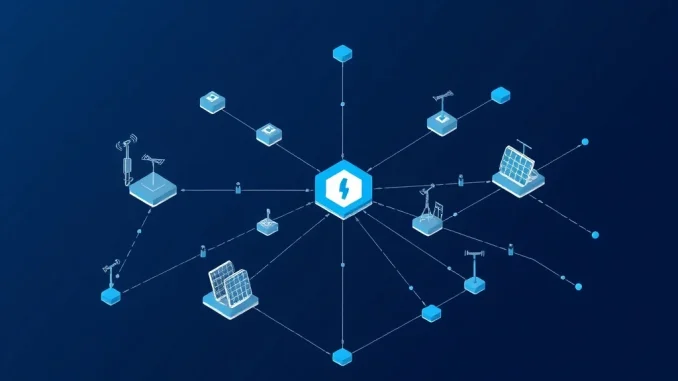
New York, March 2025: In a crypto landscape often dominated by speculative narratives, a fundamental shift is occurring beneath the surface. According to Messari’s comprehensive “State of DePIN 2025” report, Decentralized Physical Infrastructure Networks (DePIN) have staged a powerful resurgence, achieving a collective market valuation of $10 billion. This growth is not fueled by hype, but by a demonstrable foundation of real-world utility and tangible revenue generation, marking a pivotal evolution in how blockchain technology interacts with the physical world.
DePIN’s Market Resurgence: Beyond Token Prices
The most compelling data from Messari’s analysis reveals a stark divergence between market sentiment and operational reality. While the native tokens of many leading DePIN projects experienced significant price depreciation throughout 2024 and into 2025, the underlying networks themselves flourished. The sector collectively generated over $72 million in on-chain revenue, a figure that represents verifiable economic activity rather than inflationary tokenomics or speculative trading fees. This performance underscores a maturation within the crypto sector, where value is increasingly derived from utility and service provision.
A prime example of this dynamic is the Helium Network. Messari’s data indicates that despite a 77% decline in the price of its HNT token, the network’s operational revenue surged by an astonishing 800%. This paradox highlights a critical insight: the health of a decentralized network can be independent of its token’s short-term market valuation. The revenue stemmed from its core service—providing decentralized wireless coverage for Internet of Things (IoT) devices—demonstrating clear product-market fit and sustainable demand.
The Rise of InfraFi: A New Hybrid Financial Model
Messari’s report introduces and details the emergence of “InfraFi” (Infrastructure Finance), a hybrid model that represents a significant innovation in crypto-economics. InfraFi protocols leverage stablecoins and tokenized real-world assets to fund the deployment and maintenance of physical infrastructure. This creates a direct financial bridge between decentralized capital and tangible assets like GPU computing clusters, solar panel arrays, and wireless network hardware.
Projects such as USDai, Dawn, and Daylight exemplify this trend. They attract capital not with promises of exponential token appreciation, but by offering yields backed by the actual revenue streams generated by the underlying physical assets. In 2025 alone, more than $1 billion in capital was deployed into these InfraFi initiatives. This model appeals to a different class of investor—one seeking asset-backed, predictable returns—and could fundamentally alter how large-scale infrastructure projects are financed globally.
- Asset-Backed Yields: Returns are generated from real-world usage fees (e.g., compute power rental, energy sales).
- Risk Diversification: Capital is deployed across diverse physical assets and geographical regions.
- Transparent Accounting: All revenue and distribution are recorded immutably on-chain.
Contrasting DePIN with Traditional Crypto Models
The success of DePIN stands in sharp contrast to the challenges faced by many Decentralized Finance (DeFi) protocols and layer-1 blockchains. While these sectors often grapple with issues of speculative liquidity, vampire attacks, and narrative-driven cycles, DePIN projects are evaluated on more traditional business metrics: customer acquisition, unit economics, and revenue growth. Messari’s “DePIN Leaders” index identifies 15 projects each generating a minimum of $500,000 in annual revenue, proving that sustainable business models are not only possible but are actively thriving in the decentralized space.
This represents a deliberate break from what analysts term “hollow storytelling.” The focus has shifted from speculative tokenomics to operational excellence. Investors are increasingly scrutinizing a project’s ability to produce real income, its cost of service delivery, and its competitive moat in the physical world. This rational framework is attracting institutional interest and paving the way for more resilient crypto-economic structures.
The Core Utility Sectors Driving DePIN Growth
DePIN’s $10 billion valuation is not monolithic; it is built upon several distinct, high-utility verticals. Each addresses a specific physical infrastructure need through decentralization.
| Sector | Primary Function | Example Projects | Key Metric |
|---|---|---|---|
| Wireless Networks | Decentralized LTE/5G & IoT Coverage | Helium, Pollen Mobile | Network Coverage Area, Data Transfers |
| Compute Resources | Distributed GPU/CPU Power for AI & Rendering | Render Network, Akash | Compute Hours Sold, Utilization Rate |
| Storage Networks | Geographically Distributed Data Storage | Filecoin, Arweave | Storage Capacity, Retrieval Speed |
| Sensor & Data Networks | Environmental, IoT, & Logistics Data Feeds | Hivemapper, DIMO | Data Points Collected, API Calls |
| Energy Grids | Peer-to-Peer Energy Trading & Grid Management | Power Ledger, Grid+ | Energy Transacted, Grid Stability |
The growth in these sectors is largely organic, driven by end-users paying for a service that is often more cost-effective, censorship-resistant, or geographically accessible than its centralized counterpart. For instance, a developer needing GPU power for AI training can procure it via a DePIN marketplace at a competitive rate, with payment settled instantly in crypto. This seamless integration of blockchain as a coordination and payment layer for physical services is the core innovation.
Future Implications: DePIN as a Foundation for Web3 and AI
Messari’s analysis positions DePIN not as a niche crypto trend, but as a foundational layer for the next phase of the internet and technological advancement. The report suggests this segment could become central for Web3 businesses, particularly those in artificial intelligence and robotics—sectors that are poised for explosive growth and have immense, tangible infrastructure needs.
Decentralized compute networks are already becoming vital for AI startups seeking alternatives to centralized cloud providers. Similarly, the data integrity and provenance offered by sensor DePINs are crucial for autonomous systems and supply chain logistics. As these adjacent technologies mature, their reliance on robust, decentralized, and trust-minimized physical infrastructure will only increase, potentially making DePIN one of the most critical intersections between blockchain and the global economy.
This trajectory suggests that the current $10 billion valuation may represent an early stage. The convergence of decentralized coordination, token-incentivized hardware deployment, and real-world demand creates a powerful flywheel effect. As networks grow, services improve and costs decrease, attracting more users and further validating the model.
Conclusion
The resurgence of DePIN to a $10 billion market, as detailed in Messari’s 2025 report, signals a profound maturation within the cryptocurrency ecosystem. It demonstrates that blockchain’s ultimate value proposition may lie not in creating new financial instruments alone, but in efficiently organizing and financing the physical world. The divergence between strong revenue growth and weak token performance highlights a market still learning to value utility over speculation. As the InfraFi model gains traction and real-world applications for decentralized infrastructure expand, DePIN is poised to move from a compelling narrative to an indispensable component of the global technological stack, fundamentally reshaping how we build, fund, and interact with the infrastructure around us.
FAQs
Q1: What exactly is DePIN?
DePIN stands for Decentralized Physical Infrastructure Networks. These are blockchain-based protocols that use token incentives to coordinate the build-out and operation of real-world physical infrastructure, such as wireless networks, data storage, computing power, and energy grids, without a central corporate entity.
Q2: If DePIN projects are generating real revenue, why are their token prices down?
Token prices are influenced by many factors, including broader crypto market sentiment, liquidity, and speculation. The recent downturn likely reflects macro-crypto conditions. Messari’s report highlights that the fundamental health of the networks—measured by usage and revenue—is strong and growing independently of short-term token volatility.
Q3: What is InfraFi and how is it different from DeFi?
InfraFi, or Infrastructure Finance, is a subset of DePIN focused on funding physical assets. While traditional DeFi often involves lending, trading, and yield farming with digital assets, InfraFi uses stablecoins and tokenization to fund real-world hardware (like GPUs or solar panels). The yield for investors comes from the revenue generated by that physical hardware, creating an asset-backed financial model.
Q4: What are the biggest challenges facing the DePIN sector?
Key challenges include regulatory uncertainty regarding hardware deployment and token classification, the technical complexity of integrating blockchain with physical systems, achieving sufficient network density to provide reliable service, and competing with established, subsidized centralized infrastructure providers on cost and convenience.
Q5: How does a user actually interact with a DePIN?
Interaction depends on the network. A user might install a hotspot to earn tokens for providing wireless coverage (Helium), rent out spare hard drive space for monthly crypto payments (Filecoin), or purchase distributed GPU time to train a machine learning model (Render Network). End-users can also simply purchase the service, like buying storage or compute power, often using a cryptocurrency or stablecoin.