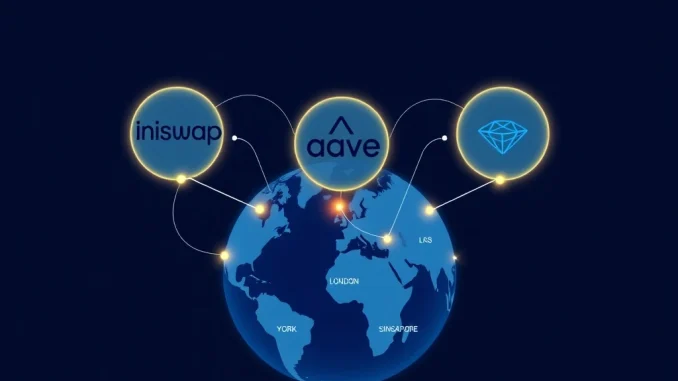
Global, February 2026: The decentralized finance (DeFi) sector is experiencing a definitive shift this month, driven by foundational upgrades from its most established protocols. Industry leaders Uniswap, Aave, and Chainlink are simultaneously launching significant technical overhauls and strategic expansions, creating unprecedented institutional momentum in February 2026. This coordinated evolution marks a pivotal moment, transitioning DeFi from a niche, retail-driven experiment into a mature component of the global financial infrastructure.
DeFi Institutional Momentum Reaches a February 2026 Inflection Point
The concept of institutional adoption in DeFi has evolved over several market cycles. Initially, interest centered on yield opportunities and basic treasury management. Today, the focus has shifted toward infrastructure reliability, regulatory clarity, and interoperability with traditional finance (TradFi). The concurrent actions by Uniswap, Aave, and Chainlink directly address these institutional prerequisites. Analysts point to this month’s developments not as isolated events, but as the culmination of multi-year roadmaps. These projects, some of the oldest and most battle-tested in the ecosystem, are now deploying upgrades designed for scale, security, and seamless integration. This creates a compelling narrative for asset managers, banks, and fintech firms that have been cautiously observing the space.
Uniswap v4 and the Professionalization of Liquidity
Uniswap’s launch of its v4 protocol represents the most significant upgrade to the world’s largest decentralized exchange (DEX) since the introduction of Uniswap v3 in 2021. The core innovation is the introduction of “hooks”—smart contracts that execute at key points in a pool’s lifecycle. This allows for unprecedented customization. For institutions, this means the ability to create pools with features previously only available on centralized venues or through complex, layered protocols.
- Custom Fee Tiers: Institutions can design pools with dynamic fees that adjust based on volatility or time of day, optimizing for specific market-making strategies.
- Advanced Order Types: The hook architecture enables limit orders, time-weighted average price (TWAP) orders, and dynamic ranges, moving beyond the simple constant product formula.
- On-Chain KYC/Whitelisting: A critical feature for regulated entities, hooks can restrict pool participation to pre-verified addresses, enabling compliant DeFi products.
The practical implication is profound. Asset managers can now deploy sophisticated trading strategies directly on-chain with greater capital efficiency and control. This upgrade effectively bridges a major functionality gap between decentralized and centralized exchanges, removing a key barrier to large-scale institutional capital deployment.
The Aave V4 Overhaul and Risk Management
Parallel to Uniswap’s evolution, Aave, the leading decentralized lending protocol, is rolling out its Aave V4 architecture. The primary thrust of this upgrade is a holistic rethinking of risk and capital efficiency, framed within a new “unified liquidity model.” Historically, liquidity in Aave has been siloed across different networks and asset types. V4 introduces a cross-chain liquidity layer that allows assets deposited on one blockchain to be used as collateral on another, dramatically improving capital utility.
For institutional participants, risk management is paramount. Aave V4 introduces several mechanisms directly addressing this concern:
| Feature | Description | Institutional Benefit |
|---|---|---|
| Isolation Mode Enhancements | New assets can be listed with strict debt ceilings and collateral restrictions to contain risk. | Allows safe exposure to novel assets without threatening core protocol stability. |
| Dynamic Loan-to-Value (LTV) | LTV ratios adjust automatically based on asset volatility and liquidity depth. | Provides real-time risk mitigation during market stress, protecting both borrowers and lenders. |
| Gasless Debt Repayment | Liquidations can be triggered and executed without the liquidator paying gas upfront. | Ensures the liquidation system remains robust and efficient under all network conditions, safeguarding collateral. |
This focus on a robust, automated risk framework provides the predictability and safety assurances that institutional treasury desks and credit funds require to allocate significant capital.
Chainlink’s CCIP and the Cross-Chain Future
While Uniswap and Aave upgrade their core offerings, Chainlink is expanding the very fabric of interoperability with the full-scale commercialization of its Cross-Chain Interoperability Protocol (CCIP). CCIP moves beyond simple oracle price feeds to enable generalized messaging and token transfers across any blockchain. In February 2026, several major financial institutions and payment networks announced pilot programs using CCIP.
The institutional use cases are transformative. A bank could use CCIP to tokenize a real-world asset (like a bond or private equity stake) on one blockchain where regulation is clear, and allow it to be used as collateral in a DeFi lending market on another blockchain known for its liquidity. This creates a seamless, cross-chain financial system. The protocol’s focus on a decentralized risk management network, which actively monitors and can pause anomalous cross-chain activity, provides the security blanket necessary for large-value transactions. Chainlink’s established reputation for reliability with its data oracles has directly translated into trust for CCIP, making it the preferred interoperability layer for enterprises entering the space.
The Synergistic Effect and Market Implications
The true significance of February 2026 lies in the synergy between these three upgrades. They are not competing visions but complementary layers of a new stack. Chainlink’s CCIP provides the secure highways for value and data to move. Aave V4 uses this to create unified, cross-chain money markets with sophisticated risk parameters. Uniswap v4 then provides the deep, customizable liquidity pools for the assets flowing through these systems. Together, they form a coherent, institutional-grade DeFi infrastructure.
Data from on-chain analytics firms already shows a measurable uptick in large-wallet activity (transactions over $1 million) across these protocols in the first two weeks of February. Furthermore, several publicly-traded companies have amended their treasury disclosures to include formal policies for utilizing these specific DeFi protocols for yield generation and liquidity provisioning. This shift from speculative testing to formal policy integration is a clear indicator of deepening institutional commitment.
Conclusion
The coordinated advancements from Uniswap, Aave, and Chainlink in February 2026 represent a watershed moment for decentralized finance. By addressing the core institutional requirements of customizable trading, managed risk, and secure interoperability, these DeFi pioneers are collectively driving the sector’s next growth phase. This institutional momentum is not based on hype but on substantive technological upgrades that solve long-standing limitations. The result is a more robust, efficient, and accessible financial system being built in real-time, with February 2026 poised to be remembered as the month the infrastructure truly matured.
FAQs
Q1: What is the main reason for the increased institutional interest in DeFi in February 2026?
A1: The primary driver is the simultaneous launch of major, long-awaited upgrades from foundational protocols like Uniswap (v4), Aave (V4), and Chainlink (CCIP). These upgrades directly address institutional concerns around trading flexibility, risk management, and cross-chain interoperability, making DeFi more viable for large-scale, professional use.
Q2: How does Uniswap v4 specifically appeal to institutions?
A2: Uniswap v4 introduces “hooks,” which allow for highly customizable liquidity pools. Institutions can create pools with features like dynamic fees, limit orders, and on-chain whitelisting (KYC), enabling sophisticated, compliant trading strategies that were previously only possible on centralized exchanges.
Q3: What is Aave V4’s “unified liquidity model”?
A3: It is a new architecture that allows assets deposited as collateral on one blockchain network (e.g., Ethereum) to be borrowed against on another network (e.g., Avalanche). This breaks down liquidity silos, significantly improving capital efficiency for users across the entire DeFi ecosystem.
Q4: Why is Chainlink’s CCIP important for DeFi’s future?
A4: CCIP (Cross-Chain Interoperability Protocol) enables secure messaging and token transfers between different blockchains. This is crucial for creating a seamless financial system where assets and data can flow freely, allowing protocols on different chains to work together and unlocking new cross-chain applications for institutions.
Q5: Are these February 2026 developments likely to reduce volatility in the DeFi sector?
A5: While crypto markets will always exhibit volatility, these upgrades introduce greater stability mechanisms. Aave’s dynamic risk parameters and Chainlink’s decentralized security network are designed to mitigate systemic risk. The influx of longer-term institutional capital focused on infrastructure utility may also contribute to a more stable foundation over time.
This article was produced with AI assistance and reviewed by our editorial team for accuracy and quality.