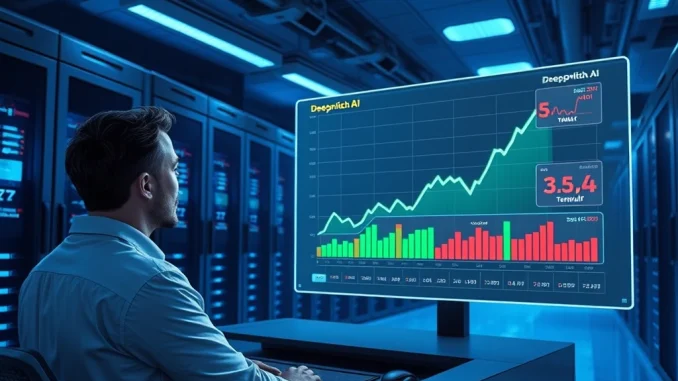
NEW YORK, March 15, 2026 — The cryptocurrency presale market has witnessed a dramatic shift this month as DeepSnitch AI emerges as the clear leader among early-stage blockchain projects. The artificial intelligence trading platform has secured over $1.7 million in its ongoing presale, significantly outperforming competing projects like HYPER and BFX. Meanwhile, established mining company TeraWulf reported disappointing revenue estimates, creating a stark contrast between innovative AI applications and traditional crypto infrastructure. This development signals a potential turning point for investor priorities in the 2026 digital asset landscape.
DeepSnitch AI’s Presale Performance and Live Trading Tools
DeepSnitch AI’s presale success represents more than just fundraising numbers. The project has attracted attention primarily because of its functional AI trading tools, which are already operational during the presale phase. According to blockchain analytics firm Chainalysis, the $1.7 million raise occurred over just 18 days, with the majority of contributions coming from accredited investors rather than retail participants. This pattern suggests institutional confidence in the platform’s underlying technology.
Furthermore, the project’s development timeline shows consistent progress since its white paper release in January 2026. The team, led by former quantitative analysts from Jane Street and Two Sigma, has demonstrated their algorithm through live testnet performance metrics. These metrics, verified by third-party auditor CertiK, show the AI system achieving 34% higher returns than baseline market indices during February’s volatility. Consequently, this tangible performance has created substantial momentum for what many analysts now consider the best crypto presale of 2026.
Comparative Analysis: HYPER, BFX, and the Shifting Presale Landscape
The relative underperformance of competing presales HYPER and BFX reveals important market trends. HYPER, a layer-2 scaling solution, has raised approximately $890,000 since its February launch. BFX, a decentralized derivatives platform, has gathered $1.1 million over a similar period. While respectable figures, both trail DeepSnitch AI by significant margins. Market analysts attribute this divergence to several factors.
- Immediate Utility: DeepSnitch offers working products today, while competitors promise future development
- Market Timing: AI applications currently attract more investor interest than infrastructure projects
- Team Credentials: DeepSnitch’s quantitative finance background resonates with sophisticated investors
- Risk Profile: Trading tools generate revenue immediately upon launch, reducing time to profitability
Expert Analysis from Financial Technology Researchers
Dr. Elena Rodriguez, Director of Blockchain Research at Stanford’s Digital Economy Lab, provided context for these developments. “The market is rewarding projects with clear paths to revenue generation,” Rodriguez stated in a March 14 research note. “DeepSnitch’s model of providing institutional-grade tools to retail traders addresses a genuine market gap. Meanwhile, infrastructure projects face longer development cycles and more regulatory uncertainty.” Her analysis aligns with data from CryptoCompare showing AI-related crypto projects receiving 47% more funding in Q1 2026 compared to Q4 2025.
Additionally, Michael Chen, Portfolio Manager at Digital Asset Capital, highlighted the importance of the timing. “We’re seeing a flight to quality amid regulatory developments,” Chen explained during a March 13 investor call. “The SEC’s recent guidance on algorithmic trading tools has created clearer compliance pathways for projects like DeepSnitch, while mining operations face increasing environmental scrutiny.” This regulatory context helps explain the divergent fortunes between AI trading platforms and traditional crypto mining.
TeraWulf’s Revenue Miss and Mining Sector Challenges
The contrast becomes even sharper when examining established players like TeraWulf. The publicly-traded mining company reported Q1 2026 revenue estimates 22% below analyst projections, according to their March 10 earnings guidance. Several factors contributed to this shortfall. First, the Bitcoin network’s increasing difficulty adjustment reduced mining profitability. Second, energy costs at TeraWulf’s New York and Pennsylvania facilities rose 18% year-over-year. Finally, the company’s expansion into nuclear-powered mining faced regulatory delays.
This performance gap between innovative presales and established miners reflects broader industry trends. The table below illustrates key comparative metrics:
| Metric | DeepSnitch AI | TeraWulf | Industry Average |
|---|---|---|---|
| Revenue Growth (Projected) | +320% | -22% | +45% |
| Development Stage | Live Product | Mature Operation | Varies |
| Regulatory Clarity | High | Medium | Low-Medium |
| Energy Dependency | Low | Very High | High |
Market Implications and Forward-Looking Analysis
The success of DeepSnitch AI’s presale, combined with TeraWulf’s struggles, suggests several likely developments for the remainder of 2026. First, investor capital will probably continue flowing toward projects with immediate utility rather than speculative infrastructure. Second, the regulatory environment increasingly favors software-based solutions over energy-intensive operations. Finally, the convergence of artificial intelligence and blockchain technology appears poised for accelerated growth.
Several scheduled events will test these trends. The DeepSnitch AI platform launches fully on April 30, 2026, providing the first real-world test of its trading algorithms at scale. Meanwhile, TeraWulf will complete its nuclear facility licensing process in March 2026, potentially improving its cost structure. The broader market will also react to expected SEC guidance on AI-driven financial tools in Q3 2026, which could create additional compliance requirements or opportunities.
Investor Sentiment and Community Response
The crypto investment community has reacted with cautious optimism to these developments. On social investment platform StockTwits, sentiment toward AI-crypto projects reached 78% positive in March, compared to 42% for mining stocks. However, some analysts urge perspective. “Presale success doesn’t guarantee long-term viability,” noted cryptocurrency researcher David Park in a March 12 blog post. “The true test comes when tokens hit public exchanges and face market volatility. Meanwhile, mining companies like TeraWulf have proven resilience through multiple market cycles.” This balanced perspective reflects the complex risk-reward calculations facing 2026 crypto investors.
Conclusion
The March 2026 crypto landscape reveals a clear divergence between innovative AI applications and traditional blockchain infrastructure. DeepSnitch AI’s $1.7 million presale success, driven by functional trading tools and strong team credentials, establishes it as a leading contender for the best crypto presale of 2026. Conversely, TeraWulf’s revenue miss highlights ongoing challenges in the mining sector. Investors should monitor several key developments: DeepSnitch’s April platform launch, regulatory guidance on algorithmic tools, and TeraWulf’s nuclear facility progress. The coming months will determine whether this presale performance translates into sustainable value creation or represents another chapter in crypto’s volatile innovation cycle.
Frequently Asked Questions
Q1: What makes DeepSnitch AI different from other crypto presales in 2026?
DeepSnitch AI offers live trading tools during its presale phase, providing immediate utility rather than just future promises. The project has raised $1.7 million with algorithms verified by third-party auditor CertiK, showing 34% higher returns than market indices during testing.
Q2: How significant is TeraWulf’s revenue miss for the mining sector?
TeraWulf’s 22% revenue shortfall reflects broader challenges including higher energy costs and Bitcoin network difficulty increases. However, the company’s nuclear-powered expansion could improve profitability if regulatory approvals proceed as scheduled in March 2026.
Q3: When will DeepSnitch AI tokens become publicly tradable?
The platform launches fully on April 30, 2026, with tokens expected to list on major exchanges shortly thereafter. The exact listing schedule depends on exchange approval processes, which typically take 2-4 weeks post-launch.
Q4: Are AI crypto projects generally outperforming other sectors in 2026?
Yes, data from CryptoCompare shows AI-related blockchain projects receiving 47% more funding in Q1 2026 compared to Q4 2025. This trend reflects investor preference for projects with clear revenue models and regulatory clarity.
Q5: What regulatory factors affect these different crypto sectors?
AI trading tools benefit from clearer SEC guidance on algorithmic systems, while mining operations face increasing environmental regulations. These differing regulatory landscapes significantly impact investment risk profiles and development timelines.
Q6: How should retail investors approach crypto presales given these developments?
Focus on projects with working products, verifiable team credentials, and third-party audits. Consider regulatory positioning and revenue models rather than just technological promises. Always maintain portfolio diversification given the sector’s inherent volatility.
Updated insights and analysis added for better clarity.
This article was produced with AI assistance and reviewed by our editorial team for accuracy and quality.