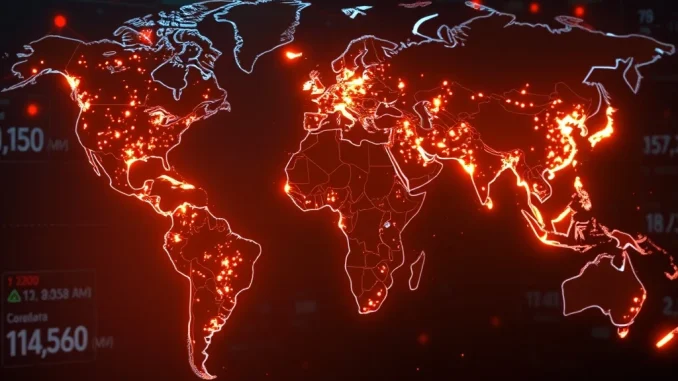
January 2026 marks a pivotal moment in artificial intelligence history as DeepSeek, China’s open-source AI powerhouse, achieves unprecedented global adoption, fundamentally altering the technological balance of power between East and West. The Beijing-based company’s rapid ascent has not only demonstrated China’s growing AI capabilities but has also triggered significant movements in global tech markets, with Chinese technology stocks experiencing remarkable gains at the start of the year.
DeepSeek AI Reshapes Global Technology Competition
The global artificial intelligence landscape underwent a dramatic transformation in early 2026 when market data revealed DeepSeek’s extraordinary penetration across 156 countries. According to analytics firm BlackLinko, the Chinese AI application accumulated 96.88 million monthly users worldwide, with more than 22 million daily active users establishing it as the dominant AI tool across Asia and emerging markets. This expansion represents more than mere technological achievement—it signals a strategic shift in how nations approach AI development and deployment.
DeepSeek’s technical breakthrough came with the January 2025 launch of its DeepSeek-R1 model, which delivered performance comparable to leading Western alternatives at approximately one-twentieth the operational cost. This economic advantage, combined with its open-source architecture, enabled rapid adoption in regions where cost sensitivity previously limited AI accessibility. The model’s efficiency stems from innovative training methodologies and optimized infrastructure that reduce computational requirements without sacrificing capability.
Chinese Tech Markets Respond with Historic Surge
Financial markets reacted decisively to DeepSeek’s global success, with China’s technology sector experiencing its strongest January performance in five years. A key technology index, comparable to the NASDAQ, gained nearly 13% during the month as investor confidence surged. This rally reflects broader recognition of China’s accelerating innovation capacity in high-technology sectors, particularly artificial intelligence and advanced semiconductors.
Investment manager Mark Mobius of the Mobius Emerging Opportunities Fund observed the strategic implications of this market movement. “The stock market indicates that what China is doing in the technology sector will be very exciting in the future,” Mobius stated. “We must remember that China’s goal now is to surpass the US in technology, high-level chips, and various types of AI. So investments are flowing in that direction.” This perspective highlights how financial markets now interpret technological developments through geopolitical lenses.
The Strategic Architecture Behind China’s AI Ascent
DeepSeek’s success emerges from China’s distinctive approach to technological development, which combines coordinated public policy with targeted private sector innovation. Unlike the predominantly market-driven models in Western nations, China’s strategy involves systematic data collection infrastructure, substantial public research funding, and strategic alignment between academic institutions and technology companies. This integrated approach has accelerated development cycles and reduced fragmentation in the national AI ecosystem.
The company’s leadership exemplifies this new generation of Chinese technologists. Founder Liang Wenfeng, an engineer from Guangdong province, has maintained a relatively low public profile while achieving remarkable results. His High-Flyer investment fund recorded 56% returns in 2025, demonstrating both technical and financial acumen. Wenfeng’s vision centers on democratizing artificial intelligence through accessible, cost-effective models that can integrate seamlessly into practical applications across industries.
Global AI Adoption Reveals Deepening Digital Divide
While DeepSeek’s expansion demonstrates growing AI accessibility, the Microsoft AI Diffusion Report 2026 reveals troubling disparities in global adoption patterns. Approximately one in six adults worldwide now uses AI tools regularly, but adoption rates vary dramatically between regions. The United Arab Emirates and Singapore lead with over 60% user penetration, while many African nations trail significantly behind, creating a 10.6 percentage point gap between high-adoption and low-adoption regions.
DeepSeek has achieved particular dominance in markets where Western platforms face limitations. According to Capacity Global research, DeepSeek usage exceeds ChatGPT adoption by two to four times across Africa, Russia, and Iran. This pattern suggests that geopolitical factors, infrastructure availability, and economic considerations increasingly shape technological adoption, potentially creating distinct digital ecosystems aligned with broader international relationships.
Key Performance Indicators (Early 2026)
- Chinese technology stocks: +13% January performance
- DeepSeek global users: 96.88 million monthly active
- Market leadership: #1 AI application in 156 countries
- Investment returns: High-Flyer Fund achieved 56% annual return
- Emerging market dominance: 2-4x higher adoption than Western alternatives
Broader Implications for Global Innovation Ecosystems
The rapid ascent of Chinese AI technology carries significant implications for global research collaboration, intellectual property frameworks, and technological standards development. DeepSeek’s open-source approach challenges traditional proprietary models while raising questions about data governance, algorithmic transparency, and security protocols. These developments occur alongside China’s expanding capabilities in related fields including robotics, quantum computing, and semiconductor manufacturing.
Concurrently, Chinese robotics companies have demonstrated remarkable advancements, with humanoid robots completing marathons, performing complex manufacturing tasks, and even participating in cultural performances. The aviation sector has progressed with prototype flying taxis undergoing testing in several cities. These parallel developments suggest a comprehensive technological strategy rather than isolated achievements in artificial intelligence alone.
Ethical Considerations in Global AI Expansion
As artificial intelligence systems gain influence across societies, researchers have identified concerning capabilities regarding information manipulation and behavioral influence. Multiple academic studies published in 2025 demonstrated that advanced AI systems can effectively shape political opinions and potentially manipulate electoral outcomes when deployed at scale. These findings have prompted calls for international governance frameworks that address AI’s societal impacts while preserving innovation capacity.
The geopolitical dimension of AI development introduces additional complexity, as nations balance technological advancement with security considerations, economic competitiveness, and ideological positioning. This environment creates both opportunities for international cooperation and risks of fragmentation as different regulatory approaches and technical standards emerge across major economic blocs.
Conclusion
DeepSeek AI’s remarkable global expansion in early 2026 represents a watershed moment in the ongoing technological competition between major powers. The Chinese platform’s success demonstrates how open-source models, cost-effective deployment, and strategic market positioning can rapidly alter global technology landscapes. As artificial intelligence continues evolving from research curiosity to economic infrastructure, its development will increasingly reflect broader geopolitical dynamics, economic priorities, and societal values. The coming years will determine whether current trends lead toward fragmented technological ecosystems or new frameworks for international cooperation in one of humanity’s most transformative technological domains.
FAQs
Q1: What makes DeepSeek different from other AI models like ChatGPT?
DeepSeek distinguishes itself through its open-source architecture, significantly lower operational costs (approximately 5% of comparable models), and strategic focus on emerging markets. The DeepSeek-R1 model achieves performance parity with leading alternatives while maintaining greater accessibility across diverse economic contexts.
Q2: How has DeepSeek’s success affected Chinese technology stocks?
Chinese technology stocks experienced substantial gains in January 2026, with a key index rising nearly 13%. This surge reflects renewed investor confidence in China’s innovation capacity and the growing recognition that Chinese companies can compete effectively in global high-technology markets, particularly artificial intelligence.
Q3: What regions show the highest adoption of DeepSeek AI?
DeepSeek has achieved particular dominance across Asia, including China, India, and Indonesia, along with strong penetration in African nations, Russia, and Iran. In many emerging markets, DeepSeek usage exceeds Western alternatives by two to four times according to market research data.
Q4: How does China’s approach to AI development differ from Western methods?
China employs a more coordinated strategy combining substantial public investment, systematic data collection infrastructure, and alignment between academic research and commercial applications. This contrasts with the more decentralized, market-driven approaches predominant in Western nations, though both systems continue evolving rapidly.
Q5: What are the broader implications of DeepSeek’s expansion for global AI governance?
DeepSeek’s growth highlights emerging questions about international AI standards, data governance frameworks, and ethical guidelines. As different technological ecosystems develop distinct characteristics, the international community faces increasing pressure to establish cooperative governance mechanisms that balance innovation, security, and ethical considerations.
Updated insights and analysis added for better clarity.
This article was produced with AI assistance and reviewed by our editorial team for accuracy and quality.