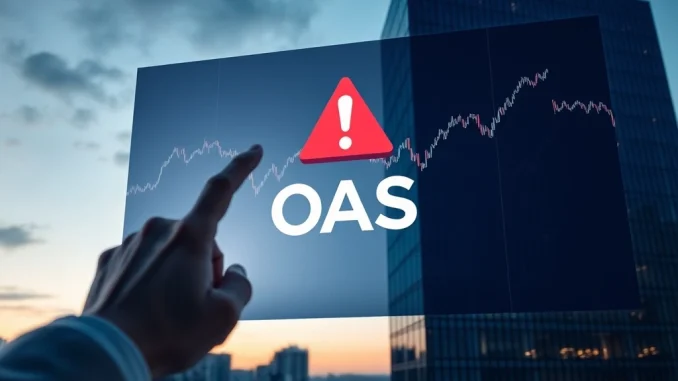
Seoul, South Korea, May 15, 2025: In a significant regulatory move, the Digital Asset eXchange Alliance (DAXA) has placed the gaming-centric blockchain platform Oasys and its native token, OAS, under an official investment warning. This decisive action by South Korea’s unified exchange body signals heightened scrutiny and introduces immediate uncertainty for one of the sector’s prominent projects. The warning compels member exchanges to implement specific investor protection measures, directly impacting trading accessibility and market perception for OAS.
DAXA Investment Warning for Oasys: Decoding the Regulatory Action
The Digital Asset eXchange Alliance, a coalition comprising South Korea’s five major licensed cryptocurrency exchanges—Upbit, Bithumb, Coinone, Korbit, and Gopax—functions as the nation’s de facto self-regulatory organization for digital asset trading. An investment warning represents a formal, intermediate step in DAXA’s risk management protocol. It sits between a simple caution and a full-fledged delisting. When DAXA issues such a warning, all member exchanges must uniformly enact several mandatory safeguards. These typically include prominent risk notifications on trading pages, stricter requirements for order placement, and potentially the suspension of new deposits for the token. The primary goal is to alert investors to potential risks that DAXA has identified, ranging from concerns about a project’s transparency and compliance to suspicions of market manipulation or significant technical vulnerabilities.
Understanding Oasys and the OAS Token Ecosystem
To grasp the implications of this warning, one must understand what Oasys represents. Launched in 2022, Oasys brands itself as a blockchain built by gamers, for gamers. It employs a unique, layered architecture designed to solve scalability issues that have plagued other networks attempting to host complex video games and non-fungible token (NFT) experiences. The ecosystem consists of a primary, highly secure Layer 1 hub chain and multiple, fast, game-specific Layer 2 chains called Verse L2s. Prominent gaming companies like Square Enix, Sega, and Bandai Namco have partnered with or are exploring the Oasys ecosystem. The OAS token serves as the network’s fuel, used for gas fees, staking to secure the network, and governance voting. Its market performance and utility are intrinsically tied to the adoption and success of games built on its Verse chains.
The Precise Triggers Behind the Warning
While DAXA’s public announcement did not specify granular details, industry analysis points to several probable triggers based on historical precedent. Regulatory bodies often act on concerns related to information disclosure. DAXA may have determined that Oasys’ foundation or core development team failed to provide adequate, timely updates on treasury management, key personnel changes, or progress against its technical roadmap. Another common catalyst is a significant and unexplained concentration of token holdings. If a disproportionate percentage of the OAS supply is controlled by a small number of wallets—potentially the team, early investors, or a single exchange—it raises red flags about market fairness and vulnerability to price manipulation. Furthermore, DAXA monitors trading patterns for anomalies. Unusual volume spikes, wash trading indicators, or coordinated price action across exchanges can prompt a warning to protect retail investors from potential schemes.
Immediate Consequences and Market Reaction
The practical effects of the DAXA investment warning for Oasys are immediate and multifaceted. Firstly, trading of OAS on Upbit, Bithumb, and other DAXA member exchanges now occurs under restrictive banners. New investors may face educational pop-ups and quizzes about the risks before they can place buy orders. Secondly, market sentiment typically reacts negatively in the short term. The warning creates sell-side pressure from risk-averse traders and algorithmic systems that automatically divest from assets flagged by regulators. This can lead to increased volatility and downward price momentum. Thirdly, the project’s reputation takes a hit. For a platform seeking mainstream gaming studio adoption, a regulatory warning from a major market like South Korea is a serious public relations challenge. It forces the Oasys team to engage in direct and transparent communication with both DAXA and its community to address the underlying concerns.
Historical Context: DAXA’s Evolving Regulatory Posture
This action against Oasys is not an isolated event but part of a clear, tightening regulatory trend in South Korea. Following the Terra-LUNA collapse in 2022, which devastated local investors, Korean authorities empowered DAXA to take a more proactive and stringent role in market oversight. The alliance has since established a rigorous token listing and monitoring framework. In 2024, DAXA issued similar warnings for several other altcoins, which in some cases led to voluntary project improvements and warning removal, and in others, escalated to full delisting. This pattern demonstrates DAXA’s commitment to its mandate: preemptively identifying risk rather than reacting after investor losses occur. The move underscores that even projects with high-profile partnerships are not immune to scrutiny if they fail to meet evolving standards of operational transparency and market integrity.
The Ripple Effect on the Blockchain Gaming Industry
The warning for Oasys sends a cautionary signal across the entire blockchain gaming (GameFi) sector. South Korea is a global powerhouse in both gaming and cryptocurrency adoption. Regulatory actions there are closely watched worldwide. This event may prompt other jurisdictions to examine gaming tokens more closely, particularly regarding their economic models and token distribution schedules. For developers building on Oasys, the warning introduces a layer of uncertainty, though the technical functionality of their Verse L2s remains unchanged. The long-term impact depends entirely on Oasys’ response. A swift, cooperative resolution with DAXA that clarifies any issues could restore confidence. Conversely, prolonged ambiguity or failure to comply could erode developer trust and hinder future ecosystem growth, potentially benefiting competing gaming blockchains.
Path Forward for Oasys and OAS Holders
The immediate path for the Oasys project team is one of urgent engagement. They must formally communicate with DAXA to understand the specific concerns and present a remediation plan. This likely involves publishing enhanced financial reports, clarifying tokenomics and vesting schedules, or providing verifiable proof of decentralization in key operations. For OAS token holders, especially those in South Korea, the situation demands heightened diligence. Investors should monitor official communications from both DAXA and the Oasys Foundation, avoid panic selling based on speculation, and reassess their investment thesis based on the new risk factor introduced by a major regulatory body. The warning period is a test of the project’s resilience and commitment to compliance.
Conclusion
The DAXA investment warning for Oasys (OAS) represents a critical inflection point, highlighting the increasing maturity and strictness of South Korea’s digital asset regulatory framework. It serves as a powerful reminder that in the evolving crypto landscape, technological innovation must be matched by robust governance and transparent operations. The ultimate outcome for Oasys will depend on its ability to navigate this regulatory challenge effectively. This event reinforces the principle that protecting investors is becoming the paramount concern for exchanges and alliances worldwide, potentially reshaping how all blockchain projects approach compliance and communication in 2025 and beyond.
FAQs
Q1: What does a DAXA investment warning mean for Oasys (OAS)?
A DAXA investment warning is a formal risk alert. It mandates that all member Korean exchanges (Upbit, Bithumb, etc.) implement extra safeguards for OAS trading, like prominent risk disclaimers. It is a serious notice that indicates DAXA has identified specific concerns requiring the project’s attention.
Q2: Will OAS be delisted from Korean exchanges because of this?
Not necessarily. A warning is a step short of delisting. It gives the Oasys project an opportunity to address DAXA’s concerns. If the issues are resolved satisfactorily, the warning can be lifted. If not, the situation could escalate to a trading suspension or delisting.
Q3: What are the most likely reasons DAXA issued this warning?
Based on past actions, likely reasons include insufficient transparency from the Oasys team (e.g., lack of financial disclosure), concerns over highly concentrated token ownership making the market prone to manipulation, or the detection of suspicious trading activity involving OAS.
Q4: How does this affect games already built on the Oasys blockchain?
The technical operation of the Oasys blockchain and its Verse L2s is unaffected. Games should continue to run normally. The impact is primarily on market perception, investor confidence, and the reputation of the Oasys ecosystem, which could influence future developer adoption.
Q5: What should an OAS token holder do now?
Holders should seek information from official sources: the Oasys Foundation’s response and DAXA’s updates. Avoid reactionary decisions based on rumors. Understand that short-term price volatility is likely, and consider the new regulatory risk factor in your long-term investment strategy.