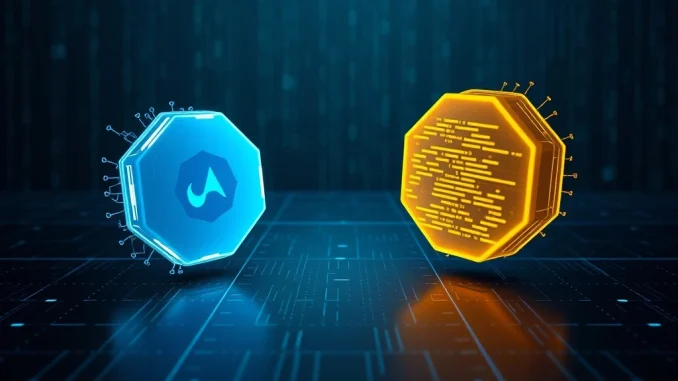
LONDON, February 26, 2026 — A significant legal and technical dispute has erupted in the decentralized finance (DeFi) sector. Curve Finance, a foundational DeFi protocol, has publicly accused the rival decentralized exchange PancakeSwap of copying its proprietary StableSwap code without proper licensing. The accusation, made via social media platform X, centers on code used in PancakeSwap Infinity, the latest version of the popular DEX. This incident immediately raises urgent questions about intellectual property, cybersecurity, and collaboration norms within the permissionless yet interdependent world of DeFi. Curve’s team explicitly warned PancakeSwap to “go through the proper licensing process” to avoid legal problems and ensure user safety.
Curve Finance’s Code Copying Allegation Against PancakeSwap
The core of the dispute lies in the StableSwap algorithm, a sophisticated mathematical model designed for efficient swapping of stablecoins and tightly-pegged assets with minimal slippage. Originally pioneered by Curve, this code is a key differentiator for platforms offering stablecoin liquidity. On February 25, 2026, the Curve Finance team stated that PancakeSwap had integrated this code into its newly launched PancakeSwap Infinity platform without authorization. “If you want to enjoy using stableswap without legal problems and to borrow some of our expertise to keep users SAFU, you still can contact us for licensing and collaboration,” the Curve team posted, framing the issue as both a legal and security matter.
This is not merely a claim of inspiration. Curve argues that direct code replication without the accompanying deep expertise poses a tangible risk. In a separate post, the team pointed to historical precedents, citing the 2022 exploit of Saddle Finance and the devastating $116 million hack of Balancer in 2025 as catastrophic examples of vulnerabilities in similar swap-based code. “Deep stableswap expertise is needed to safely integrate swap features,” they emphasized, suggesting that proper licensing includes access to critical security knowledge. The timeline is crucial: PancakeSwap Infinity launched on Arbitrum and BNB Chain in April 2025, meaning the allegedly copied code has been live for nearly ten months before this public call-out.
Immediate Impacts and Legal Ramifications for DeFi
The public accusation creates immediate ripple effects across the DeFi landscape, impacting developer relations, protocol security, and investor confidence. First, it sets a confrontational precedent for how open-source projects handle derivative use of their core innovations. Second, it forces a conversation about the blurred lines between open-source ethos and proprietary business logic in a multi-billion dollar industry.
- Developer Trust and Collaboration: The public nature of the accusation could chill the open collaboration that DeFi often relies upon, making teams more secretive and litigious.
- User Security Concerns: Curve’s linking of the code to past exploits directly injects uncertainty for users of PancakeSwap’s stablecoin pools, potentially affecting liquidity and volume.
- Legal Precedent Setting: While many DeFi projects use forked code, this explicit demand for licensing could establish a new norm for commercial use of specialized algorithms, moving beyond pure open-source.
Official Responses and Industry Expert Perspective
PancakeSwap’s initial response was conciliatory but non-committal. The team stated it would reach out to Curve Finance to discuss the issue, a move that Curve welcomed by responding, “Indeed, better to be friends and build together.” This exchange suggests private negotiations are likely underway. Sam Bourgi, Chief Analyst at Horizon Research, provided context: “This dispute highlights the growing pains of DeFi. Protocols are maturing from experimental code into financial institutions with valuable IP. Curve’s StableSwap is a prime example—it’s not just code, it’s a battle-tested financial primitive. The question becomes how to protect that investment while adhering to crypto’s open-source roots.” Bourgi’s analysis points to a sector-wide tension. Furthermore, referencing the 2025 Balancer hack report from blockchain security firm CertiK provides an external, authoritative data point on the severe consequences of flawed swap implementations.
Broker Context: The Evolution of PancakeSwap Infinity
To understand the stakes, one must examine PancakeSwap’s ambitious expansion. PancakeSwap Infinity represents a major cross-chain upgrade, launching on Arbitrum, BNB Chain, and later Base in July 2025. Its key features include one-click cross-chain swaps and customizable “hooks” for liquidity pools. The platform also drastically reduced pool creation fees by up to 99%, aggressively seeking market share. The integration of a high-efficiency stablecoin swap mechanism like StableSwap would be a logical competitive move to attract liquidity. The table below contrasts the core swap offerings of both platforms prior to the dispute:
| Feature | Curve Finance (Primary) | PancakeSwap Infinity (Pre-dispute) |
|---|---|---|
| Core Swap Focus | Stablecoins & Pegged Assets | Broad (Stablecoins, Volatile, Cross-Chain) |
| Key Innovation | Proprietary StableSwap Algorithm | Customizable Hooks & Cross-Chain Swaps |
| Licensing Model | Now Asserting Commercial Licensing | Presumed Open-Source/Forking |
| Security Argument | Years of Audited, Battle-Tested Code | Reliant on Internal & External Audits |
What Happens Next: Legal, Technical, and Community Pathways
The immediate future hinges on private negotiations between the two development teams. Several outcomes are possible. A licensing agreement seems the most probable, where PancakeSwap pays a fee or shares revenue for the use of Curve’s IP and expertise. Alternatively, PancakeSwap could choose to rewrite or replace the contested code, though this would be technically demanding and time-sensitive. A protracted public legal battle is the least likely but most damaging scenario for both brands and the DeFi space’s reputation. The community’s reaction on governance forums and social media will also apply significant pressure, as both protocols rely on user trust and liquidity.
Stakeholder Reactions and Developer Community Sentiment
Initial reactions from the DeFi community are mixed. Some developers side with Curve, arguing that sustained innovation requires mechanisms to protect and monetize breakthroughs. Others view the move as antithetical to crypto’s open-source philosophy, where forking is a right. A notable voice on the Ethereum Research forum commented, “This is the inevitable clash between the ‘commons’ and ‘commercial’ models of public goods. Curve’s code is a public good, but its maintenance and risk management are private costs.” This sentiment captures the core dilemma. Meanwhile, liquidity providers on both platforms are watching closely, as any uncertainty can lead to capital migration.
Conclusion
The accusation by Curve Finance that PancakeSwap copied its StableSwap code marks a pivotal moment for decentralized finance. It transcends a simple spat, forcing the industry to grapple with intellectual property, security responsibility, and sustainable business models within an open-source framework. The resolution will set a critical precedent. Will it be collaboration and licensing, or conflict and rewrites? The outcome will influence how DeFi protocols innovate, compete, and secure user funds for years to come. All eyes now turn to the private negotiation table, where the future of this code—and perhaps a norm for the industry—will be decided.
Frequently Asked Questions
Q1: What specific code is Curve Finance accusing PancakeSwap of copying?
Curve Finance alleges PancakeSwap copied its proprietary StableSwap algorithm, a mathematical model optimized for swapping stablecoins with minimal price slippage, and integrated it into the PancakeSwap Infinity platform without a license.
Q2: What are the potential legal consequences for PancakeSwap?
While based on open-source code, Curve may assert copyright over specific implementations or business logic. Potential consequences range from a forced takedown of the code, a financial settlement or licensing fee, to a protracted lawsuit, though the latter is considered damaging for both parties.
Q3: What is the timeline of this dispute?
PancakeSwap Infinity launched with the contested feature in April 2025. Curve Finance made its public accusation on February 25, 2026. PancakeSwap has agreed to discuss the issue, and private negotiations are presumed to be underway as of late February 2026.
Q4: How does this affect the average user of PancakeSwap?
In the short term, very little changes operationally. However, Curve’s warning about security risks linked to unlicensed code use could concern liquidity providers. A major code rewrite or legal action could eventually disrupt stablecoin swap services on the platform.
Q5: Is forking code legal in DeFi and crypto?
Generally, yes, if the code is under a permissive open-source license (like MIT or GPL). The dispute arises when forked code is used for direct commercial competition, and the original creators seek to enforce rights over specific, innovative components or demand recognition and collaboration.
Q6: What does this mean for the future of open-source development in DeFi?
This incident signals a maturation phase. Protocols may become more selective about licensing, potentially moving core innovations to more restrictive licenses or dual-licensing models. It encourages explicit collaboration agreements over silent forking, which could slow innovation or make it more formalized and secure.