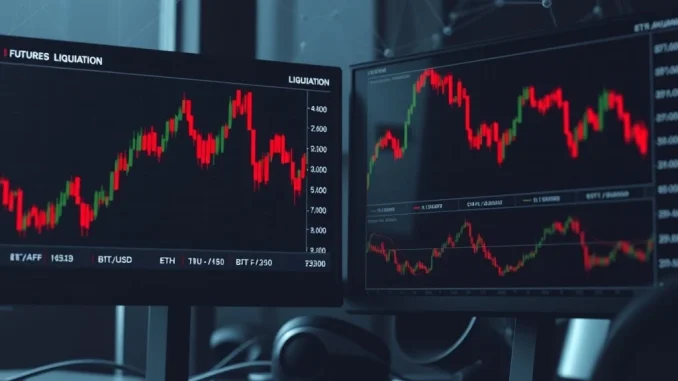
Global cryptocurrency markets experienced significant turbulence today as major exchanges liquidated approximately $150 million worth of futures contracts within a single hour. This substantial liquidation event represents one of the most concentrated periods of forced position closures in recent months, highlighting the ongoing volatility in digital asset markets. According to aggregated exchange data from leading analytics platforms, the total liquidations reached $250 million over the past 24 hours, signaling heightened market stress and increased leverage unwinding across trading platforms worldwide.
Understanding Cryptocurrency Futures Liquidations
Cryptocurrency futures liquidations occur when exchanges automatically close leveraged positions due to insufficient margin. Traders using leverage borrow funds to amplify their trading positions, but they must maintain minimum collateral requirements. When market prices move against these positions, exchanges trigger automatic closures to prevent losses from exceeding deposited collateral. The recent $150 million liquidation wave primarily affected long positions during a sudden downward price movement across major cryptocurrencies.
Major exchanges including Binance, Bybit, OKX, and Deribit reported the highest liquidation volumes during this period. Bitcoin futures accounted for approximately 65% of the total liquidated value, while Ethereum contracts represented around 25%. The remaining 10% involved various altcoin futures and perpetual swap contracts. This distribution pattern reflects the typical concentration of trading volume and leverage in the two largest cryptocurrency markets.
Market Context and Historical Comparison
The current liquidation event follows several weeks of relatively stable trading conditions in cryptocurrency markets. Historical data reveals that similar liquidation spikes typically correlate with specific market triggers. For instance, the March 2024 liquidation wave reached $750 million during a 24-hour period when Bitcoin experienced a 15% price decline. Comparatively, today’s $250 million 24-hour total represents a moderate but significant volatility event within current market conditions.
Several factors contributed to the market movement that triggered these liquidations. First, unexpected regulatory announcements from multiple jurisdictions created uncertainty among institutional traders. Second, large whale wallet movements indicated potential selling pressure from major holders. Third, technical indicators showed overbought conditions on shorter timeframes, suggesting a correction was statistically probable. These elements combined to create the perfect conditions for rapid price movements and subsequent margin calls.
Liquidation Mechanics and Exchange Protocols
Exchanges employ sophisticated risk management systems to handle futures liquidations. When a trader’s margin ratio falls below the maintenance requirement, the exchange issues a margin call. If the trader fails to add additional collateral within a specified timeframe, typically minutes, the exchange automatically closes the position. This process happens through the exchange’s liquidation engine, which matches the forced closure with available buyers or sellers in the order book.
The liquidation process follows a specific sequence across most major platforms:
- Initial Warning: Systems alert traders when positions approach liquidation thresholds
- Partial Liquidation: Some exchanges close only portions of positions to restore margin ratios
- Full Liquidation: Complete position closure when margin falls below critical levels
- Auto-Deleveraging: In extreme volatility, exchanges may trigger socialized loss mechanisms
Impact on Market Structure and Trader Psychology
Significant liquidation events like today’s $150 million hour create ripple effects throughout cryptocurrency markets. The forced selling from liquidated long positions creates additional downward pressure on prices, potentially triggering further liquidations in a cascade effect. This phenomenon, known as a liquidation cascade or long squeeze, can amplify market movements beyond what fundamental factors might justify.
Market data from the liquidation period shows distinct patterns in trading behavior. Spot market volumes increased by approximately 40% during the liquidation peak as traders adjusted their portfolios. Funding rates on perpetual swap contracts turned negative across most exchanges, indicating increased demand for short positions. Open interest in futures markets declined by roughly 15% as leveraged positions unwound, reducing overall market leverage and potentially setting the stage for more stable conditions moving forward.
Risk Management Lessons from Recent Liquidations
Professional traders emphasize several risk management strategies in response to liquidation events. First, maintaining conservative leverage ratios below 5x significantly reduces liquidation risk during normal volatility. Second, using stop-loss orders rather than relying solely on exchange liquidation engines provides more control over exit prices. Third, diversifying across multiple exchanges can mitigate platform-specific risks during extreme market conditions.
Historical analysis reveals that periods following major liquidation events often present strategic opportunities. Market sentiment typically becomes excessively bearish immediately after large liquidations, potentially creating buying opportunities for patient investors. However, traders must carefully assess whether fundamental conditions have changed or if the movement represents temporary market inefficiency. The current market structure suggests the latter, with most analysts viewing this as a healthy correction within an ongoing bull market structure.
Regulatory Considerations and Exchange Responsibilities
Regulatory bodies worldwide have increased scrutiny of cryptocurrency derivatives trading in recent years. The substantial liquidation volumes reported today will likely attract additional regulatory attention to leverage practices in digital asset markets. Exchanges operating in regulated jurisdictions typically implement additional safeguards, including lower maximum leverage limits, mandatory risk disclosures, and enhanced capital requirements for derivatives trading.
Leading exchanges have implemented several protective measures in response to previous liquidation events. These include:
- Isolated Margin Mode: Limits losses to specific positions rather than entire accounts
- Price Protection Mechanisms: Prevents liquidations during extreme price spikes
- Insurance Funds: Covers losses when liquidations cannot execute at expected prices
- Advanced Risk Indicators: Provides real-time margin ratio monitoring and alerts
Technical Analysis of the Liquidation Event
Technical indicators provide valuable context for understanding today’s liquidation dynamics. The liquidation spike coincided with Bitcoin breaking below its 20-day moving average, a key technical level watched by algorithmic traders. Relative Strength Index (RSI) readings approached oversold territory on 4-hour charts, suggesting the selling pressure might be nearing exhaustion. Volume profile analysis shows the highest liquidation concentrations occurred at specific price levels where large clusters of stop-loss orders had accumulated.
Exchange data reveals interesting patterns in liquidation timing and distribution. The $150 million liquidation hour began with approximately $40 million in positions closed within the first 15 minutes, accelerated to $75 million in the next 30 minutes, and completed with $35 million in the final 15 minutes. This pattern suggests an initial trigger followed by cascading effects as falling prices hit successive liquidation thresholds. The majority of liquidations occurred on centralized exchanges, with decentralized derivatives platforms accounting for less than 5% of the total.
Institutional Versus Retail Impact Analysis
Data segmentation reveals distinct patterns between institutional and retail trader liquidations. Institutional positions, typically defined as trades over $100,000, accounted for approximately 60% of the total liquidated value. However, retail traders experienced a higher percentage of account liquidations due to generally higher leverage usage. This distribution highlights the different risk management approaches between professional and individual traders in cryptocurrency markets.
The institutional liquidation patterns show strategic positioning rather than panic responses. Many large traders intentionally allow positions to liquidate rather than adding additional margin during expected volatility events. This approach limits downside risk while maintaining exposure to potential rebounds. Retail traders, conversely, often employ emotional decision-making during volatility, leading to suboptimal outcomes including unnecessary margin additions or premature position closures.
Conclusion
The $150 million cryptocurrency futures liquidation event represents a significant but not unprecedented volatility moment in digital asset markets. These forced position closures highlight the inherent risks of leveraged trading while demonstrating the robustness of modern exchange risk management systems. As cryptocurrency markets continue maturing, both traders and platforms will likely implement more sophisticated mechanisms to mitigate liquidation cascades. The current event serves as a valuable case study for understanding market microstructure, risk management practices, and the evolving dynamics of cryptocurrency derivatives trading. Market participants should carefully analyze today’s cryptocurrency futures liquidations to inform their future trading strategies and risk parameters.
FAQs
Q1: What causes cryptocurrency futures liquidations?
Cryptocurrency futures liquidations occur when leveraged positions lose sufficient value that the collateral no longer covers potential losses. Exchanges automatically close these positions to prevent negative balances.
Q2: How does the $150 million liquidation compare to historical events?
The $150 million single-hour liquidation ranks as a significant but not extreme event. Larger events have exceeded $500 million per hour during major market corrections, particularly in 2021 and 2022 volatility periods.
Q3: Which cryptocurrencies experienced the most liquidations?
Bitcoin futures accounted for approximately 65% of the liquidated value, Ethereum for 25%, with the remaining 10% distributed among major altcoins including Solana, Cardano, and Dogecoin derivatives.
Q4: Do liquidations affect spot market prices?
Yes, futures liquidations can impact spot prices through several mechanisms. Forced selling from liquidated positions adds downward pressure, while the psychological impact can influence broader market sentiment and trading decisions.
Q5: How can traders protect against unexpected liquidations?
Traders can employ multiple protective strategies including using lower leverage ratios, setting manual stop-loss orders, maintaining adequate margin buffers, diversifying across positions, and actively monitoring positions during high volatility periods.
Updated insights and analysis added for better clarity.
This article was produced with AI assistance and reviewed by our editorial team for accuracy and quality.