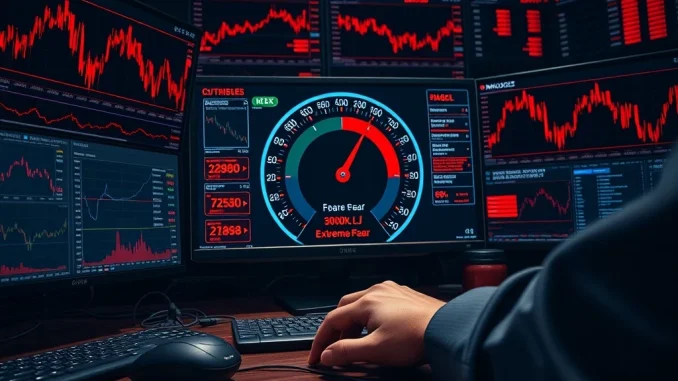
Global, March 2025: The cryptocurrency market is experiencing a prolonged period of psychological stagnation, with investor sentiment firmly entrenched in what analysts term ‘extreme fear.’ This persistent emotional state, quantified by the widely-referenced Crypto Fear & Greed Index, reflects more than just price volatility; it signals a deep-seated caution that has frozen trading volumes, compressed price action, and created a market environment where indecision reigns supreme. Understanding this dynamic requires examining technical indicators, historical parallels, and the underlying behavioral economics at play.
The Anatomy of the Fear & Greed Index
The Crypto Fear & Greed Index serves as the primary emotional barometer for the digital asset space. It aggregates multiple data points to generate a single score, typically ranging from 0 (Extreme Fear) to 100 (Extreme Greed). The components feeding this index include market volatility, trading volume, social media sentiment, surveys, Bitcoin dominance, and Google Trends data. For several consecutive weeks in early 2025, this index has remained stubbornly below 20, a zone historically associated with investor panic and risk aversion. This persistence is unusual; fear spikes are common, but sustained periods at such lows often precede significant trend changes or indicate a market lacking fundamental catalysts. The index’s current reading isn’t just a snapshot but a symptom of a broader narrative where traditional bullish drivers—such as institutional adoption narratives or macroeconomic tailwinds—have temporarily lost their potency.
Technical Indicators Painting a Picture of Stagnation
Beyond sentiment surveys, on-chain and trading chart data corroborate the fearful climate. Several key metrics illustrate the market’s frozen state:
- Declining Exchange Volumes: Spot trading volumes across major exchanges have eroded significantly. This indicates a withdrawal of capital and participation, as both retail and institutional players adopt a ‘wait-and-see’ approach rather than committing to new positions.
- Compressed Volatility: Bollinger Bands, which measure price volatility, have tightened dramatically around major assets like Bitcoin and Ethereum. This ‘squeeze’ suggests a period of consolidation and indecision, often preceding a sharp price movement in either direction once the tension breaks.
- Stablecoin Dynamics: An increase in outflows from major stablecoins like USDT and USDC suggests capital is moving off crypto exchanges. This can be interpreted as investors parking funds in these dollar-pegged assets while on the sidelines or, more bearishly, cashing out entirely into traditional finance systems.
- Lack of Momentum Breaks: Bitcoin has repeatedly failed to sustain a break above key psychological resistance levels, such as $83,000. Conversely, it has also found consistent support, preventing a cascading sell-off. This creates a narrow trading range that frustrates both bulls and bears.
Historical Context: When Fear Becomes the Norm
Current conditions invite comparison to previous crypto winters and periods of consolidation. For instance, the prolonged bear market of 2018-2019 was characterized by similar extended periods of ‘extreme fear’ sentiment, low volatility, and dwindling retail interest. However, a key difference in 2025 is the matured market structure. The presence of regulated ETFs, more robust institutional custody solutions, and clearer (if still evolving) regulatory frameworks provides a underlying stability that past cycles lacked. This context suggests that while sentiment is fearful, the systemic risk of a total collapse is arguably lower. The fear today may be more about a lack of upward momentum and unclear short-term direction than existential doubt about the asset class itself.
The Psychological Impact on Investor Behavior
Extended fear sentiment creates predictable behavioral loops. Investors become hyper-sensitive to negative news, however minor, while dismissing or underreacting to positive developments—a cognitive bias known as negativity bias. This leads to a market that struggles to ‘climb a wall of worry.’ Furthermore, the low-volume environment amplifies the impact of large sell or buy orders, creating exaggerated price swings that reinforce the fearful narrative. Many participants, remembering the rapid drawdowns of past cycles, have a heightened loss aversion, making them quicker to sell at breakeven or a small loss rather than risk holding through potential downside. This collective psychology creates a self-reinforcing cycle where caution begets stagnation, which in turn deepens caution.
Diverging Signals and the Precarious Balance
Despite the overwhelming fearful sentiment, not every indicator points to imminent collapse. Technical analysis reveals a market in a state of fragile equilibrium. Bitcoin’s Relative Strength Index (RSI) often hovers near a neutral 50, indicating a balance between buying and selling pressure rather than severe overselling. The Moving Average Convergence Divergence (MACD) histogram, while negative, shows minimal downward momentum. On-chain data, such as the number of long-term holders (entities holding coins for over 155 days), remains near all-time highs, suggesting a committed cohort is unfazed by short-term sentiment. This creates a dichotomy: the emotional narrative is one of fear, but the underlying technical and on-chain structure suggests a standoff between determined holders and cautious sidelined capital.
External Catalysts: What Could Break the Deadlock?
Markets rarely exit such periods of extreme fear and compression without an external catalyst. Historically, these catalysts fall into several categories:
- Macroeconomic Shifts: A decisive change in central bank interest rate policy, particularly a shift toward easing, has historically been a powerful catalyst for risk assets, including crypto.
- Regulatory Clarity: Major jurisdictions, such as the United States or the European Union, passing definitive, constructive legislation could remove a significant overhang of uncertainty.
- Technological Breakthroughs: A major upgrade or scaling solution achieving widespread adoption could renew fundamental optimism about the utility of blockchain networks.
- Institutional Movement: A landmark announcement from a major traditional finance institution regarding product launches or deep integration could validate the asset class for wary capital.
In the absence of such a catalyst, the market may continue to drift in its fearful state, with volatility gradually returning as patience wears thin among both holders and sidelined investors.
Conclusion
The cryptocurrency market’s entrenchment in extreme fear is a multifaceted phenomenon rooted in technical stagnation, cautious capital flows, and collective investor psychology. While the Fear & Greed Index provides a clear numerical representation of this mood, the underlying reality is a market in search of direction. The convergence of low volatility, weak volume, and a lack of decisive price action has created a holding pattern that tests the resolve of all participants. For observers and investors, this period underscores that market cycles are driven as much by human emotion and narrative as by pure fundamentals. The eventual resolution of this fearful stalemate will likely hinge on a clear external catalyst that provides the narrative confidence needed to break the psychological and technical logjam currently gripping crypto sentiment.
FAQs
Q1: What does the Crypto Fear & Greed Index measure?
The index is a composite indicator that analyzes volatility, market momentum/volume, social media sentiment, surveys, Bitcoin’s dominance over the market, and Google Trends data to quantify the prevailing emotional sentiment among cryptocurrency investors on a scale from 0 (Extreme Fear) to 100 (Extreme Greed).
Q2: How long can sentiment stay in ‘extreme fear’?
Historically, sentiment can remain in this zone for extended periods, from several weeks to many months, especially during prolonged bear markets or consolidation phases. The duration often depends on the emergence of a catalyst to shift the narrative.
Q3: Is extreme fear a good buying signal?
While contrarian investors often view extreme fear as a potential buying opportunity, as it can indicate oversold conditions, it is not a timing tool on its own. It should be considered alongside fundamental analysis, on-chain data, and broader market trends. Sustained fear can also precede further declines.
Q4: What is the difference between price and sentiment?
Price is the outcome of market transactions. Sentiment is the collective psychological attitude driving those transactions. Sentiment can often lead or lag price action. A market can have stable prices but deteriorating sentiment (as seen now), or rallying prices with skeptical sentiment (climbing a ‘wall of worry’).
Q5: What typically causes sentiment to shift from fear to greed?
A sustained shift usually requires a combination of factors: a clear and sustained upward price trend on high volume, a influx of positive news (regulatory, institutional, technological), and a change in market narrative that draws sidelined capital back into the market, creating a positive feedback loop.