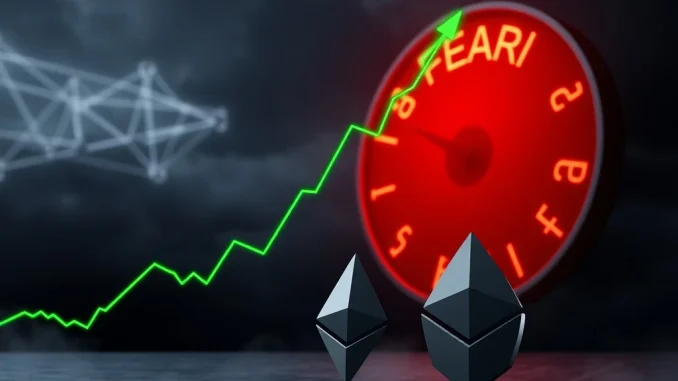
Global, April 2025: The cryptocurrency market shows a slight recovery this week, with the total market capitalization rising 2.95% to approximately $2.26 trillion. Leading assets Bitcoin (BTC) and Ethereum (ETH) posted gains, providing a glimmer of relief for investors. However, this upward price movement starkly contrasts with prevailing market psychology, as the widely-followed Crypto Fear & Greed Index remains entrenched in “Extreme Fear” territory. This divergence between price action and sentiment presents a critical puzzle for analysts and highlights the complex, often contradictory forces shaping digital asset markets.
Crypto Market Recovery: Analyzing the 2.95% Bounce
The recent uptick marks a tentative pause in a broader period of volatility. Data from multiple tracking platforms confirms the aggregate value of all tracked cryptocurrencies increased from last week’s lows, settling above the $2.26 trillion mark. This movement represents the most significant single-week gain in over a month. Bitcoin, the market bellwether, led the charge with a gain of approximately 3.2%, briefly reclaiming a key psychological price level. Ethereum followed closely, appreciating by around 2.8%. Several large-cap altcoins mirrored this positive momentum, though gains were generally modest and concentrated among the top twenty assets by market cap.
Analysts point to several potential catalysts for the crypto market recovery. On-chain data indicates a reduction in exchange inflows from long-term holders, suggesting a decrease in immediate selling pressure. Furthermore, macroeconomic developments, including the latest statements from the U.S. Federal Reserve regarding interest rate policy, provided a measure of stability to risk assets globally. It is crucial to contextualize this bounce within the longer-term trend; the market remains down significantly from its all-time highs, and trading volumes, while improved, are not indicative of a robust, broad-based rally. This recovery appears fragile and is being tested by ongoing macroeconomic uncertainty.
The Psychology of Extreme Fear in Cryptocurrency
Despite the green numbers on price charts, the dominant emotional state among market participants is one of deep apprehension. The Crypto Fear & Greed Index, which synthesizes data from volatility, market momentum, social media sentiment, surveys, and dominance metrics, has been signaling “Extreme Fear” for three consecutive weeks. This index operates on a scale from 0 to 100, with scores below 25 indicating extreme fear. The current reading sits firmly within this band, creating a stark contrast with the week’s price action.
This persistent fear is not an abstract concept; it manifests in observable market behavior. Key indicators include:
- Elevated Volatility: While prices edged up, the magnitude of daily price swings remains high, deterring new investment.
- Social Media Sentiment: Analysis of major platforms shows a predominance of cautious or negative commentary, with discussions focused on potential downside risks rather than growth narratives.
- Derivatives Market Positioning: Data from futures markets shows traders are still hedging heavily against further declines, with funding rates and put/call ratios reflecting defensive postures.
Historically, prolonged periods of extreme fear have sometimes preceded significant market rebounds, as they can indicate capitulation and a washing out of weak hands. However, they can also persist during extended bear markets. The current dichotomy suggests that while some buyers are stepping in at perceived value prices, the broader investor base lacks conviction, waiting for more definitive signals of a sustained uptrend.
Bitcoin and Ethereum: Leading the Tentative Advance
As the two largest cryptocurrencies, the performance of Bitcoin and Ethereum is paramount to overall market health. Bitcoin’s recovery saw it challenge a key technical resistance level that has acted as a ceiling for several weeks. Its relative strength, often seen as a safe haven within the crypto space during turbulent times, provided a foundation for the broader market’s move. Ethereum’s gain was supported by continued development activity on its network and steady metrics regarding decentralized application usage, though concerns about network upgrade timelines and competitive pressures remain.
The performance gap between these giants and smaller altcoins has narrowed slightly, but a true “altseason”—where smaller cryptocurrencies dramatically outperform Bitcoin—is not yet in evidence. Capital appears to be moving cautiously, favoring established assets with higher liquidity. This behavior is typical of recovery phases emerging from fear-dominated environments, where investors prioritize perceived safety and stability over high-risk, high-reward bets.
Historical Context and Market Cycle Analysis
To understand the present, one must look to the past. The cryptocurrency market has experienced several major cycles characterized by boom periods, crashes, and extended consolidation. The current phase of extreme fear juxtaposed with minor recovery echoes patterns seen in late 2018 and mid-2022. In both instances, sharp declines were followed by periods where prices attempted to stabilize or rise slightly while sentiment remained deeply negative. These phases often represented a basing process, where the market built a foundation for its next move, though the direction of that subsequent move was not immediately clear.
A comparative table illustrates key metrics from similar historical junctures:
| Period | Market Cap Change | Fear & Greed Index | Primary Market Concern |
|---|---|---|---|
| Q4 2018 | Volatile, slight recovery after -75% drop | Extreme Fear (≤ 15) | ICO bubble burst, regulatory scrutiny |
| Q2 2022 | Failed bounce after -65% drop | Extreme Fear (≤ 20) | High inflation, rising interest rates, stablecoin collapse |
| Present (Q2 2025) | +2.95% weekly gain after prolonged downturn | Extreme Fear (≤ 25) | Macro uncertainty, regulatory evolution, prior over-leverage |
This historical perspective underscores that sentiment is often a lagging indicator. Extreme fear can linger well after prices have begun to stabilize, as the memory of recent losses remains fresh. The market’s current task is to work through this residual pessimism, which requires time, constructive news flow, and demonstrable network growth.
Conclusion: A Market at a Crossroads
The cryptocurrency market presents a study in contrasts: a measurable crypto market recovery in valuation clashes with a persistent atmosphere of extreme fear sentiment. The 2.95% gain to $2.26 trillion, led by Bitcoin and Ethereum, offers a technical respite but has yet to catalyze a psychological shift among investors. This divergence is a critical signal, highlighting that true market health depends on more than short-term price fluctuations. It requires a restoration of confidence, which is built on fundamentals like adoption, regulatory clarity, and macroeconomic stability. For now, the market remains in a fragile state, where any positive price action is met with skepticism, and the path forward will be determined by which force—tentative buying or pervasive fear—ultimately gains the upper hand.
FAQs
Q1: What does the Crypto Fear & Greed Index measure?
The index is a composite indicator that analyzes multiple data sources, including market volatility, momentum, social media sentiment, surveys, and Bitcoin dominance. It quantifies the primary emotions driving the cryptocurrency market on a scale from 0 (Extreme Fear) to 100 (Extreme Greed).
Q2: Why is the market cap rising if sentiment is still in Extreme Fear?
This divergence can occur when a subset of investors (often institutional or long-term focused) sees value at current prices and begins buying, while the broader retail investor base remains pessimistic due to recent losses or negative news. Sentiment indicators often lag behind price action at turning points.
Q3: How significant is a 2.95% weekly gain for the crypto market?
In the context of the high volatility typical of cryptocurrencies, a ~3% weekly move is considered modest. However, following a period of sustained decline or sideways movement, it can represent an important technical shift, potentially indicating a test of higher price levels or a reduction in selling pressure.
Q4: Has Extreme Fear sentiment ever been a good buying indicator in the past?
Historically, prolonged periods of Extreme Fear have often coincided with market bottoms or significant local lows, as they can signal maximum pessimism. However, it is not a perfect timing tool, as fear can persist or intensify during extended bear markets. It is best used in conjunction with other fundamental and technical analysis.
Q5: What would need to change for the sentiment to shift from Extreme Fear?
A sustained shift would likely require a combination of factors: several weeks of stable or rising prices with low volatility, positive regulatory developments, strong on-chain metrics (like growth in active addresses or value settled), and a change in the macroeconomic outlook favoring risk assets.
This article was produced with AI assistance and reviewed by our editorial team for accuracy and quality.