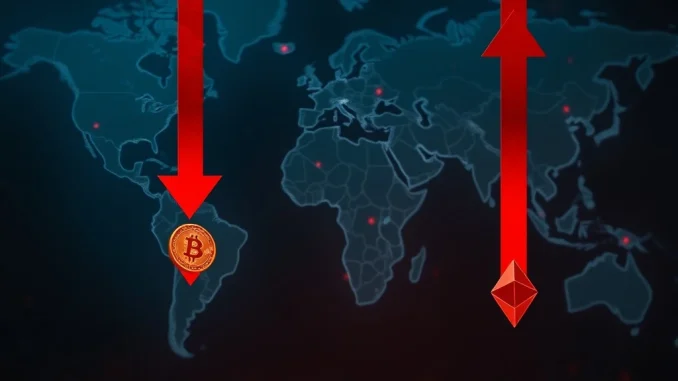
Global, October 27, 2025: Cryptocurrency markets experienced a sharp, widespread sell-off today following an urgent security alert from the United States government. The U.S. State Department issued a directive advising American citizens to depart Iran immediately, citing heightened security risks. This geopolitical development sent shockwaves through digital asset markets, with Bitcoin, the leading cryptocurrency, shedding approximately 7% of its value within hours. The swift decline underscores the crypto market’s persistent sensitivity to global macro events and its classification among investors as a high-risk, high-volatility asset class.
Crypto Markets Drop Amid Escalating Geopolitical Tensions
The sell-off was broad-based and rapid. Major cryptocurrencies, often referred to as “altcoins,” mirrored and sometimes exceeded Bitcoin’s losses. Ethereum (ETH), Solana (SOL), and Cardano (ADA) all posted significant declines. Market data from major exchanges showed a clear spike in selling volume coinciding with the news breaking across financial wires. Analysts point to a classic “flight to safety” response, where investors reduce exposure to perceived risky assets during times of international uncertainty. Consequently, capital often flows toward traditional safe havens like the U.S. dollar, gold, and government bonds during such episodes. The crypto market drop today fits a historical pattern observed during previous geopolitical crises, such as the initial phases of the Russia-Ukraine conflict in 2022, where digital assets initially sold off sharply before some, like Bitcoin, later recovered as a potential hedge against currency instability.
Analyzing the U.S. Iran Warning and Market Psychology
The State Department’s warning is not a routine travel advisory. Its language—”depart immediately”—signals a specific and credible threat assessment, which markets interpret as a potential precursor to escalated conflict or significant diplomatic action. For cryptocurrency traders and institutional investors, this triggers several risk-management protocols:
- Liquidity Preservation: Selling volatile assets to raise cash provides flexibility.
- Portfolio Rebalancing: Reducing overall portfolio risk by cutting high-beta positions.
- Sentiment Shift: A move from “risk-on” to “risk-off” mentality across all asset classes.
This event also highlights the interconnected nature of modern finance. A political statement concerning one nation can instantly impact a decentralized, global digital asset market. The speed of the reaction is facilitated by algorithmic trading and the 24/7 nature of crypto exchanges, which lack the circuit breakers of traditional stock markets.
Historical Context: Crypto as a Geopolitical Barometer
Since its inception, Bitcoin has been framed both as a hedge against traditional financial systems and as a speculative risk asset. Its price action during crises reveals this duality. For instance, during periods of hyperinflation or strict capital controls in specific countries, Bitcoin adoption and trading volumes have surged locally. However, during broad-based global risk aversion sparked by geopolitical events, it has frequently correlated with stock markets and sold off initially. The current situation with Iran presents a complex scenario. While regional tensions could theoretically increase demand for censorship-resistant assets, the immediate, dominant market reaction is to treat the entire crypto sector as a risk asset to be sold. This dynamic creates the volatile price swings witnessed today.
Bitcoin Price and Altcoin Performance Under Pressure
Bitcoin’s ~7% decline represents a significant single-day move, erasing gains from the preceding week. Technical analysis indicates the drop pushed the asset below several key short-term support levels, which can trigger further automated selling. The performance of altcoins often amplifies Bitcoin’s movements. Today’s data showed a clear pattern:
| Asset | Approximate 24-Hour Decline | Notable Factor |
|---|---|---|
| Bitcoin (BTC) | 7.2% | Broke below $65,000 support |
| Ethereum (ETH) | 9.1% | Higher beta relative to BTC |
| Solana (SOL) | 11.5% | Typically higher volatility |
| U.S. Dollar Index (DXY) | +0.8% | Strength as a safe haven |
This table illustrates the “risk-off” hierarchy. Major altcoins fell more than Bitcoin, reflecting their perceived higher risk. Conversely, the U.S. dollar index rose, confirming the movement of capital into traditional safety.
Conclusion: Navigating Uncertainty in Digital Asset Markets
The sharp crypto markets drop following the U.S. advisory on Iran serves as a potent reminder of the asset class’s volatility and its deep integration into global macro trends. While the long-term thesis for digital assets often revolves around decentralization and independence from geopolitical strife, short-term price action remains heavily influenced by traditional market psychology and risk sentiment. Investors are now closely monitoring diplomatic channels and regional developments. Further escalation could prolong the pressure on risk assets, including cryptocurrencies, while de-escalation could prompt a swift rebound. This event reinforces the critical importance of fundamental geopolitical awareness in crypto market analysis and robust risk management strategies for all market participants.
FAQs
Q1: Why did crypto prices fall after the U.S. told citizens to leave Iran?
The warning signaled heightened geopolitical risk, causing investors globally to sell volatile “risk assets” like cryptocurrencies and seek safer holdings like the U.S. dollar or bonds.
Q2: How much did Bitcoin drop?
Bitcoin’s price fell approximately 7% in the hours following the news, a significant single-day move that broke key technical support levels.
Q3: Do geopolitical events always cause crypto markets to drop?
Not always, but often. Initial reactions to major global crises typically see a sell-off in risky assets. Crypto’s 24/7 market can amplify these moves faster than traditional markets.
Q4: What are “risk assets”?
Risk assets are investments that carry a higher degree of price volatility and uncertainty, such as stocks, cryptocurrencies, and commodities, as opposed to “safe haven” assets like gold or government bonds.
Q5: Could this event affect crypto regulation?
Potentially. Lawmakers may point to such volatility as evidence of crypto’s speculative nature, possibly influencing debates around investor protection and market stability regulations.
Q6: What should investors watch next?
Key indicators include official statements from U.S. and Iranian officials, movements in traditional safe havens (gold, dollar), and whether Bitcoin can reclaim its lost support levels, which would suggest stabilizing sentiment.
Updated insights and analysis added for better clarity.
This article was produced with AI assistance and reviewed by our editorial team for accuracy and quality.