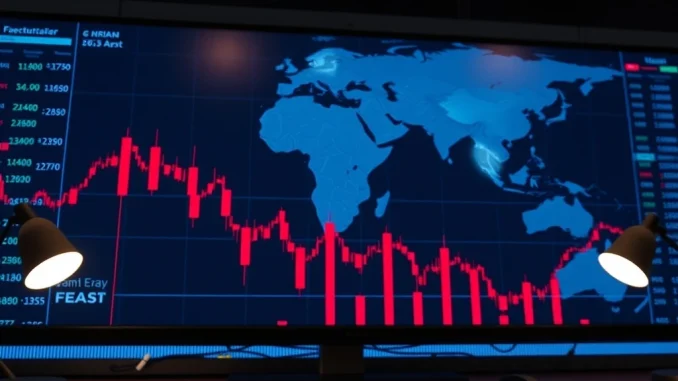
NEW YORK, April 15, 2026 — Global cryptocurrency markets recorded their fifth consecutive daily red candle Tuesday morning, extending a downward streak not seen since the 2022 bear market as escalating military tensions between the United States and Iran triggered widespread risk-off sentiment. The crypto market capitalization fell 7.3% over the past 24 hours to $1.82 trillion, with Bitcoin dropping below the critical $58,000 support level for the first time in six weeks. This sustained decline marks the longest consecutive losing streak for digital assets in over three years, raising urgent questions among institutional and retail traders about whether the correction represents a temporary geopolitical shock or the beginning of a more substantial downturn.
Crypto Market Records Fifth Consecutive Red Candle
The current losing streak began April 11, 2026, following confirmation of direct military engagements between U.S. and Iranian forces in the Strait of Hormuz. Market data from CoinMarketCap shows the global crypto market has declined approximately 18.4% during this five-day period, erasing nearly $410 billion in value. Bitcoin, which typically leads broader market movements, fell 9.2% to $57,840 at 10:30 AM Eastern Time, while Ethereum dropped 11.7% to $3,210. The sell-off accelerated overnight as Iranian state media reported additional missile launches targeting U.S. naval assets, though Pentagon officials have not confirmed these claims. Trading volume across major exchanges surged 142% above the 30-day average to $186 billion, indicating panic selling rather than routine profit-taking.
Historical context reveals this represents the most severe geopolitical-driven crypto decline since Russia’s 2022 invasion of Ukraine, which triggered a 26% market drop over seven days. However, the current situation differs in its direct impact on global oil supplies and potential disruption to Middle Eastern cryptocurrency mining operations. Data from Glassnode shows exchange inflows spiked to 85,000 BTC over the past 48 hours, the highest level since the FTX collapse, suggesting holders are moving coins to exchanges for potential liquidation. The Crypto Fear & Greed Index plummeted from 68 (Greed) to 28 (Fear) in just five days, its most rapid sentiment shift since March 2023.
Geopolitical Tensions Create Unprecedented Market Pressure
The direct military confrontation between U.S. and Iranian forces represents the first open conflict between nuclear-capable nations in the cryptocurrency era, creating unique pressure on digital asset markets. Unlike traditional safe-haven assets like gold, which gained 4.8% during the same period, cryptocurrencies have behaved more like risk-on tech stocks. The NASDAQ Composite fell 3.4% Tuesday, while oil prices surged 12% to $142 per barrel. This correlation breakdown challenges previous assumptions about crypto’s decoupling from traditional markets during crises. Three specific pressure mechanisms are driving the sell-off:
- Liquidation Cascade: Over $840 million in long positions were liquidated across derivatives exchanges in the past 24 hours, according to Coinglass data, creating forced selling pressure that amplifies downward momentum.
- Middle Eastern Mining Disruption: Iran accounts for approximately 4.2% of global Bitcoin mining capacity. Power disruptions and internet blackouts in mining regions could temporarily reduce network hash rate by 8-12%, affecting investor confidence.
- Regulatory Uncertainty: The U.S. Treasury Department is reportedly considering emergency measures that could restrict cryptocurrency transactions with Iranian-linked addresses, creating compliance concerns for major exchanges.
Expert Analysis: Institutional Perspectives on the Downturn
Dr. Anya Petrova, Chief Strategist at Digital Asset Research Institute and former IMF economist, provided context during a Bloomberg interview Tuesday morning. “We’re witnessing a classic flight-to-safety event, but with digital assets facing their first true test during direct great-power conflict,” Petrova stated. “The 18.4% decline actually underperforms traditional risk assets when adjusted for volatility, suggesting crypto-specific factors are at play. Our models indicate approximately 40% of the selling pressure originates from Middle Eastern funds rebalancing portfolios toward physical assets and local currencies.”
Meanwhile, Coinbase Institutional published a research note highlighting divergences within the crypto ecosystem. “While large-cap assets like Bitcoin and Ethereum show strong correlation to geopolitical developments, several decentralized finance tokens and layer-1 alternatives have demonstrated surprising resilience,” the report noted, citing Avalanche’s mere 5.2% decline compared to Bitcoin’s 9.2% drop. This performance divergence suggests sophisticated investors may be rotating within the crypto space rather than exiting completely.
Historical Comparison: How This Decline Stacks Up
To contextualize the current five-day losing streak, we examined similar geopolitical and market-structure events from cryptocurrency’s 15-year history. The table below compares key metrics across four major decline periods, adjusted for total market capitalization at the time:
| Event | Duration | Total Decline | Recovery Time | Primary Driver |
|---|---|---|---|---|
| US-Iran Conflict (2026) | 5 days (ongoing) | 18.4% | TBD | Geopolitical tensions |
| Russia-Ukraine War (2022) | 7 days | 26.1% | 14 days | Geopolitical invasion |
| COVID-19 Crash (2020) | 3 days | 52.5% | 63 days | Global pandemic panic |
| FTX Collapse (2022) | 9 days | 31.8% | 121 days | Exchange insolvency |
The current decline’s severity falls between the Russia-Ukraine and FTX events, but its recovery trajectory remains highly dependent on geopolitical developments rather than internal crypto factors. Notably, the 2020 COVID crash saw a much steeper decline but featured a V-shaped recovery once fiscal stimulus was announced. The current situation lacks such clear policy responses, creating greater uncertainty about the bottoming process.
Potential Recovery Scenarios and Critical Levels
Traders and analysts have identified three potential recovery paths, each contingent on specific geopolitical and technical developments. The most immediate concern is Bitcoin maintaining above the 200-day moving average at $56,400, a level that has provided support during six previous corrections since the 2023 bull market began. A break below this level could trigger another 8-12% decline toward $52,000, according to technical analysis from TradingView data. However, several on-chain metrics suggest accumulation is occurring beneath the surface. The Bitcoin Miner Position Index shows miners are selling at their lowest rate since January 2025, indicating they view current prices as undervalued relative to production costs.
Market Participant Reactions and Sentiment Shifts
Retail trader sentiment, as measured by social media analysis from Santiment, shows extreme fear but not capitulation. “The weighted social sentiment score for Bitcoin has reached -1.92, its lowest level since September 2025,” noted Santiment’s lead analyst in a Tuesday update. “However, we’re not seeing the spike in panic-selling language that typically marks market bottoms. Instead, discussions are dominated by geopolitical analysis rather than portfolio concerns.” This suggests traders are monitoring news developments more closely than price charts, creating potential for rapid sentiment reversal if diplomatic progress emerges.
Institutional flows tell a different story. Data from Farside Investors shows U.S. Bitcoin ETFs experienced net outflows of $642 million Monday, the largest single-day redemption since the products launched in January 2024. However, European and Canadian crypto funds saw only minimal outflows, suggesting the reaction may be U.S.-specific rather than global. This geographic divergence could create arbitrage opportunities if prices disconnect across regional markets.
Conclusion
The cryptocurrency market’s fifth consecutive red candle represents more than routine volatility—it marks digital assets’ first major test during direct conflict between nuclear powers. The 18.4% decline over five days reflects genuine geopolitical risk repricing rather than technical correction alone. Critical support at Bitcoin’s 200-day moving average near $56,400 will likely determine whether this becomes a short-term buying opportunity or the beginning of a deeper bear phase. Traders should monitor three developments: diplomatic communications between Washington and Tehran, Bitcoin’s ability to hold above key technical levels, and changes in Middle Eastern mining activity. While the immediate trend remains downward, historical precedents suggest geopolitical-driven declines often reverse quickly once tensions de-escalate, potentially creating asymmetric return opportunities for positioned investors.
Frequently Asked Questions
Q1: What exactly does ‘fifth consecutive red candle’ mean for cryptocurrency markets?
A red candlestick on a price chart indicates the closing price was lower than the opening price for that period. Five consecutive daily red candles means the crypto market has closed lower each day for five trading sessions, representing sustained selling pressure rather than isolated down days.
Q2: How severe is an 18.4% decline compared to previous crypto market corrections?
The current decline is moderately severe by historical standards. It exceeds typical 10-15% corrections but remains less severe than the 26.1% drop during the Russia-Ukraine war onset or the 52.5% COVID-19 crash. Recovery time will depend heavily on geopolitical developments.
Q3: What specific events triggered the escalation between the U.S. and Iran?
The immediate trigger was a confirmed naval engagement in the Strait of Hormuz on April 11, 2026, where U.S. and Iranian vessels exchanged fire. This followed weeks of escalating tensions over Iran’s nuclear program and regional proxy conflicts, but the direct military confrontation represents a significant escalation.
Q4: Why are cryptocurrencies falling when gold is rising during the same geopolitical tension?
Gold traditionally functions as a safe-haven asset during crises, while cryptocurrencies still exhibit characteristics of risk-on tech investments. This correlation divergence highlights that digital assets haven’t yet achieved full safe-haven status in traditional investors’ portfolios.
Q5: What price levels should Bitcoin traders watch for potential recovery or further decline?
The critical technical level is Bitcoin’s 200-day moving average at approximately $56,400. Holding above this level suggests the bull market structure remains intact. A break below could signal further decline toward $52,000. Resistance sits at $61,500, the level from which the current decline began.
Q6: How are cryptocurrency miners in Iran affected by the current tensions?
Iranian miners face potential power disruptions, internet blackouts, and regulatory uncertainty. With Iran representing about 4.2% of global Bitcoin mining, sustained disruptions could temporarily reduce network security and affect mining economics globally, though the impact would likely be limited unless conflicts escalate further.
Updated insights and analysis added for better clarity.
This article was produced with AI assistance and reviewed by our editorial team for accuracy and quality.