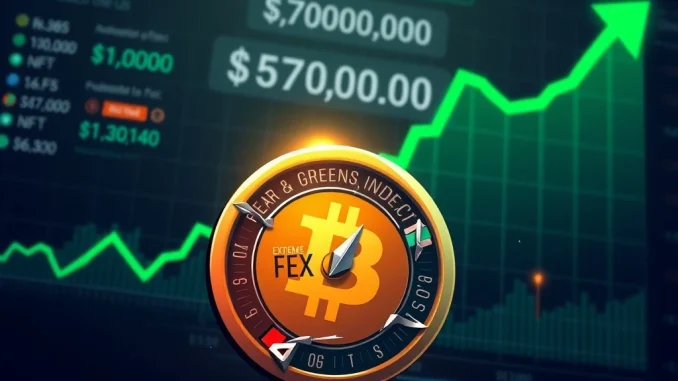
Global, May 2025: The cryptocurrency market presents a complex and seemingly contradictory picture this week. The total crypto market cap climbs to $2.42 trillion as Bitcoin ($BTC) tops $70,000, a significant psychological and financial threshold. This upward movement occurs against a backdrop of widespread investor apprehension, as measured by the Crypto Fear & Greed Index, which has registered a persistent state of ‘Extreme Fear’. Meanwhile, the decentralized finance (DeFi) sector shows resilience with rising total value locked (TVL), while the non-fungible token (NFT) market experiences a sharp and notable decline in sales volume over the past 24 hours. This divergence highlights the multifaceted and often non-correlated nature of different blockchain-based asset classes.
Crypto Market Cap Climbs Amidst a Climate of Fear
The aggregate valuation of all cryptocurrencies, known as the total market capitalization, recently reached approximately $2.42 trillion. This figure represents a recovery from lower levels seen earlier in the month, yet it remains volatile. Market capitalization is a critical metric that analysts use to gauge the overall health and size of the digital asset ecosystem. Its movement towards this level coincides with Bitcoin’s own price action, which has broken above the $70,000 mark. However, this price appreciation is not universally interpreted as a sign of bullish euphoria. On the contrary, the widely monitored Crypto Fear & Greed Index, which aggregates data from volatility, market momentum, social media sentiment, surveys, and dominance metrics, has been stuck in the ‘Extreme Fear’ zone. This creates a fascinating market dynamic where price appreciation and underlying sentiment are markedly out of sync.
Understanding the Extreme Fear Gauge and Market Psychology
The ‘Extreme Fear’ reading is more than just a catchy headline; it is a quantifiable measure of investor psychology. Historically, periods of extreme fear have sometimes preceded market bottoms or consolidation phases, as weak hands sell their holdings. The current environment suggests that while large buyers or institutional players may be accumulating assets—driving the price up—the broader retail and speculative investor base remains highly cautious. This caution can stem from several factors:
- Macroeconomic Uncertainty: Global interest rate policies, inflation data, and geopolitical tensions continue to create headwinds for risk assets, including cryptocurrencies.
- Regulatory Developments: Ongoing and anticipated regulatory actions in major economies like the United States and the European Union inject uncertainty into the market.
- Technical Market Factors: Bitcoin’s approach to its previous all-time high can trigger profit-taking and increased volatility, which feeds into fear metrics.
This divergence between price and sentiment is a classic reminder that markets are not purely rational and are driven by a complex mix of data, narrative, and emotion.
Bitcoin’s Role as the Market Bellwether
Bitcoin’s surge past $70,000 is a pivotal event. As the first and largest cryptocurrency by market cap, Bitcoin often sets the tone for the entire digital asset space. Its performance influences trader confidence and capital flows into altcoins and other crypto sectors. Breaking this key resistance level is technically significant, but analysts note that sustained volume and a shift in market structure are required for a confirmed bullish trend. The fact that this milestone is reached during a period of extreme fear adds a layer of complexity to its interpretation. It may indicate underlying strength that is not yet reflected in popular sentiment indicators, or it could signal a potential ‘squeeze’ scenario where fearful short positions are forced to cover.
DeFi TVL Rises, Signaling Sector-Specific Strength
While headline market cap and Bitcoin price capture most attention, the DeFi ecosystem tells its own story. Total Value Locked (TVL) is the sum of all assets deposited in DeFi protocols like lending platforms, decentralized exchanges (DEXs), and yield aggregators. An increase in TVL, as observed in the past 24 hours, suggests several positive developments:
- Increased Utility and Adoption: Users are depositing more capital to earn yield, provide liquidity, or access decentralized financial services.
- Protocol Innovation and Security: New or upgraded protocols with compelling features or improved security audits can attract fresh capital.
- Relative Outperformance: Capital may be rotating from underperforming areas (like some NFTs) into DeFi strategies perceived as having more fundamental value or predictable returns.
This rise in TVL demonstrates that innovation and user activity in the DeFi subsector continue unabated, even when broader market sentiment is fearful. It underscores the premise that DeFi, while correlated with crypto markets, also has independent drivers based on technological utility and financial product innovation.
NFT Sales Plunge, Highlighting Market Fragmentation
In stark contrast to DeFi’s TVL growth, the NFT market has experienced a sharp decline in sales volume. This plunge is a reminder of the distinct cycles within the crypto ecosystem. The NFT market, particularly for profile picture (PFP) projects and digital art, is often driven by different factors than Bitcoin or DeFi, including:
- Speculative Cycles: NFT markets are prone to intense, hype-driven bull runs followed by steep corrections as interest wanes.
- Liquidity and Collector Behavior: NFT markets are less liquid than token markets. A drop in sales volume can indicate collector hesitation, a lack of new major releases, or a shift in cultural trends.
- Macro Sensitivity: As discretionary luxury or collectible assets, NFT purchases may be among the first to slow when economic uncertainty rises and disposable income feels pressured.
This divergence is critical for investors to understand. It shows that a rising Bitcoin price or growing DeFi TVL does not automatically lift all boats within the crypto universe. Each vertical—store-of-value assets, decentralized finance, and digital collectibles—operates with its own supply-demand dynamics and investor psychology.
The Historical Context of Market Divergence
This is not the first time such a split has occurred. In previous market cycles, Bitcoin has occasionally decoupled from altcoin performance, and utility-driven sectors like DeFi have matured independently of speculative frenzies in other areas. The current environment, with Bitcoin strong, DeFi building, and NFTs cooling, may represent a phase of market maturation where capital seeks fundamental value and sustainable yield over pure speculative narrative. Historical analysis suggests that these periods of divergence can create long-term investment opportunities as markets eventually re-synchronize, often with new sector leaders emerging.
Conclusion
The current state of the cryptocurrency market is one of compelling contrasts. The total crypto market cap of $2.42 trillion and Bitcoin’s price above $70,000 point to underlying strength and institutional interest. Yet, the pervasive ‘Extreme Fear’ sentiment warns of lingering caution and potential volatility ahead. Simultaneously, the rise in DeFi TVL confirms continued growth in blockchain-based financial utility, while the sharp plunge in NFT sales volume illustrates the cooling of a previously red-hot speculative segment. For observers and participants, this landscape underscores the importance of nuanced, sector-specific analysis. The crypto market is not a monolith; it is a complex, evolving ecosystem where different asset classes can and do perform independently. Understanding these divergences—between price and sentiment, and between different blockchain verticals—is key to navigating the volatile yet innovative world of digital assets.
FAQs
Q1: What does a ‘Crypto Fear & Greed Index’ reading of ‘Extreme Fear’ mean?
The index is a composite indicator measuring market sentiment from multiple data sources. ‘Extreme Fear’ suggests investors are highly risk-averse, which can sometimes indicate a potential buying opportunity or a market bottom, but it is not a direct timing signal.
Q2: Why would Bitcoin’s price rise if investors are fearful?
Price is set by the balance of buy and sell orders at exchanges. A fearful broader sentiment can coexist with price increases if a smaller number of large, confident buyers (like institutions) are accumulating more aggressively than the fearful majority is selling.
Q3: What is Total Value Locked (TVL) in DeFi?
TVL is the total amount of cryptocurrency assets (like Ethereum, stablecoins) deposited and being used within decentralized finance protocols for lending, borrowing, trading, or earning yield. It’s a key metric for gauging DeFi ecosystem growth and usage.
Q4: What could cause NFT sales volume to plunge sharply?
Sharp declines can result from a combination of factors: the end of a speculative cycle for major collections, a lack of new high-profile project launches, broader economic uncertainty reducing discretionary spending, or a shift in collector interest to other digital asset classes.
Q5: Does the total crypto market cap include all cryptocurrencies?
Yes, the total market capitalization is calculated by taking the circulating supply of each cryptocurrency, multiplying it by its current market price, and summing the value of all tracked digital assets. It provides a snapshot of the entire industry’s aggregate valuation.