Crypto Market Plunges into Extreme Fear Zone as Bitcoin and Ethereum Suffer Sharp Declines
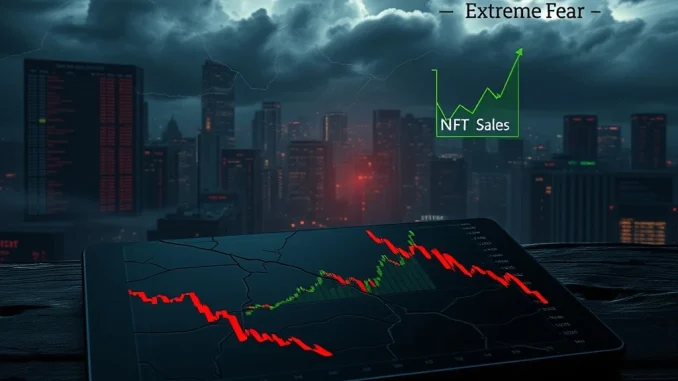
Global, March 2025: The cryptocurrency market has entered what analysts term an ‘extreme fear’ zone, marked by a significant contraction in total market capitalization and sharp price declines across major digital assets. This pronounced shift in market sentiment follows a period of heightened volatility, with Bitcoin (BTC) and Ethereum (ETH) leading the downward trend. The movement has triggered a broad reassessment of risk across the digital asset ecosystem, contrasting sharply with concurrent, surprising resilience in certain niche sectors like non-fungible tokens (NFTs).
Crypto Market Enters Extreme Fear Zone Amid Broad Sell-Off
The primary gauge of cryptocurrency market sentiment, the Crypto Fear & Greed Index, has plummeted into ‘Extreme Fear’ territory, registering one of its lowest readings in recent months. This index aggregates various data points, including volatility, market momentum, social media sentiment, and surveys. A reading in the extreme fear range typically signals widespread investor anxiety and often coincides with market bottoms, though it does not guarantee an immediate reversal. The current downturn appears driven by a confluence of macroeconomic factors and crypto-specific developments. Traders point to shifting expectations around global interest rates, regulatory uncertainty in key jurisdictions, and profit-taking after a previous rally as contributing pressures. Historical data shows that periods of extreme fear have frequently preceded consolidation phases, where the market stabilizes before establishing a new direction.
Bitcoin and Ethereum Lead Sharp Price Plunges
As the two largest cryptocurrencies by market capitalization, Bitcoin and Ethereum have borne the brunt of the selling pressure. Bitcoin, often viewed as digital gold and a market bellwether, broke below several key technical support levels that traders monitor closely. Its price action has influenced the entire altcoin market, demonstrating its enduring role as the foundational asset for the sector. Ethereum, the leading platform for smart contracts and decentralized applications, experienced a correlated drop. Analysts note that Ethereum’s decline also reflects concerns about network upgrade timelines and competitive pressures from other layer-1 blockchains. The price movements for both assets show high correlation with traditional risk-off sentiment in broader financial markets, though the magnitude of the swings remains distinctly higher in the crypto space.
- Bitcoin (BTC): Fell approximately 18% over a seven-day period, testing its lowest price point since late 2024.
- Ethereum (ETH): Declined roughly 22% in the same timeframe, underperforming Bitcoin slightly.
- Market Correlation: The 30-day correlation coefficient between Bitcoin and the Nasdaq 100 remained elevated, indicating continued linkage to tech stock sentiment.
Total Market Cap and DeFi TVL Experience Significant Contraction
The total market capitalization of all cryptocurrencies, a broad measure of the industry’s aggregate value, contracted sharply alongside the price drops. This metric fell by hundreds of billions of dollars, erasing gains accumulated over the preceding quarter. A more focused contraction occurred within the decentralized finance (DeFi) sector. The Total Value Locked (TVL) across DeFi protocols, which represents the sum of all assets deposited in these platforms for lending, borrowing, or providing liquidity, declined significantly. This drop in TVL suggests users are withdrawing funds from DeFi applications, likely due to a combination of depreciating collateral values, reduced incentives for yield farming, and a general flight to safety. The contraction highlights the sensitivity of DeFi’s leveraged and interconnected systems to broad market downturns.
| Metric | Approximate Change | Primary Driver |
|---|---|---|
| Crypto Total Market Cap | -20% | Broad risk-off sentiment, liquidations |
| DeFi Total Value Locked (TVL) | -25% | Collateral depreciation, yield compression |
| Bitcoin Dominance | Increased slightly | Flight to perceived relative stability |
Historical Context of Fear Cycles in Crypto
Volatility and sentiment swings are inherent characteristics of the cryptocurrency market. The current ‘extreme fear’ phase finds precedent in several historical episodes, such as the market downturns of mid-2021, early 2022, and late 2023. Each previous cycle featured similar plunges in the Fear & Greed Index, dramatic price corrections, and contractions in market cap and DeFi activity. However, the market structure has evolved. The increased institutional participation, development of regulated futures and spot ETFs, and more mature derivative markets mean the mechanisms of price discovery and liquidation are different today. While past performance never guarantees future results, understanding these cycles provides context for the current volatility, suggesting it is a recurrent, if painful, feature of the asset class’s development.
NFT Market Shows Surprising Resilience Amid Broader Decline
In a notable divergence from the broader market trend, the non-fungible token (NFT) sector has displayed relative resilience. Sales volumes across major marketplaces have not collapsed in tandem with cryptocurrency prices and have, in some segments, even increased. This suggests that the drivers for NFT activity may be partially decoupled from the short-term speculative sentiment affecting fungible tokens. Activity appears concentrated in high-profile collections with strong communities and in utility-focused NFTs, such as those tied to gaming or membership. Some analysts interpret this as a sign of maturation within the NFT space, where value is increasingly derived from cultural significance, access, and application rather than pure financial speculation on crypto prices. However, the overall valuation of NFT collections, often denominated in ETH, has still suffered due to the drop in the underlying cryptocurrency’s price.
Conclusion
The cryptocurrency market has decisively entered an extreme fear zone, characterized by a steep decline in the prices of major assets like Bitcoin and Ethereum, a contracting total market capitalization, and a significant withdrawal of capital from the DeFi ecosystem. This shift reflects a complex interplay of macroeconomic headwinds and sector-specific dynamics. While the pervasive fear presents clear challenges and risks for investors, the contrasting stability in the NFT market offers a nuanced view of the industry’s segmentation. As the market navigates this period of heightened volatility, the focus for many participants will be on risk management, fundamental analysis of projects, and the long-term technological trajectory underlying the crypto space. The extreme fear zone, while daunting, represents a recurring phase in the market’s evolution, testing the resilience of both the technology and its adoption.
FAQs
Q1: What does it mean when the crypto market is in ‘extreme fear’?
The term refers to a low reading on the Crypto Fear & Greed Index, which aggregates multiple data sources to measure overall market sentiment. ‘Extreme Fear’ suggests widespread panic, selling pressure, and negative sentiment among traders and investors, often occurring during sharp price declines.
Q2: Why did Bitcoin and Ethereum prices drop so sharply?
The plunge was likely caused by a combination of factors including negative macroeconomic signals (like interest rate concerns), regulatory uncertainty, large-scale liquidations in leveraged derivative markets, and a general shift towards risk-off behavior across global financial markets.
Q3: What is DeFi TVL and why did it drop?
DeFi Total Value Locked (TVL) is the total amount of assets deposited in decentralized finance protocols. It dropped because the value of the locked assets (like ETH) fell with the market, users withdrew funds to avoid further losses or to seek safety, and the incentives for providing liquidity diminished.
Q4: How can the NFT market be doing well if crypto prices are falling?
NFT trading activity can be driven by factors separate from cryptocurrency prices, such as community engagement, artistic value, gaming utility, or collector demand. Sales volumes can remain stable or grow even if the floor prices of collections, denominated in a falling crypto like ETH, decrease in dollar terms.
Q5: Has the market been in ‘extreme fear’ before?
Yes, the crypto market has experienced multiple periods of extreme fear throughout its history, notably in 2018, 2020, and 2022. These phases are a cyclical part of the market’s high-volatility nature and have, in the past, sometimes preceded periods of consolidation and eventual recovery, though this is not guaranteed.
Related News
- XRP Ledger Unlocks Crucial Permissioned Domains Following Overwhelming 91% Validator Approval
- Crypto Bill: US House Unveils Crucial Draft Ahead of May 6 Hearing
- Binance Alpha Unveils FalconFinance (FF): A Strategic Leap for Early-Stage Crypto
Related: Bitcoin's Institutional Sell Pressure Eases as Coinbase Premium Gap Narrows Sharply
Related: Strategic Shift: Public Miner Sells Entire Bitcoin Stockpile as Self-Managed Hashrate Climbs to Top
Related: XRP Ledger Transactions Surge 40%: A Revealing 2.5M Daily Activity Divergence