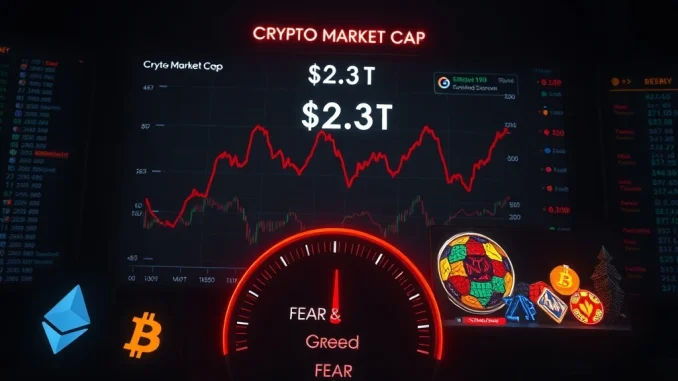
Global, April 2025: The cryptocurrency market is experiencing a significant downturn, with its total capitalization falling to approximately $2.3 trillion. This sharp decline has triggered a prevailing sentiment of Extreme Fear among investors, as major assets like Bitcoin (BTC) and Ethereum (ETH) post notable losses. In a contrasting development, the non-fungible token (NFT) sector has recorded a substantial surge in trading volume today, creating a complex and layered market narrative.
Crypto Market Drops to $2.3 Trillion Amid Widespread Selling
The global cryptocurrency market cap, a key aggregate metric tracking the total value of thousands of digital assets, has retreated to the $2.3 trillion mark. This represents a multi-week low and a double-digit percentage decline from recent highs. Market analysts point to a confluence of factors driving the sell-off. Macroeconomic concerns, including persistent inflation data and shifting expectations for central bank interest rate policies, have increased risk aversion across all financial markets. This has led to capital flowing out of perceived risk-on assets like cryptocurrencies. Furthermore, on-chain data indicates significant exchange inflows for both Bitcoin and Ethereum, suggesting holders are moving assets to trading platforms to sell.
The decline has been broad-based, affecting a wide range of altcoins alongside the major market leaders. However, the severity of losses varies significantly across different sectors of the crypto ecosystem. The market’s structure during this pullback provides critical insights into current investor behavior and sector rotation.
Extreme Fear Grips the Market as Sentiment Indicators Flash Red
The Crypto Fear and Greed Index, a popular sentiment gauge that analyzes volatility, market momentum, social media activity, and surveys, has plunged into “Extreme Fear” territory. This index, which ranges from 0 (Extreme Fear) to 100 (Extreme Greed), serves as a contrarian indicator for many seasoned traders. Historically, prolonged periods of Extreme Fear have sometimes preceded market bottoms, though they are not a guaranteed timing signal.
Several specific metrics contribute to this bleak sentiment reading:
- Volatility: A sharp increase in price swings, particularly to the downside.
- Market Momentum/Volume: High trading volume on down days, confirming selling pressure.
- Social Media Sentiment: A measurable shift toward negative commentary and panic on platforms like X (formerly Twitter) and crypto-focused forums.
- Dominance: Bitcoin’s market dominance often rises during fearful periods as investors flee altcoins for the perceived relative safety of the original cryptocurrency.
This pervasive fear creates a self-reinforcing cycle where negative news is amplified, and positive developments are overlooked, often leading to oversold conditions.
Bitcoin and Ethereum Lead the Decline with Notable Losses
As the two largest cryptocurrencies by market capitalization, Bitcoin and Ethereum are setting the tone for the broader market downturn. Bitcoin (BTC), often viewed as digital gold, has broken below several key technical support levels. Its price action is being closely watched, as a sustained drop below certain thresholds can trigger automated selling from leveraged derivatives positions, exacerbating the decline. Analysts are monitoring Bitcoin’s realized price and the cost basis of long-term holders to gauge potential areas of support.
Ethereum (ETH), the foundation for the decentralized finance (DeFi) and much of the NFT ecosystem, has mirrored Bitcoin’s drop. The decline in ETH price increases gas fees as a percentage of transaction value and can temporarily slow network activity as users become more cost-conscious. The performance of these two bellwethers is critical for overall market health, as their combined market cap constitutes a significant portion of the total $2.3 trillion figure.
| Asset | Approximate 24-Hour Change | Notable Context |
|---|---|---|
| Bitcoin (BTC) | -8.5% | Testing yearly support zone; miner selling pressure observed. |
| Ethereum (ETH) | -10.2% | Decline correlates with reduced DeFi Total Value Locked (TVL). |
| Total Market Cap | -7.8% | Fell from ~$2.5T to ~$2.3T. |
The Historical Context of Crypto Market Corrections
Volatility and sharp corrections are inherent features of the cryptocurrency market’s maturation process. Since Bitcoin’s inception, the market has experienced numerous drawdowns exceeding 50%, often within short timeframes. For instance, the 2018 bear market saw an 80%+ decline from peak to trough, while the 2021-2022 cycle also featured several severe contractions. These periods are typically characterized by high fear, negative media coverage, and a “crypto winter” narrative. However, they have also been followed by periods of innovation, infrastructure building, and eventual recovery. Understanding this cyclical nature is crucial for separating short-term price action from long-term technological adoption trends.
NFT Sales Surge Defies the Broader Market Downturn
In a striking divergence, the non-fungible token (NFT) market has reported a sharp increase in sales volume today. Data from primary and secondary market aggregators shows a spike in transactions across several leading collections, particularly on the Ethereum and Solana blockchains. This counter-trend movement suggests that capital within the crypto ecosystem may be rotating, rather than exiting entirely.
Several factors could explain this surge amidst a falling market:
- Perceived Value Hunting: Collectors and traders may view depressed ETH and SOL prices as an opportunity to acquire high-profile NFTs at a lower effective cost in dollar terms.
- Specific Catalyst Events: New project launches, artist drops, or anticipated airdrops for existing collections can drive isolated volume.
- Community-Led Initiatives: Strong communities around certain NFT projects often rally during market stress to demonstrate resilience and support floor prices.
- Utility-Driven Demand: NFTs with ongoing utility (e.g., access to games, events, or royalties) may see more stable demand less tied to speculative market cycles.
This activity highlights the increasing segmentation within the crypto economy, where different asset classes can exhibit independent momentum based on their unique fundamentals and community dynamics.
Implications for Investors and the Ecosystem
The current market environment presents both challenges and opportunities. For investors, periods of Extreme Fear necessitate a focus on risk management, portfolio diversification, and fundamental analysis over emotional reactions. For the broader blockchain ecosystem, market downturns often redirect attention and developer activity toward building substantive technology and user experiences rather than financial speculation. Historically, bear markets have been fertile ground for the development of core infrastructure, such as scaling solutions and improved security protocols, which lay the groundwork for the next cycle of adoption.
Conclusion
The cryptocurrency market is navigating a pronounced downturn, with the total market cap dropping to $2.3 trillion amid an Extreme Fear sentiment environment. Leading assets Bitcoin and Ethereum are experiencing significant losses, driven by macroeconomic headwinds and sector-wide deleveraging. However, the simultaneous surge in NFT sales volume illustrates the nuanced and multifaceted nature of the digital asset space, where capital rotation and specific use-case demand can create pockets of strength even during broad market stress. As the market digests these developments, participants are reminded of the sector’s inherent volatility and the importance of a long-term, fundamentals-based perspective.
FAQs
Q1: What does a “Crypto Fear and Greed Index” reading of “Extreme Fear” mean?
A1: The Extreme Fear reading indicates that current market sentiment is overwhelmingly negative, based on an analysis of price volatility, momentum, social media, and other factors. It is often viewed as a potential contrarian indicator, suggesting the market may be oversold, though it does not predict the exact timing of a reversal.
Q2: Why are NFT sales increasing when Bitcoin and Ethereum are falling?
A2: This divergence can occur due to capital rotation within the crypto ecosystem, where traders move funds from one asset class to another. It may also be driven by specific NFT project catalysts, community support initiatives, or collectors taking advantage of lower cryptocurrency prices to buy NFTs at a discount in dollar terms.
Q3: How significant is a drop to a $2.3 trillion total crypto market cap?
A3: The $2.3 trillion level represents a key psychological and technical threshold. It signifies a substantial pullback from recent highs and can trigger further selling if it breaks below established support levels watched by institutional and algorithmic traders.
Q4: What typically happens after a period of “Extreme Fear” in crypto markets?
A4: Historically, prolonged Extreme Fear periods have often, but not always, preceded market bottoms and periods of consolidation or recovery. However, sentiment can remain fearful for extended periods during bear markets, so this index is best used alongside fundamental and on-chain analysis.
Q5: Could the surge in NFT sales be a leading indicator for the broader market?
A5: While NFT activity reflects risk appetite within a specific crypto niche, it is not a reliable leading indicator for the overall cryptocurrency market. Broader market direction is more heavily influenced by macroeconomic factors, Bitcoin and Ethereum’s performance, and institutional capital flows.