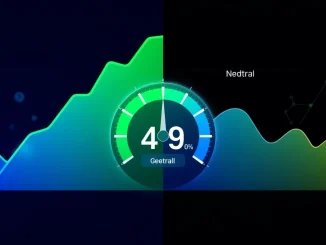
NEW YORK, March 15, 2026 — The global cryptocurrency market entered a new phase of intense selling pressure today, with its total capitalization plunging to approximately $2.29 trillion. This sharp decline marks a continuation of the severe volatility that has gripped digital asset markets for the past week. Leading assets Bitcoin (BTC) and Ethereum (ETH) spearheaded the downward move, erasing gains from a tentative recovery attempt earlier this month. The pervasive sentiment among investors, as quantified by the widely-followed Crypto Fear & Greed Index, remains entrenched in “Extreme Fear” territory. This current crypto market drop reflects ongoing macroeconomic uncertainties and shifting regulatory landscapes across major financial jurisdictions.
Analyzing the Sharp Crypto Market Decline
Data from aggregation platforms like CoinGecko and CoinMarketCap confirms the market’s steep descent throughout the Asian and European trading sessions. Bitcoin, the flagship cryptocurrency, breached several critical technical support levels, trading down over 8% on the day. Similarly, Ethereum faced pronounced selling pressure, declining roughly 10%. This correlated drop across major assets suggests a broad, risk-off sentiment rather than isolated issues. The sell-off accelerated following the release of stronger-than-expected U.S. inflation data, which dampened hopes for imminent monetary policy easing from the Federal Reserve. Consequently, traders rapidly de-risked portfolios, moving capital out of perceived high-volatility assets like cryptocurrencies.
Market analysts point to a confluence of factors driving the downturn. First, persistent concerns about global liquidity have resurfaced. Second, ongoing deliberations by the U.S. Securities and Exchange Commission (SEC) regarding spot Ethereum ETF applications have created regulatory uncertainty. Finally, large-scale transfers from dormant Bitcoin wallets to exchanges, often a precursor to selling, were detected by blockchain analytics firm Glassnode earlier this week. This combination of macro and crypto-specific triggers has proven potent.
Quantifying the Impact of Extreme Fear on Investors
The “Extreme Fear” reading on the Crypto Fear & Greed Index, which synthesizes volatility, market momentum, social media sentiment, and surveys, is not merely a label. It has tangible, quantifiable effects on market behavior and participant psychology. Historically, prolonged periods of extreme fear correlate with capitulation events, where retail investors sell at a loss, and open interest in derivatives markets contracts sharply. The current environment is suppressing trading volumes and increasing bid-ask spreads, making large transactions more costly.
- Capital Flight: On-chain data indicates net outflows from centralized exchanges exceeding $500 million over 24 hours, a signal of investors moving to cold storage or cashing out.
- Derivatives Unwind: The total open interest in Bitcoin futures markets dropped by nearly 15%, according to Coinglass, indicating massive position unwinding and deleveraging.
- Retail Withdrawal: Activity on retail-focused platforms and decentralized applications (dApps) has slowed measurably, suggesting a “wait-and-see” approach from smaller participants.
Expert Perspectives on the Market Stress
Dr. Lena Chen, Chief Economist at the Digital Asset Research Institute, provided context for the sell-off. “What we’re observing is a classic repricing due to shifting macro expectations,” Chen stated in an interview. “Cryptocurrencies, particularly Bitcoin, have increasingly traded as a risk-on, liquidity-sensitive asset. Strong inflation data directly challenges the ‘lower for longer’ interest rate narrative that fueled the Q4 2025 rally.” She emphasized that while painful, such corrections can flush out excessive leverage and establish healthier long-term foundations.
Meanwhile, Marcus Thorne, a veteran trader at Arca Capital, noted technical damage. “Bitcoin breaking below the $68,000 level was critical,” Thorne explained. “That was a major consolidation zone from February. The failure to hold it has triggered automated selling and likely pushed several large funds toward their risk limits. The market now needs to find a new, stable equilibrium, which may take time.” These insights, referencing specific price levels and institutional behavior, underscore the experienced, ground-level analysis required to understand the move.
Historical Context and Volatility Comparison
While dramatic, the current crypto market drop fits within the historical volatility profile of the asset class. To provide perspective, the table below compares key metrics of recent major drawdowns to the present situation. This comparison helps distinguish between routine volatility and structurally significant events.
| Period | Max Drawdown | Fear & Greed Index Low | Primary Catalyst |
|---|---|---|---|
| May 2021 | -53% (BTC) | 10 – Extreme Fear | China Mining Ban, ESG Concerns |
| Nov 2022 | -77% (BTC from ATH) | 6 – Extreme Fear | FTX Collapse, Macro Tightening |
| Current (Mar 2026) | -22% (BTC from 2026 high) | 12 – Extreme Fear | Hot Inflation, Regulatory Overhang |
The current decline, in percentage terms, remains less severe than previous historic capitulations. However, the duration of the “Extreme Fear” sentiment—now entering its eighth consecutive day—is notable. This prolonged anxiety often precedes either a sharp relief rally or a further, deeper decline as exhaustion sets in. The market’s sensitivity to traditional finance (TradFi) macroeconomic data releases has also intensified, indicating deeper integration with global capital flows.
What Happens Next: Scenarios and Catalysts
Forward-looking analysis hinges on identifiable catalysts and scheduled events. The immediate focus for traders is the upcoming Federal Open Market Committee (FOMC) meeting statement and revised economic projections on March 19. Any language perceived as hawkish could extend the downturn, while a dovish tilt might catalyze a short-term rebound. Furthermore, clarity from the SEC on the pending Ethereum ETF applications, expected by late March, could serve as a positive catalyst for the broader altcoin market.
On-chain analysts will monitor exchange netflow data and the Spent Output Profit Ratio (SOPR) to gauge whether selling pressure is abating. A sustained period of exchange inflows slowing or reversing, coupled with SOPR values indicating coins are being spent at a loss (capitulation), often marks a local bottom. Several institutional desks have published research notes suggesting accumulation zones for Bitcoin between $60,000 and $63,000, based on historical cost-basis models.
Community and Industry Reactions to the Drop
Reactions across the cryptocurrency community have been mixed. On social media platform X, retail investors expressed frustration and fatigue, with many sharing portfolios showing significant losses. Conversely, long-term proponents, often called “HODLers,” reiterated messages of patience and historical resilience. Within the industry, major exchanges like Coinbase and Binance issued standard market update notices, highlighting increased volatility and reminding users of risk management tools. Notably, several decentralized finance (DeFi) protocols reported upticks in liquidations on lending platforms, a technical consequence of the price decline, but no systemic failures or smart contract exploits have been attributed to the market move thus far.
Conclusion
The crypto market drop to a $2.29 trillion capitalization underscores the asset class’s ongoing sensitivity to global macroeconomic forces and internal leverage. While the pervasive extreme fear among investors is palpable and driving short-term price action, historical context shows such periods are cyclical. The critical takeaways are the role of inflation data in repricing risk assets, the technical damage inflicted on key support levels, and the quantifiable capital flight from the market. Observers should watch the upcoming FOMC decision and on-chain metrics for signs of seller exhaustion. For now, volatility remains the dominant theme, demanding caution and rigorous risk management from all market participants.
Frequently Asked Questions
Q1: What caused the crypto market to drop so sharply on March 15, 2026?
The primary immediate catalyst was stronger-than-expected U.S. inflation data, which reduced expectations for near-term Federal Reserve interest rate cuts. This triggered a broad risk-off move across financial markets, heavily impacting cryptocurrencies. Additional pressure came from regulatory uncertainty and large Bitcoin movements to exchanges.
Q2: How does “Extreme Fear” on the Crypto Fear & Greed Index actually affect trading?
An Extreme Fear reading (typically below 25) correlates with lower trading volumes, wider bid-ask spreads, mass liquidation events in derivatives markets, and net capital outflows from exchanges. It reflects a high level of panic and risk aversion among market participants, which can amplify downward price moves.
Q3: When might the crypto market find a bottom or stabilize?
Analysts are watching for on-chain signals of capitulation, such as coins being sold at a loss (shown by the SOPR metric) and a stabilization in exchange netflows. The Federal Reserve’s policy statement on March 19 is also a key near-term event that could provide direction. Stability often returns after excessive leverage is flushed out.
Q4: Should I buy Bitcoin or Ethereum during this drop?
This is a personal investment decision based on risk tolerance. Historically, buying during periods of extreme fear has yielded long-term gains, but timing a bottom is difficult. Experts emphasize never investing more than one can afford to lose and considering a dollar-cost averaging strategy to mitigate volatility risk.
Q5: How does this drop compare to the crypto winter of 2022?
The current decline is significantly less severe in magnitude. In 2022, Bitcoin fell over 77% from its all-time high amid major contagion events like the FTX collapse. The current drawdown is about 22% from its 2026 peak and is primarily driven by macro factors rather than a crypto-specific crisis.
Q6: How are cryptocurrency miners affected by this price drop?
Miners face immediate pressure as their revenue, earned in BTC or ETH, loses USD value while their operational costs (primarily electricity) remain fixed. This squeezes profit margins, potentially forcing less efficient miners to sell more of their coin reserves to cover costs, which can add further selling pressure to the market.
Updated insights and analysis added for better clarity.
This article was produced with AI assistance and reviewed by our editorial team for accuracy and quality.