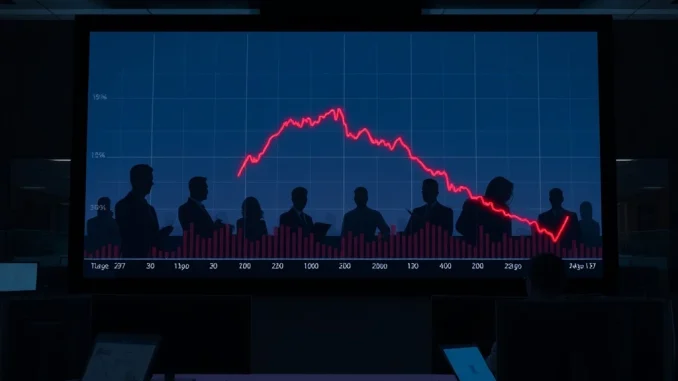
Global, March 2025: The cryptocurrency market is undergoing a significant correction, with top digital assets like Bitcoin (BTC) and Ethereum (ETH) showing notable price declines. This sharp downturn has pushed the total market capitalization down to approximately $2.18 trillion, while a key sentiment indicator has plunged into “extreme fear” territory, signaling heightened anxiety among investors worldwide. The move represents one of the most pronounced pullbacks in the asset class this year, prompting analysis of underlying causes and potential implications for the broader digital economy.
Analyzing the Crypto Market Downturn
The current crypto market downturn is characterized by broad-based selling pressure across major and minor digital assets. Market data from multiple exchanges shows Bitcoin, the largest cryptocurrency by market value, falling below key psychological support levels it had maintained for several weeks. Similarly, Ethereum, the leading platform for smart contracts and decentralized applications, has mirrored this downward trajectory. This correlated movement is not unusual, as Bitcoin often sets the tone for market sentiment, but the velocity of the decline has captured the attention of both retail and institutional participants. Analysts point to a confluence of macroeconomic factors, including shifting expectations around central bank interest rate policies and traditional equity market volatility, which have historically influenced crypto asset prices. The downturn also follows a period of sustained growth, suggesting a natural market cycle of consolidation after significant gains.
Bitcoin and Ethereum Price Performance and Context
Bitcoin and Ethereum serve as the twin pillars of the cryptocurrency ecosystem, and their performance is a critical barometer for overall market health. During this downturn, both assets have retreated from recent highs, erasing gains made during the previous quarter.
- Bitcoin (BTC): The pioneer cryptocurrency experienced a drop of over 15% from its monthly peak, breaching several technical support levels that traders monitor closely. Its price action is being scrutinized against historical patterns, including previous halving cycles and long-term adoption trends.
- Ethereum (ETH): As the foundation for a vast ecosystem of decentralized finance (DeFi) and non-fungible tokens (NFTs), Ethereum’s decline has a ripple effect. Its drop often amplifies losses in tokens built on its network, contributing to the overall market cap contraction.
This is not the first major correction for either asset. Both Bitcoin and Ethereum have weathered numerous cycles of boom and bust since their inception, with each downturn testing investor conviction and the fundamental thesis behind blockchain technology. The current price dips are being measured against these historical precedents to assess whether they represent a temporary setback or the beginning of a more prolonged bear phase.
The Significance of the Fear & Greed Index Reading
The Crypto Fear & Greed Index, a popular sentiment tool that aggregates data from volatility, market momentum, social media, surveys, and dominance, has fallen to a reading of 11. This places it firmly in the “Extreme Fear” zone, which ranges from 0 to 25. Historically, such readings have often coincided with local market bottoms, though they are not a guaranteed timing indicator. The index works on the principle that excessive fear can drive overselling, while extreme greed can signal a market top. The current low reading suggests that negative sentiment is pervasive, which some contrarian investors view as a potential opportunity. However, market professionals caution that sentiment indicators are just one piece of the puzzle and must be considered alongside on-chain data, derivatives market positioning, and fundamental developments.
Market Cap Contraction and Broader Implications
The drop in the total cryptocurrency market capitalization to $2.18 trillion represents a substantial loss of nominal value. This figure is a sum of the value of all circulating cryptocurrencies and is highly sensitive to the prices of Bitcoin and Ethereum due to their large weighting. A shrinking market cap can have several downstream effects:
- Reduced Project Funding: Newer blockchain projects and startups often hold treasury assets in major cryptocurrencies. A downturn decreases the value of these treasuries, potentially slowing development or expansion plans.
- Derivatives Market Stress: Significant price moves can trigger liquidations in leveraged futures and options markets, sometimes exacerbating the downward momentum in a cascade effect.
- Regulatory Scrutiny: Periods of high volatility often renew discussions among financial regulators about investor protection and market stability in the crypto space.
It is important to contextualize this $2.18 trillion valuation within the longer-term trajectory of the asset class. While a decline from recent highs, it remains significantly above levels seen during the previous major bear market, suggesting a maturation of the underlying infrastructure and investor base.
Historical Parallels and Market Cycle Perspective
Cryptocurrency markets are notoriously cyclical, with periods of explosive growth followed by sharp corrections. Analysts often examine past cycles, such as the 2017-2018 boom and bust or the 2021-2022 drawdown, for clues about current behavior. These historical parallels show that downturns, while painful for holders, have consistently been followed by periods of innovation, consolidation, and eventual recovery driven by technological advancements and increased adoption. The current downturn is occurring in a different macro environment, with greater institutional participation and more developed regulatory frameworks than in past cycles. This evolution may influence the depth and duration of the market’s movement.
Conclusion
The sharp crypto market downturn, marked by declining prices for Bitcoin and Ethereum and a total market cap falling to $2.18 trillion, underscores the inherent volatility of the digital asset space. The extreme fear reading on the sentiment index highlights the psychological impact of such moves on investors. While these corrections pose challenges, they are a documented feature of the market’s evolution. The long-term narrative for cryptocurrency continues to hinge on fundamental factors like technological utility, institutional adoption, and regulatory clarity, rather than short-term price fluctuations. Market participants are now watching for signs of stabilization, accumulation, and the next phase of development within the blockchain ecosystem.
FAQs
Q1: What does a “Fear & Greed Index” reading of 11 mean?
A reading of 11 on the Crypto Fear & Greed Index indicates “Extreme Fear” among market participants. The index compiles data from volatility, trading volume, social media, surveys, and market dominance to gauge overall sentiment, with lower numbers representing fear and higher numbers representing greed.
Q2: How does Bitcoin’s price drop affect other cryptocurrencies?
Bitcoin is often considered a benchmark for the broader crypto market. Significant moves in its price frequently influence sentiment and trading activity across other digital assets, including Ethereum and altcoins, leading to correlated price action, especially during strong bullish or bearish trends.
Q3: Is a falling total market cap a sign of a bear market?
A declining total market capitalization can be a characteristic of a bearish trend, but it is not a definitive indicator on its own. Analysts look for sustained downward momentum over weeks or months, combined with negative fundamentals and sentiment, to confirm a bear market phase.
Q4: What typically happens after a period of “extreme fear” in crypto markets?
Historically, periods of “extreme fear” have sometimes preceded market rebounds, as pessimistic sentiment can lead to oversold conditions. However, this is not a guaranteed signal, and markets can remain fearful or decline further based on evolving news and macroeconomic conditions.
Q5: Why is the current downturn happening?
Cryptocurrency prices are influenced by a complex mix of factors, including broader macroeconomic trends (like interest rate expectations), traditional market performance, regulatory news, profit-taking after rallies, and shifts in investor risk appetite. The current downturn likely reflects a combination of several such factors.
This article was produced with AI assistance and reviewed by our editorial team for accuracy and quality.