Global, May 2025: The cryptocurrency market witnesses a pronounced and sustained decline this week, with a palpable shift in investor sentiment from cautious optimism to outright fear. The total market capitalization for digital assets has retreated to approximately $2.27 trillion, a significant pullback from recent highs. This downward pressure is primarily led by losses in the two largest cryptocurrencies, Bitcoin (BTC) and Ethereum (ETH), which traditionally set the tone for the broader sector. Notably, this bearish trend unfolds even as certain niche segments, like the Non-Fungible Token (NFT) market, report a counterintuitive surge in sales volume, creating a complex and fragmented landscape for investors and analysts to decipher.
Analyzing the Broad Crypto Market Decline
The current downturn represents a multi-faceted correction across the digital asset ecosystem. Market data from major exchanges and aggregators confirms a broad-based sell-off, not isolated to a handful of tokens. This pattern often indicates a macro-driven shift in risk appetite rather than project-specific failures. Several concurrent factors contribute to this environment. Firstly, traditional financial markets have exhibited volatility, influencing correlated asset classes like crypto. Secondly, regulatory developments in key jurisdictions continue to create uncertainty, prompting some institutional players to adopt a wait-and-see approach. Finally, the natural market cycle of expansion and contraction, a hallmark of the crypto industry’s relative youth, appears to be entering a corrective phase following a period of aggressive growth earlier in the year.
Bitcoin and Ethereum Lead the Losses
As the foundational assets of the cryptocurrency space, the performance of Bitcoin and Ethereum serves as a critical barometer. Bitcoin, often dubbed ‘digital gold,’ has seen its price fall below several key psychological support levels identified by traders. This movement challenges the narrative of Bitcoin as a steadfast inflation hedge in the short term, though long-term holders often view such dips as accumulation opportunities. Ethereum’s decline is similarly pronounced, reflecting its dual role as both a high-value asset and the essential fuel for the decentralized application (dApp) and decentralized finance (DeFi) ecosystems. The price drop for ETH can increase transaction costs (gas fees) in dollar terms, potentially dampening activity on its network, which in turn can create a feedback loop affecting sentiment.
- Bitcoin (BTC): Facing selling pressure amid broader risk-off sentiment. Its price action is closely watched for signals of a market bottom.
- Ethereum (ETH): Experiencing correlated declines, with added pressure from network activity metrics and the ongoing evolution of its proof-of-stake consensus mechanism.
- Altcoin Correlation: Most major altcoins have shown high correlation with BTC and ETH during this period, magnifying the overall market cap decline.
The Significance of the Crypto Fear and Greed Index
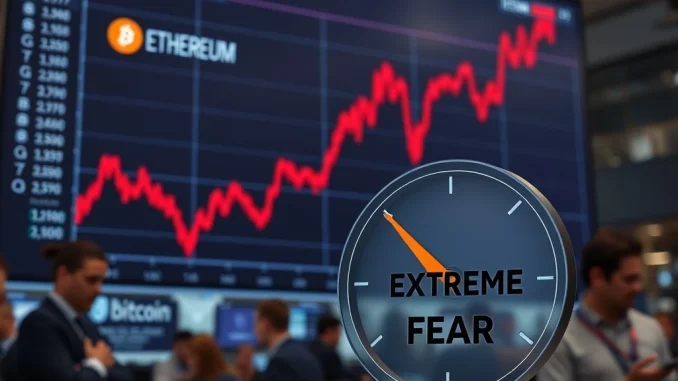
The widely referenced Crypto Fear and Greed Index has moved decisively into ‘Extreme Fear’ territory. This quantitative tool aggregates various data points, including market volatility, trading volume, social media sentiment, and surveys, to produce a single score. A reading of extreme fear typically signals that market participants are driven more by emotion than by fundamentals, which historical data sometimes associates with potential buying opportunities for contrarian investors. However, analysts caution that the index is a sentiment indicator, not a timing tool. Prolonged periods of fear can precede further declines, and the index’s current signal primarily confirms the nervous and pessimistic mood dominating current discourse, validating the observed price action with behavioral data.
A Surprising Counter-Narrative: Resilience in NFT Sales
In a notable divergence from the broader market trend, sales volume across major NFT marketplaces has reported a measurable surge. This activity suggests that certain segments of the digital asset economy can decouple, however temporarily, from the price movements of major cryptocurrencies. Several hypotheses explain this phenomenon. The NFT market may be driven by different participant motivations, such as collecting, community membership, or utility access, rather than pure financial speculation on token prices. Additionally, a downturn in fungible token prices can sometimes redirect liquidity and attention toward the NFT space as traders seek alternative opportunities. It is also possible that specific high-profile project launches or celebrity endorsements have driven isolated spikes in volume, creating an aggregate figure that masks variability beneath the surface.
| Metric | Status | Context & Implication |
|---|---|---|
| Total Market Cap | ~$2.27 Trillion | Represents a significant week-over-week decline, erasing gains from Q1 2025. |
| Bitcoin (BTC) Price Trend | Downward | Testing key long-term support levels; increased selling volume on exchanges. |
| Ethereum (ETH) Price Trend | Downward | Highly correlated with BTC; network upgrade timelines remain a focal point. |
| Fear & Greed Index | Extreme Fear | Indicates sentiment-driven market; often viewed as a potential contrarian signal. |
| Aggregate NFT Sales Volume | Surge Reported | Suggests niche resilience; may be driven by specific projects or collector behavior. |
Historical Context and Market Cycles
The cryptocurrency market has experienced numerous boom and bust cycles since Bitcoin’s inception. Periods of rapid expansion, often fueled by technological breakthroughs, speculative fervor, or macroeconomic conditions, are frequently followed by sharp contractions where weak projects fail and leverage is flushed from the system. These corrections, while painful for short-term holders, have historically served to consolidate innovation and strengthen the foundational infrastructure of the space. The current decline, when viewed through this multi-cycle lens, fits a recognizable pattern. However, each cycle possesses unique catalysts; the mature presence of institutional capital and complex derivatives markets in 2025 adds new layers of complexity to the price discovery process compared to earlier eras.
Conclusion
The cryptocurrency market is currently defined by a clear crypto market decline, with fear dominating investor sentiment as evidenced by plummeting prices for major assets like Bitcoin and Ethereum and a corresponding ‘Extreme Fear’ reading on key sentiment indices. This environment underscores the asset class’s inherent volatility and its sensitivity to broader financial currents. The paradoxical surge in NFT sales highlights the market’s increasing sophistication and segmentation, where different verticals can exhibit independent momentum. For observers and participants, the present moment emphasizes the importance of fundamental analysis, risk management, and a long-term perspective over reactive emotional trading. The evolution from this point will depend on a confluence of macroeconomic factors, regulatory clarity, and underlying blockchain adoption metrics, reminding all that in crypto markets, sentiment and price are in a constant, dynamic dance.
FAQs
Q1: What does the Crypto Fear and Greed Index measure?
The index is a composite tool that analyzes multiple data sources—including volatility, market momentum, social media, surveys, and dominance—to quantify the prevailing emotional sentiment among cryptocurrency investors on a scale from 0 (Extreme Fear) to 100 (Extreme Greed).
Q2: Why are Bitcoin and Ethereum prices falling?
The decline is likely due to a combination of factors: a broader shift away from risk assets in global markets, ongoing regulatory uncertainties, profit-taking after previous rallies, and the natural ebb and flow of market cycles specific to the volatile crypto sector.
Q3: How can NFT sales increase while the overall crypto market is down?
The NFT market can sometimes decouple because it is driven by different use cases like digital art, collectibles, and community access. A downturn in coin prices may redirect attention and capital to NFTs, or specific high-profile project launches can drive isolated volume spikes.
Q4: Is a low Fear and Greed Index a good time to buy cryptocurrency?
Historically, periods of ‘Extreme Fear’ have sometimes preceded market recoveries, leading some to view them as potential buying opportunities. However, it is not a precise timing tool. It indicates prevailing sentiment, and prices can remain low or fall further. Thorough personal research and risk assessment are essential.
Q5: What happens to blockchain networks like Ethereum when the token price falls?
The core functionality of the blockchain network continues uninterrupted. However, a lower ETH price can affect the dollar cost of transaction fees (gas), potentially influencing user activity. For validators, the yield in dollar terms from staking rewards may decrease, but the network’s security and operations are designed to be price-agnostic.