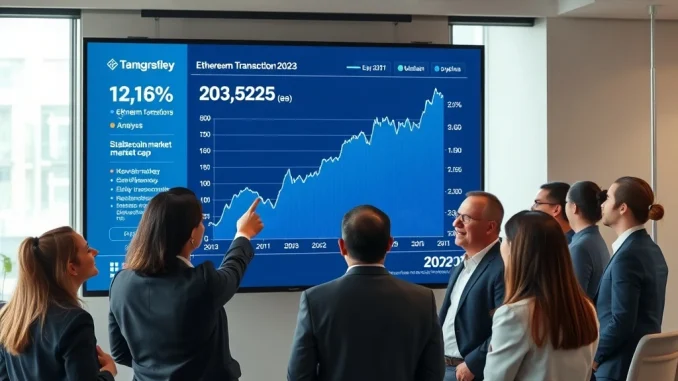
In a significant analysis for the digital asset sector, Bitwise Chief Investment Officer Matt Hougan has presented a compelling case that the cryptocurrency market likely found its cyclical low point during the final quarter of 2023. This assessment, detailed in a comprehensive report covered by Cointelegraph, points to a confluence of fundamental metrics that historically signal market inflection points. Consequently, investors and industry observers are now scrutinizing whether the current landscape mirrors the early-stage recovery patterns witnessed in previous cycles.
Analyzing the Crypto Market Bottom Thesis
Matt Hougan’s report meticulously outlines several key indicators that collectively suggest a market bottom formed in Q4 2023. First, Ethereum and associated Layer 2 scaling solutions achieved record-high transaction volumes during that period. This surge in network usage demonstrates robust underlying demand and developer activity, often a leading indicator of value accrual. Furthermore, revenue growth for publicly-traded cryptocurrency companies provided tangible evidence of business model sustainability beyond mere asset price speculation.
Another critical pillar of the thesis is the stablecoin market capitalization, which reached an all-time high. Stablecoins serve as the primary on-ramp and settlement layer for decentralized finance (DeFi). Their growth signals increased capital preparation and liquidity within the crypto ecosystem, a necessary precursor for sustained bullish momentum. Simultaneously, DeFi adoption metrics showed consistent expansion, indicating that real-world utility and financial activity were growing independently of price trends.
Historical Parallels and Market Psychology
Hougan draws a direct comparison to the first quarter of 2023, a period marked by profound uncertainty following the collapse of the FTX exchange. At that time, market sentiment was overwhelmingly negative, and on-chain data presented a mixed picture. However, Bitcoin’s price subsequently embarked on a multi-year rally. This historical precedent suggests that bottoms often form amidst pessimism, precisely when fundamental health begins to improve unnoticed by the broader market. The current environment, according to the analysis, shares similar characteristics of strengthening fundamentals beneath a surface of cautious sentiment.
Potential Catalysts for the 2025 Crypto Market
Looking forward, the Bitwise CIO identifies several specific catalysts that could propel the market following the hypothesized bottom. Legislative progress remains paramount. The U.S. crypto market structure bill, known as the CLARITY Act, represents a potential watershed moment for regulatory clarity. Passage or significant advancement of this legislation could reduce institutional uncertainty and unlock substantial capital inflows.
Monetary policy developments also feature prominently. The announcement of a new Federal Reserve Chair could shift the macroeconomic landscape, influencing interest rate trajectories and liquidity conditions that heavily impact risk assets like cryptocurrency. Additionally, Hougan introduces the concept of a “stablecoin supercycle.” This scenario envisions accelerated adoption of dollar-pegged digital currencies for global payments and finance, potentially driving the next phase of exponential growth for the entire blockchain sector.
| Metric | Observation | Significance |
|---|---|---|
| Ethereum & L2 Transactions | Record Highs | Indicates strong network utility and user adoption. |
| Crypto Company Revenue | Sustained Growth | Shows viable business models beyond trading. |
| Stablecoin Market Cap | All-Time High | Signals increased on-chain liquidity and capital preparation. |
| DeFi Adoption | Continued Expansion | Demonstrates growing real-world financial utility. |
The Role of Institutional Expertise in Market Analysis
Analyses from firms like Bitwise carry significant weight due to their E-E-A-T (Experience, Expertise, Authoritativeness, Trustworthiness). As a registered investment adviser and issuer of the first publicly-traded Bitcoin ETF, Bitwise possesses deep, hands-on experience in crypto markets. Their research is grounded in verifiable on-chain data and traditional financial modeling, not speculation. This authoritative perspective helps separate signal from noise, providing investors with a framework based on evidence rather than sentiment.
Broader Market Context and Implications
The assertion of a Q4 2023 bottom must be contextualized within the broader crypto market cycle. Historically, crypto winters, characterized by prolonged price declines and negative sentiment, have been followed by periods of renewed innovation and capital allocation. The strengthening fundamentals cited by Hougan align with this pattern. If accurate, the market may currently be in an accumulation phase, where informed capital builds positions before a more widespread recognition of the improving landscape.
For portfolio managers and long-term investors, this analysis underscores the importance of fundamental metrics over short-term price action. Key areas to monitor include:
- On-chain activity: Sustained growth in active addresses and transaction counts.
- Regulatory developments: Clear milestones for legislation like the CLARITY Act.
- Institutional participation: Flows into regulated products like spot Bitcoin and Ethereum ETFs.
- Developer activity: Commitments to major open-source repositories, signaling continued innovation.
Conclusion
Matt Hougan’s report presents a data-driven argument that the crypto market bottom likely occurred in the fourth quarter of 2023. This conclusion is supported by converging evidence from transaction volumes, corporate revenues, stablecoin growth, and DeFi adoption. While market cycles are never certain, the identification of these fundamental strengths, coupled with potential catalytic events in 2025, provides a structured framework for evaluating the market’s trajectory. Ultimately, this analysis highlights a critical transition from a phase dominated by fear and contagion to one potentially defined by utility, regulation, and institutional maturation.
FAQs
Q1: What does “market bottom” mean in cryptocurrency?
A market bottom refers to the lowest price point in a cycle before a sustained recovery begins. It is typically identified in hindsight using a combination of price action, sentiment extremes, and improving fundamental metrics like those highlighted by Bitwise.
Q2: Why is stablecoin market capitalization considered a bullish sign?
Stablecoins represent liquid capital parked on blockchain networks, ready to be deployed. An all-time high in stablecoin market cap suggests strong demand for crypto exposure and ample liquidity to fuel trading and investment across the ecosystem.
Q3: What is the CLARITY Act and why is it important?
The CLARITY Act is proposed U.S. legislation aimed at creating a comprehensive regulatory framework for digital assets. Clear rules would reduce legal uncertainty for businesses and institutions, potentially encouraging greater mainstream adoption and investment.
Q4: How does the current situation compare to early 2023?
According to Hougan, both periods followed major negative events (FTX collapse vs. the 2022 bear market) and exhibited mixed surface-level sentiment while underlying fundamentals began to strengthen. Early 2023 preceded a major rally, suggesting a possible parallel.
Q5: What is a “stablecoin supercycle”?
This concept describes a potential phase of explosive growth for stablecoins, driven by their use in global trade, remittances, and as a digital dollar alternative. This utility-driven demand could benefit the entire crypto infrastructure.
Q6: Should investors act solely on this bottom prediction?
No single analysis should dictate investment strategy. Hougan’s report provides one expert framework based on specific data. Prudent investors should consider this alongside other research, their risk tolerance, and conduct their own due diligence.
Updated insights and analysis added for better clarity.
This article was produced with AI assistance and reviewed by our editorial team for accuracy and quality.