Global, May 2025: The cryptocurrency market presents a complex landscape for investors seeking to understand what crypto to buy now, as regulatory developments and price volatility create both challenges and opportunities across different asset classes. Recent weeks have seen significant movements in major cryptocurrencies alongside emerging discussions about stablecoin regulation that could reshape the entire digital asset ecosystem.
Stablecoin Policy Discussions Intensify Globally
Regulatory bodies in multiple jurisdictions have accelerated discussions about stablecoin frameworks, creating uncertainty and opportunity in equal measure. The United States Congress has scheduled additional hearings on stablecoin legislation, while European regulators continue implementing their Markets in Crypto-Assets (MiCA) regulations that specifically address stablecoin issuance and oversight.
These policy discussions focus on several key areas that could impact investor decisions about what crypto to buy now:
- Reserve Requirements: Proposed regulations may mandate specific reserve compositions for stablecoin issuers
- Transparency Standards: Increased disclosure requirements for backing assets and redemption mechanisms
- Cross-border Coordination: Efforts to create international standards for stablecoin oversight
- Consumer Protection: Enhanced safeguards for stablecoin holders against potential de-pegging events
The timing of these discussions coincides with broader market volatility, creating a complex environment where regulatory clarity could either stabilize or disrupt current market dynamics. Market analysts note that previous regulatory announcements have triggered both positive and negative price movements across different cryptocurrency sectors.
BNB Faces Resistance at Key Psychological Level
Binance Coin (BNB) has encountered significant resistance in its attempt to reclaim the $800 price level, a threshold that represents both a technical and psychological barrier for the exchange token. After reaching a yearly high of $792 in early April, BNB has retreated to the $720-$750 range, reflecting broader market uncertainty and specific exchange-related developments.
Several factors contribute to BNB’s current price challenges:
| Factor | Impact | Timeframe |
|---|---|---|
| Exchange Volume Trends | Moderate decline in spot trading volumes across major exchanges | Last 30 days |
| Regulatory Scrutiny | Ongoing regulatory discussions affecting exchange tokens globally | Ongoing |
| Technical Resistance | Strong selling pressure identified at $780-$800 range | Current |
| Market Sentiment | Cautious investor approach toward exchange-affiliated tokens | Recent weeks |
Technical analysts point to the $750 level as crucial support, with a break below potentially signaling further downside toward the $680 region. The token’s performance remains closely tied to Binance exchange metrics, including trading volumes, new user acquisition, and platform developments.
Historical Context of Exchange Token Performance
Exchange tokens like BNB have historically demonstrated correlation with overall cryptocurrency trading activity rather than independent fundamental drivers. During the 2021 bull market, BNB achieved significant gains alongside rising trading volumes, while the 2022 downturn saw proportional declines. This pattern suggests that investors considering what crypto to buy now should monitor exchange metrics alongside broader market trends.
Avalanche Experiences Significant Price Correction
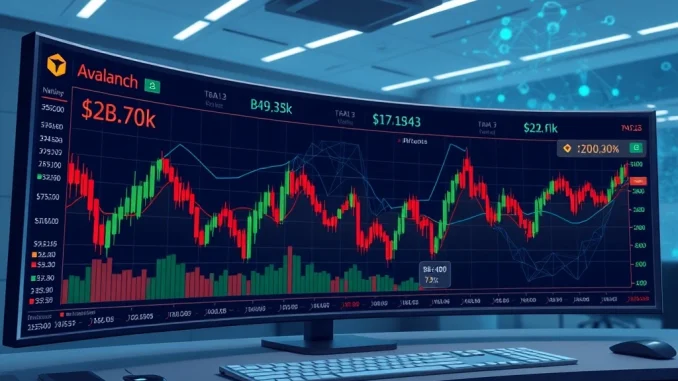
The Avalanche (AVAX) network has recorded a 13-14% price decline over the past week, reflecting both broader market conditions and specific ecosystem developments. The layer-1 blockchain platform, known for its high throughput and sub-second transaction finality, now trades approximately 40% below its 2024 highs despite continued network growth and development activity.
Several contributing factors to Avalanche’s recent performance include:
- Network Activity Metrics: While transaction counts remain robust, value transferred has moderated
- DeFi TVL Trends: Total Value Locked in Avalanche DeFi protocols has seen modest outflows
- Competitive Landscape: Increased competition from other layer-1 and layer-2 solutions
- Developer Activity: Sustained but not accelerating growth in new deployments
Market observers note that Avalanche’s technological advantages, particularly its consensus mechanism and subnet architecture, continue to attract institutional and developer interest despite short-term price movements. The network’s focus on institutional adoption through its Evergreen subnets initiative represents a long-term growth strategy that may not immediately reflect in token price.
Emerging AI Projects Attract Presale Attention
Amid broader market volatility, emerging artificial intelligence-focused cryptocurrency projects have garnered significant attention from presale participants. One such project, DeepSnitch AI, has reported substantial presale participation, though claims of potential 200x returns represent speculative projections rather than guaranteed outcomes.
The intersection of artificial intelligence and blockchain technology represents a growing sector within cryptocurrency markets, with several distinct approaches emerging:
- AI-Powered Trading: Platforms offering algorithmic trading solutions using machine learning
- Decentralized AI Computation: Networks facilitating distributed AI model training and inference
- AI-Enhanced Blockchain Operations: Projects applying AI to blockchain scalability, security, or governance
- Data Marketplaces: Platforms enabling monetization of AI training data via blockchain
Investors considering what crypto to buy now in the AI sector should exercise particular caution, as this emerging field combines the volatility of cryptocurrency markets with the rapid evolution of artificial intelligence technologies. Due diligence should include technical team evaluation, whitepaper analysis, and realistic assessment of market potential.
Evaluating Presale Opportunities Responsibly
Presale participation in emerging cryptocurrency projects requires careful risk assessment beyond potential returns. Responsible evaluation includes examining tokenomics, vesting schedules, use of funds, regulatory compliance, and the project’s technological feasibility. Historical data indicates that most presale projects fail to deliver sustained value, making diversification and risk management essential considerations.
Market Analysis Framework for Current Conditions
Navigating current cryptocurrency market conditions requires a structured approach to investment decision-making. Rather than focusing solely on short-term price movements, investors should consider multiple dimensions when evaluating what crypto to buy now:
Fundamental Analysis: Evaluate project fundamentals including technology, team, adoption metrics, and competitive positioning. For established projects like BNB and Avalanche, this includes exchange metrics and network activity data.
Regulatory Environment: Monitor ongoing policy developments, particularly regarding stablecoins and exchange operations. Regulatory clarity often precedes significant market movements.
Technical Indicators: Utilize technical analysis to identify support and resistance levels, though these should complement rather than replace fundamental assessment.
Risk Management: Implement appropriate position sizing, diversification, and exit strategies given cryptocurrency’s inherent volatility.
Time Horizon Alignment: Match investment selections with appropriate time horizons, distinguishing between short-term trading opportunities and long-term investment theses.
Conclusion
The question of what crypto to buy now reflects a market in transition, where regulatory developments, technical price levels, and emerging sectors create a complex decision-making environment. Stablecoin policy discussions may establish new frameworks for digital asset stability, while established projects like BNB and Avalanche navigate specific challenges alongside broader market conditions. Meanwhile, emerging AI cryptocurrency projects attract attention but require particularly careful evaluation. Successful navigation of current markets depends on balanced analysis, risk-aware positioning, and attention to both technological fundamentals and regulatory developments that will shape the cryptocurrency landscape through 2025 and beyond.
FAQs
Q1: How do stablecoin regulations affect other cryptocurrencies?
Stablecoin regulations primarily impact tokens designed to maintain price stability, but they can indirectly affect the broader market by influencing liquidity, institutional participation, and regulatory approaches to other digital assets. Clear stablecoin frameworks may increase overall market stability.
Q2: What technical levels are important for BNB’s price recovery?
Technical analysts identify $750 as immediate support, with $780-$800 representing significant resistance. A sustained break above $800 could signal renewed bullish momentum, while failure to hold $750 might indicate further downside toward $680 support.
Q3: Why has Avalanche declined despite technological strengths?
Price movements often reflect broader market sentiment and liquidity conditions rather than specific technological merits. Avalanche’s decline coincides with general market volatility, though its fundamental technology and development continue progressing independently of short-term price action.
Q4: How should investors evaluate AI cryptocurrency projects?
Evaluation should include technical team assessment, whitepaper analysis, tokenomics review, use case feasibility, competitive landscape analysis, and regulatory considerations. Historical data suggests most early-stage projects fail, making risk management essential.
Q5: What time horizon is appropriate for cryptocurrency investment decisions?
Time horizons should align with investment goals and risk tolerance. Short-term trading requires different analysis than long-term investment. Most financial advisors recommend that cryptocurrency allocations represent only a portion of a diversified portfolio appropriate to individual circumstances.
This article was produced with AI assistance and reviewed by our editorial team for accuracy and quality.