Global cryptocurrency markets witnessed significant derivatives liquidations over the past 24 hours, with short positions bearing the brunt of the financial pressure across major digital assets. This development highlights the ongoing volatility in crypto futures trading and provides crucial insights into current market sentiment. Data from leading exchanges reveals a clear pattern of short sellers facing substantial losses as market conditions shifted unexpectedly.
Crypto Futures Liquidations: A Detailed Breakdown
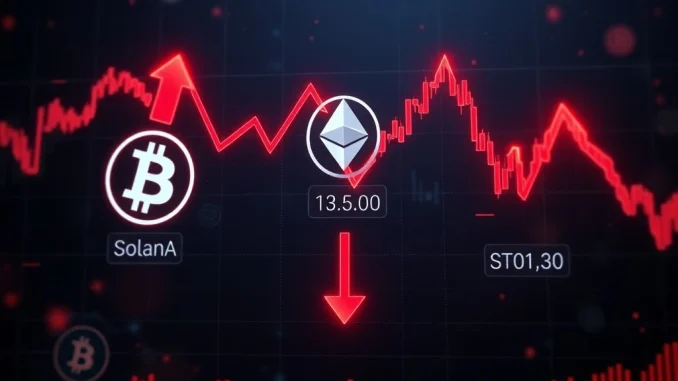
The cryptocurrency perpetual futures market experienced notable turbulence during the recent trading session. Bitcoin (BTC) liquidations totaled $29.08 million, with short positions accounting for a remarkable 78.74% of that amount. Ethereum (ETH) followed closely with $27.55 million in liquidations, of which 68.9% were short positions. Additionally, Solana (SOL) saw $9.97 million in liquidations, with short positions making up 78.59% of the total. These figures demonstrate a consistent pattern across multiple major cryptocurrencies.
Perpetual futures contracts differ from traditional futures because they lack an expiration date. Traders use leverage to amplify their positions, which increases both potential profits and risks. When prices move against leveraged positions, exchanges automatically close them to prevent further losses. This process, known as liquidation, creates cascading effects that can intensify market movements. The recent data clearly shows that traders betting on price declines faced the most significant challenges.
Understanding Market Mechanics and Trader Psychology
Several factors typically contribute to disproportionate short liquidations in cryptocurrency markets. First, unexpected positive news or technical breakthroughs can trigger rapid price increases. Second, coordinated buying activity from institutional investors often catches retail traders off guard. Third, algorithmic trading systems can amplify price movements through automated responses to market signals. Finally, market makers adjusting their positions sometimes create temporary imbalances that disadvantage one side of the market.
The dominance of short liquidations suggests that many traders anticipated price declines that did not materialize. This miscalculation resulted in forced position closures as collateral values fell below maintenance margins. Consequently, the buying pressure from these liquidations may have contributed to further price increases, creating a feedback loop that exacerbated losses for short sellers. Market analysts refer to this phenomenon as a “short squeeze,” where rising prices force short sellers to cover their positions through purchases.
Historical Context and Market Evolution
Cryptocurrency derivatives markets have evolved significantly since their inception. Initially, Bitcoin futures dominated trading activity, but Ethereum and other altcoins now command substantial market share. The introduction of perpetual contracts revolutionized crypto trading by eliminating settlement dates. However, this innovation also increased systemic risk during volatile periods. Regulatory developments have gradually shaped market structure, with some jurisdictions implementing stricter leverage limits to protect retail investors.
Comparing current liquidation patterns to historical data reveals important trends. Previous market cycles often showed more balanced liquidation ratios between long and short positions. The current skew toward short liquidations suggests either unusually bullish sentiment or coordinated market movements. Trading volume data from major exchanges confirms increased activity during the liquidation period, indicating heightened participation from both retail and institutional traders.
Impact on Market Structure and Participant Behavior
Significant liquidation events influence market dynamics in multiple ways. First, they redistribute capital from losing traders to winning positions. Second, they can temporarily reduce overall market leverage as risk-averse participants exit positions. Third, they provide liquidity through forced trading, though sometimes at unfavorable prices. Fourth, they serve as warning signals about excessive speculation in particular market segments. Finally, they often precede periods of reduced volatility as markets digest the repositioning.
The cryptocurrency ecosystem includes various participants affected differently by liquidation events. Retail traders using high leverage face the greatest risk of complete position loss. Market makers and liquidity providers must manage their exposure carefully during volatile periods. Institutional investors often use more sophisticated risk management strategies, including hedging across multiple exchanges. Exchange platforms themselves monitor liquidation thresholds closely to maintain system stability and prevent cascading failures.
Risk Management Considerations for Traders
Experienced derivatives traders employ several strategies to mitigate liquidation risks. They typically use stop-loss orders to limit potential losses before reaching liquidation thresholds. Many diversify their exposure across multiple assets rather than concentrating on single positions. Professional traders often maintain lower leverage ratios than maximum allowed limits. Some utilize portfolio margin systems that consider correlated positions rather than evaluating each position independently. Advanced participants sometimes hedge spot market exposure with opposing derivatives positions.
Exchange platforms implement various safeguards to protect market integrity. Most use sophisticated risk engines that calculate margin requirements in real-time. Many employ circuit breakers that temporarily halt trading during extreme volatility. Some platforms offer partial liquidation mechanisms that close only enough position to restore margin requirements. Insurance funds exist on certain exchanges to cover losses when liquidations cannot execute at favorable prices. These measures collectively help maintain market stability during stressful periods.
Technical Analysis and Market Indicators
Technical analysts examine multiple indicators when assessing liquidation risks. Funding rates in perpetual markets provide clues about market sentiment imbalances. Open interest data shows the total value of outstanding contracts, indicating overall market exposure. Volume profiles reveal where the most trading activity occurs, highlighting potential support and resistance levels. Order book depth demonstrates available liquidity at various price points. Historical volatility metrics help traders anticipate potential price swings that could trigger liquidations.
The relationship between spot and futures markets deserves particular attention. Sometimes, price discrepancies develop between these markets, creating arbitrage opportunities. However, these discrepancies can also signal impending liquidations if positions become misaligned. The recent liquidation event coincided with specific technical patterns on price charts, including breakouts above key resistance levels. These technical developments likely contributed to the pressure on short positions as stop-loss orders clustered around these technical levels.
Conclusion
The recent crypto futures liquidations demonstrate the ongoing volatility and risk inherent in cryptocurrency derivatives trading. Short positions dominated the liquidation statistics across Bitcoin, Ethereum, and Solana markets, revealing prevailing trader sentiment and unexpected market movements. These events serve as important reminders about proper risk management in leveraged trading environments. Market participants should carefully monitor position sizing, leverage ratios, and market indicators to navigate future volatility successfully. The crypto futures liquidations data provides valuable insights into current market dynamics and trader positioning as digital asset markets continue evolving.
FAQs
Q1: What causes short positions to liquidate in crypto futures markets?
Short positions liquidate when asset prices rise significantly against leveraged bets on price declines. Exclosures automatically close these positions when collateral values fall below maintenance margin requirements, preventing further losses for both traders and exchanges.
Q2: How do perpetual futures differ from traditional futures contracts?
Perpetual futures lack expiration dates, allowing traders to maintain positions indefinitely. They use funding rate mechanisms to keep contract prices aligned with spot markets, rather than converging at settlement dates like traditional futures.
Q3: Why did Bitcoin show higher short liquidation percentages than Ethereum?
Different market structures, participant compositions, and trading patterns explain varying liquidation ratios. Bitcoin typically attracts more institutional interest, while Ethereum’s ecosystem includes different use cases that might influence trader positioning and sentiment.
Q4: Can liquidation events predict future market direction?
While not perfect predictors, liquidation events often indicate extreme sentiment that sometimes precedes market reversals. However, multiple factors influence price movements, making single indicators unreliable for precise forecasting.
Q5: What protections exist for traders against unexpected liquidations?
Traders can use stop-loss orders, maintain conservative leverage, diversify positions, monitor funding rates, and utilize exchange risk management features. Understanding margin requirements and maintaining adequate collateral remains crucial for all derivatives participants.
This article was produced with AI assistance and reviewed by our editorial team for accuracy and quality.