Futures Liquidated: A Staggering $100 Million Wiped Out in One Hour as Crypto Volatility Surges
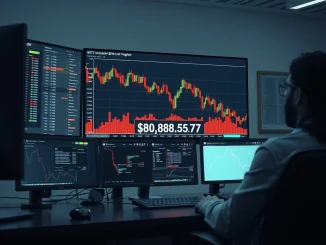
Global Cryptocurrency Markets, April 2025: A sudden wave of selling pressure has triggered a significant liquidation event across major cryptocurrency derivatives exchanges. Data confirms that over $100 million worth of futures positions were liquidated in just the past hour, amplifying existing market turbulence. This intense activity contributes to a 24-hour liquidation total exceeding $478 million, signaling heightened volatility and shifting trader sentiment in the digital asset space.
Futures Liquidated: Breaking Down the Hour of High Pressure
The core mechanism behind this event is the forced closure of leveraged futures contracts. When traders use borrowed funds to amplify their market bets, they must maintain a minimum collateral level, known as margin. If the market moves against their position and their collateral falls below this threshold, the exchange automatically sells their assets to repay the loan—a process known as liquidation. The past hour saw this process unfold on a massive scale, with long positions (bets on price increases) likely bearing the brunt during a rapid price decline. Real-time data aggregators from platforms like CoinGlass and Bybt show a consistent stream of liquidations across exchanges including Binance, OKX, and Bybit, with the majority occurring in Bitcoin (BTC) and Ethereum (ETH) pairs.
Understanding Cryptocurrency Futures and Market Mechanics
To grasp the scale of a $100 million liquidation, one must understand the derivatives market’s structure. Cryptocurrency futures allow traders to speculate on an asset’s future price without owning it, using leverage that can multiply gains and losses. Common leverage ratios range from 5x to over 100x.
- Liquidation Price: The specific price at which a leveraged position becomes undercollateralized and is automatically closed.
- Liquidation Cascade: A domino effect where one large liquidation triggers rapid price movement, hitting the liquidation prices of other clustered positions.
- Funding Rates: Periodic payments between long and short traders; extreme rates can signal overcrowded positioning and precede volatility.
Analysts often monitor aggregate open interest and funding rates to gauge market sentiment. A high open interest with extreme funding can indicate a market ripe for a sharp correction and subsequent liquidations, similar to patterns observed in March 2024 and late 2023.
Historical Context and Comparative Analysis
While $100 million in an hour is significant, historical precedents provide context. The cryptocurrency market has experienced far larger liquidation events. For instance, during the LUNA/UST collapse in May 2022, single-day liquidations surpassed $1 billion. The November 2022 FTX collapse also triggered multi-billion dollar liquidations over several days. A comparative table illustrates the scale:
| Event / Period | Approximate Liquidations | Primary Catalyst |
|---|---|---|
| May 2022 (LUNA) | $1B+ (24hr) | Stablecoin depeg & ecosystem collapse |
| November 2022 (FTX) | $3B+ (Multi-day) | Centralized exchange insolvency |
| January 2024 | $500M (24hr) | BTC ETF approval volatility |
| Current Hour (April 2025) | $100M (1hr) | Sharp corrective price movement |
This current event, while substantial, appears as a sharp correction within a broader market cycle rather than a systemic crisis, based on available data.
The Ripple Effect: Implications for Traders and Market Stability
Such liquidation waves have immediate and secondary effects. Primarily, they represent a direct transfer of wealth from liquidated traders to their counterparts and can exacerbate price movements through forced selling. This selling pressure can temporarily distort spot market prices, creating arbitrage opportunities. For the broader market, large liquidations often act as a “reset,” flushing out excessive leverage and potentially creating a more stable foundation for price discovery. However, they also serve as a stark reminder of the risks inherent in leveraged trading. Risk management protocols, including the use of stop-loss orders (which are distinct from exchange liquidations) and careful leverage selection, are critical for participants in this market.
Exchange Protocols and Risk Management Systems
Major exchanges have sophisticated risk engines that manage these liquidations. The process is typically automated and aims to close positions at the bankruptcy price—the point where the remaining margin is zero. Some platforms employ a partial liquidation system or an Auto-Deleveraging (ADL) mechanism, which closes opposing profitable positions to cover losses if the liquidation cannot be filled on the open market. The efficiency and fairness of these systems are a constant focus for exchange developers and a key consideration for institutional participants entering the crypto derivatives space.
Conclusion
The liquidation of $100 million in cryptocurrency futures within a single hour underscores the inherently volatile and high-stakes nature of the digital asset derivatives market. While not an unprecedented event, it highlights the powerful interplay between leverage, clustered liquidity, and rapid price action. For market observers, such events are critical data points, reflecting the clearing of excessive speculation and the ongoing process of price discovery. For traders, they reinforce the paramount importance of disciplined risk management in a landscape where market structure can amplify movements dramatically. As the cryptocurrency market continues to mature, the dynamics of futures and liquidations will remain a central feature of its volatility profile.
FAQs
Q1: What does “futures liquidated” mean?
A1: It refers to the forced closure of a leveraged futures contract by an exchange. This happens when a trader’s collateral falls below the required maintenance margin due to adverse price movement, triggering an automatic sell-off to prevent further loss.
Q2: Why did $100 million get liquidated in one hour?
A2: A rapid and substantial price move (likely downward) triggered a cascade. As prices fell, long positions hit their individual liquidation prices. The forced selling from these liquidations can push the price down further, hitting more positions in a short period—a phenomenon known as a liquidation cascade.
Q3: Who loses money when futures are liquidated?
A3: The traders whose positions are liquidated lose the collateral they posted for that trade. The exchange uses these funds to keep the contract whole. Counterparties on the winning side of the trade profit, and any remaining margin from the liquidated position may be added to an insurance fund.
Q4: Are liquidations bad for the overall crypto market?
A4: They have mixed effects. In the short term, they create selling pressure and increase volatility. In the medium term, they can be healthy by removing excessive, unstable leverage from the system, which may reduce volatility and create a more stable price floor.
Q5: How can traders avoid being liquidated?
A5: Traders can manage this risk by using lower leverage, maintaining ample collateral above the maintenance margin, setting prudent stop-loss orders, and actively monitoring their positions, especially during periods of high volatility or when funding rates are extreme.
Related News
- Revolutionary: AIW3 Integrates Snowball's MNS, CIP, and ORS for Advanced On-Chain Strategy Execution
- Ethereum Accumulation Surges: Why Long-Term Holders Are Buying the 2025 Dip
- Dormant Whale Stuns Market: $145M ETH Transfer to Gemini After 9-Year Silence
Related: On-Chain Derivatives: How High-Performance Chains and Layer 3 Solutions Create a Scalable Future
Related: Solana Dominates: Unprecedented Network Transaction Lead Across All Blockchains in 2025